Firms, costs and market structures
Introduzido| English | Significado |
|---|---|
| perfect competition/ˈpɜːfekt ˌkɒmpəˈtɪʃn/ | A market with many firms, an identical product, and free entry. |
| monopoly/məˈnɒpəli/ | A market structure in which a single seller supplies a good or service with no close substitutes. |
| marginal revenue/ˈmɑːdʒɪnl ˈrevənjuː/ | The additional total revenue obtained from selling one extra unit of output. |
| marginal cost/ˈmɑːdʒɪnl kɒst/ | custo marginal |
| monopolistic competition/məˈnɒpəlɪstɪk ˌkɒmpəˈtɪʃn/ | A market structure with many firms offering differentiated products and relatively easy entry and exit. |
| oligopoly/ˌɒlɪˈɡɒpəli/ | A market dominated by a small number of interdependent large firms. |
| contestability/kənˌtestəˈbɪlɪti/ | competitividade |
| sunk costs | Costs already paid that cannot be got back, so they should not affect future choices. |
16,000 coffee shops
- Luckin Coffee opened its first store in Beijing in 2017. By 2023 it had over 16,000 stores in China — more than twice as many as Starbucks there.
- How did it decide how many cups to sell, at what price, and how did rivals respond?
- Business economics studies firms: their size, goals, costs, revenues and the markets they compete in.
The map of this topic
- Firms: types of business, how they grow and what they aim for.
- Revenues and costs: how they change with output, and the profit each output gives.
- Market structures: from perfect competition to monopoly, and how many rivals there are and how easily new ones can enter.
Worked example: thinking at the margin
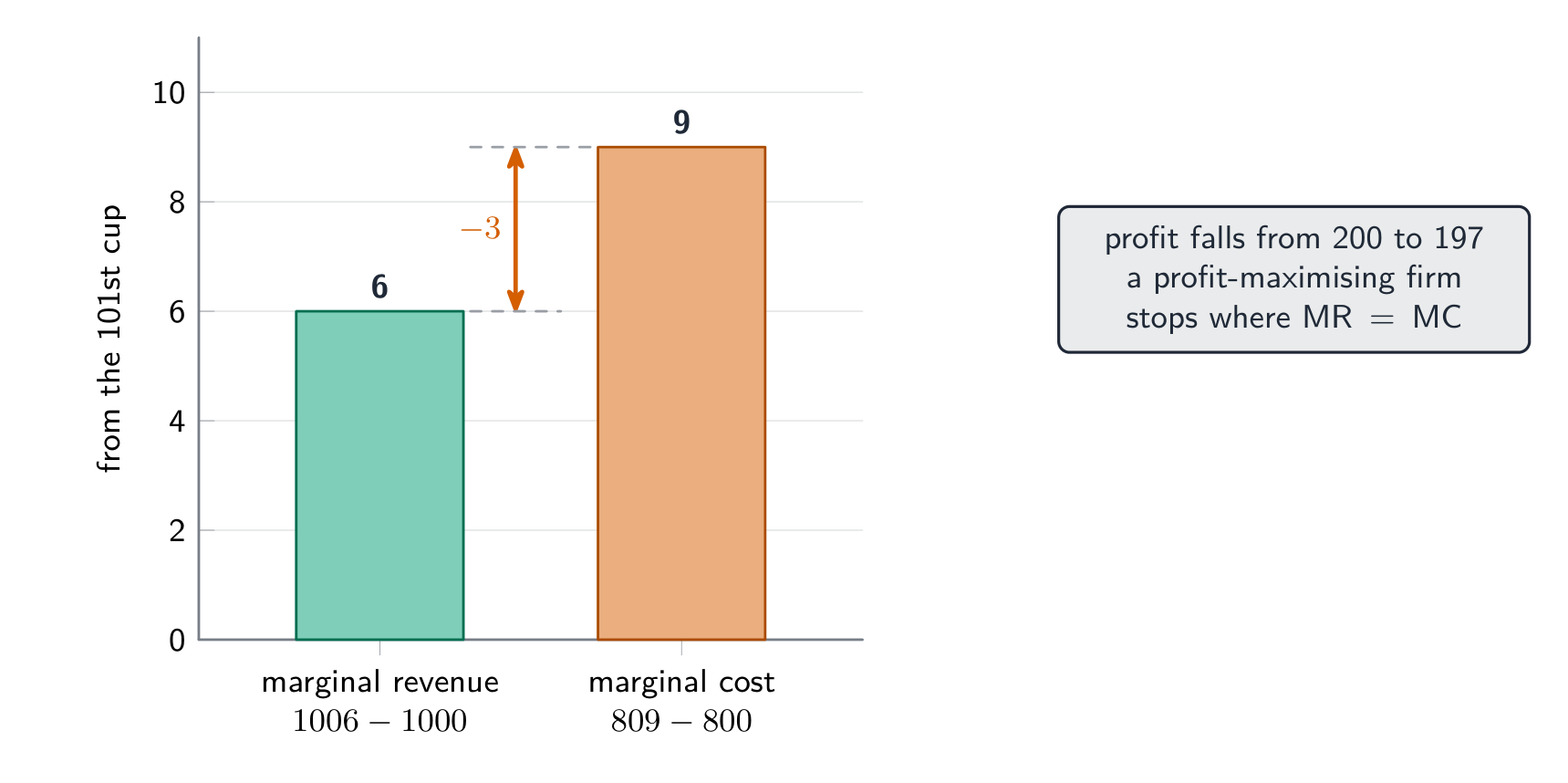
At 100 cups a day, revenue is 1000 and total cost 800: profit is 200. At 101 cups, revenue is 1006 and cost 809.
- Marginal revenue 边际收益 $= 1006 - 1000 = 6$; marginal cost 边际成本 $= 809 - 800 = 9$.
- The extra cup adds 3 more to cost than to revenue, so profit falls to 197.
- A profit-maximising firm stops where $\text{MR} = \text{MC}$.
At 50 units TR is 600 and TC 450. At 51 units TR is 610 and TC 458. By how much does profit change?
Dificuldade 2/5 · Moedas 140 + pequeno bônus na primeira conclusão hoje
MR $= 10$, MC $= 8$, so profit rises by $2$.
MR is 12 and MC is 9 at the current output. What should a profit-maximising firm do?
Dificuldade 1/5 · Moedas 100 + pequeno bônus na primeira conclusão hoje
Each extra unit still adds 3 to profit.
How many rivals?
- In perfect competition many small firms sell the same product; in monopoly one firm supplies the market.
- Between them are monopolistic competition (many firms, differentiated products, like cafés) and oligopoly (a few large firms, like mobile networks).
Match each market to its likely structure.
Dificuldade 2/5 · Moedas 140 + pequeno bônus na primeira conclusão hoje
Structure depends on number of firms and product type.
Order these from most to fewest firms.
Dificuldade 3/5 · Moedas 200 + pequeno bônus na primeira conclusão hoje
From many firms to one.
Can new firms get in?
- Contestability 可竞争性 is how easily firms can enter and leave a market. It depends on barriers such as sunk costs — costs that cannot be recovered on exit.
- A market with only two firms can still be competitive if a third could enter quickly.
Which is a sunk cost?
Dificuldade 1/5 · Moedas 100 + pequeno bônus na primeira conclusão hoje
Sunk costs cannot be recovered if the firm leaves.
A few large firms do not prove that they collude or overcharge. If entry is easy, the threat of new rivals keeps prices close to costs. Judge competition by barriers to entry as well as by the number of firms.
A market with only two firms can be competitive if new firms can enter easily.
Dificuldade 1/5 · Moedas 100 + pequeno bônus na primeira conclusão hoje
The threat of entry limits prices.
Business economics asks what firms aim for, how their costs and revenues change with output, and how market structure affects price and profit. Decisions are made at the margin: produce while MR exceeds MC. Competition depends on barriers to entry, not only on the number of firms.
Explain why the number of firms in a market is not enough to judge how competitive it is.
Use contestability.