Six macroeconomic objectives and their measures
Introduzido| English | Significado |
|---|---|
| macroeconomic objective/ˌmækrəˌriːkəˈnɒmɪk ɒbˈdʒektɪv/ | objetivo macroeconômico |
| government budget balance/ˈɡʌvənmənt ˈbʌdʒɪt ˈbæləns/ | saldo orçamentário governamental |
| budget deficit/ˈbʌdʒɪt ˈdefɪsɪt/ | The amount by which spending exceeds revenue over a given period. |
| deflation/diːˈfleɪʃn/ | A sustained fall in the general price level of goods and services. |
China's targets for the year
- Each March China's government publishes its targets: in 2024, growth of "around 5%", consumer inflation of about 3%, urban unemployment of about 5.5%, and 12 million new urban jobs.
- Other countries publish similar goals. The UK, for example, gives its central bank an inflation target of 2%.
- Each macroeconomic objective 宏观经济目标 has its own measure.
Six objectives and how they are measured
- Growth: the % change in real GDP; for living standards, real GDP per head.
- Inflation: the % change in a consumer price index. Unemployment: the share of the labour force without work but seeking it.
- Current account: its balance, often as a % of GDP. Government budget balance 政府预算余额: revenue minus spending. Equality: for example the Gini coefficient.
Match each objective to its measure.
Dificuldade 2/5 · Moedas 140 + pequeno bônus na primeira conclusão hoje
Each objective has its own statistic.
Worked example: two different balances
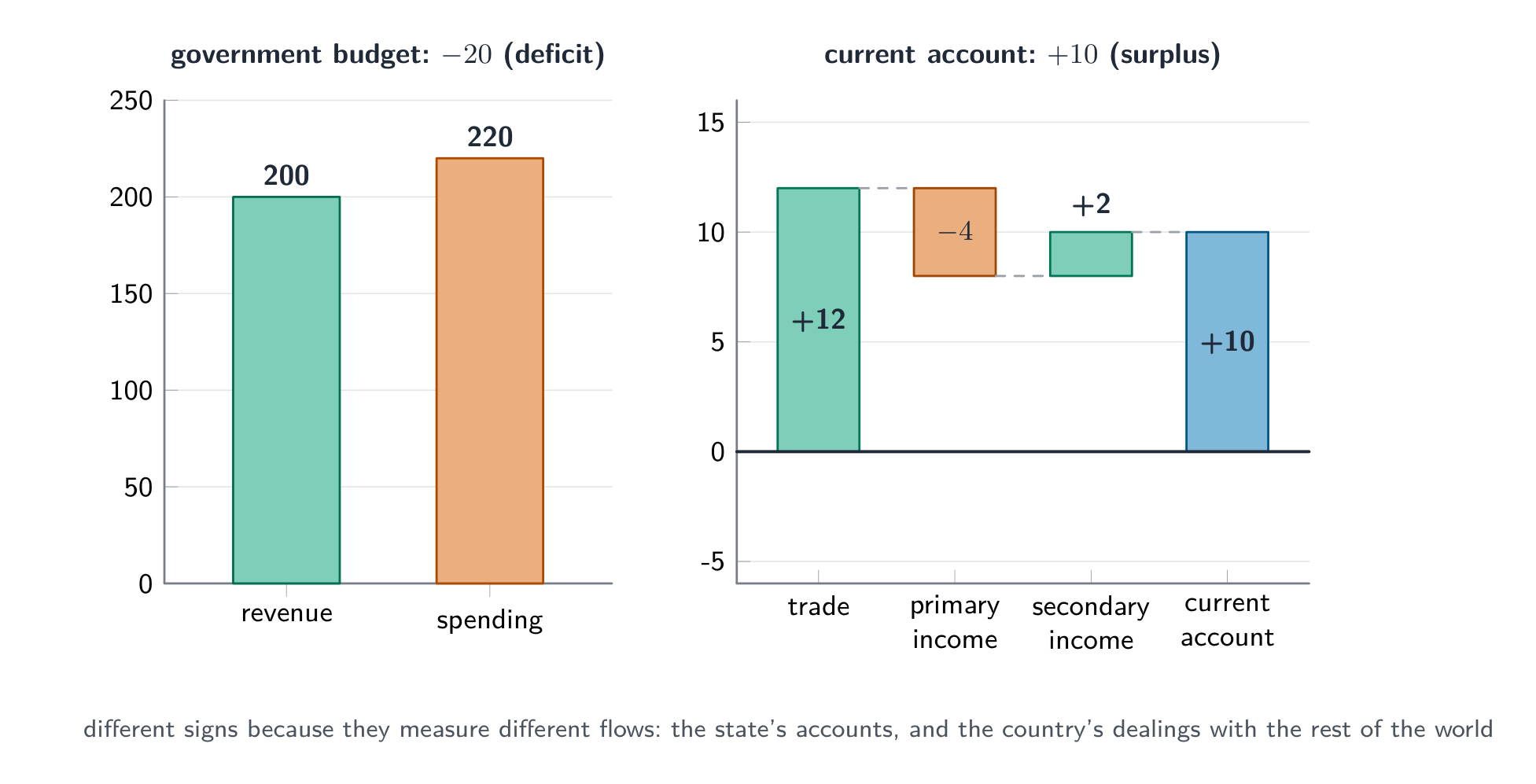
Government revenue is 200 and government spending 220. Separately, the trade balance is +12, primary income −4 and secondary income +2.
- Budget balance $= 200 - 220 = -20$: a budget deficit 预算赤字.
- Current account $= 12 - 4 + 2 = +10$: a surplus.
- The signs differ because they measure different flows: one is the state's accounts, the other the country's dealings with the rest of the world.
Revenue minus expenditure
Government revenue 200 and total expenditure 220 give a budget balance of 200 − 220 = −20: a deficit. It measures a different flow from the current account, which can be in surplus at the same time.
Government revenue is ¥3.2 trillion and spending ¥3.5 trillion. What is the budget balance, in trillions?
Dificuldade 2/5 · Moedas 140 + pequeno bônus na primeira conclusão hoje
$3.2 - 3.5 = -0.3$: a deficit.
Growth per head
- Real GDP rises from 500 to 515: growth of 3%. Population rises from 100 to 105 million.
- GDP per head falls from $\dfrac{500}{100} = 5$ to $\dfrac{515}{105} \approx 4.90$ — about 1.9% lower. The economy grew, but the average person became poorer.
Real GDP rises from 1000 to 1040 and population from 50 to 51 million. What is the new GDP per head, to 2 d.p.?
Dificuldade 2/5 · Moedas 140 + pequeno bônus na primeira conclusão hoje
$\dfrac{1040}{51} \approx 20.39$, up from 20.
"Low" inflation is not zero
- Most targets are about 2–3%, not 0%. Falling prices (deflation 通货紧缩) can make people delay spending and make debts harder to repay.
- Inflation falling from 6% to 3% means prices still rise, only more slowly.
Inflation falling from 6% to 3% means the price level is falling.
Dificuldade 1/5 · Moedas 100 + pequeno bônus na primeira conclusão hoje
Prices still rise, by 3% instead of 6%.
Why do central banks usually target inflation of about 2% rather than 0%?
Dificuldade 1/5 · Moedas 100 + pequeno bônus na primeira conclusão hoje
A small positive rate gives a margin against deflation.
A budget deficit and a current account deficit are not the same thing. The budget is government revenue against government spending; the current account is the whole country's trade and income with other countries. One can be in deficit while the other is in surplus.
A country with a large budget deficit must also have a current account deficit.
Dificuldade 1/5 · Moedas 100 + pequeno bônus na primeira conclusão hoje
They measure different flows.
The six objectives are growth, low and stable inflation, low unemployment, a sustainable current account, a sound budget balance and fair income distribution. Each has its own measure, and success on one does not prove success on the others.
Explain why a 3% rise in real GDP may not mean that living standards have risen.
Growth is a total; living standards are per person.