The costs of economic growth
Introduzido| English | Significado |
|---|---|
| emissions intensity/ɪˈmɪʃnz ɪnˈtensɪti/ | intensidade de emissões |
| income inequality/ˈɪŋkʌm ɪniːˈkwɒlɪti/ | desigualdade de renda |
| demand-pull inflation/dɪˈmænd pʊl ɪnˈfleɪʃn/ | A rise in the general price level caused by aggregate demand growing beyond the economy's available output capacity. |
| resource depletion/rɪˈzɔːs dɪˈpliːʃn/ | The reduction of a stock of natural resources through extraction or use faster than it is replenished. |
Cleaner per unit, more in total
- Between 2005 and 2020 China cut the carbon dioxide it emits per unit of GDP by roughly half.
- Yet total emissions still rose by well over half, because the economy grew several times larger.
- Growth brings costs as well as benefits, and some of them conflict with other goals.
Environmental costs
- More output usually means more energy, more resources and more waste.
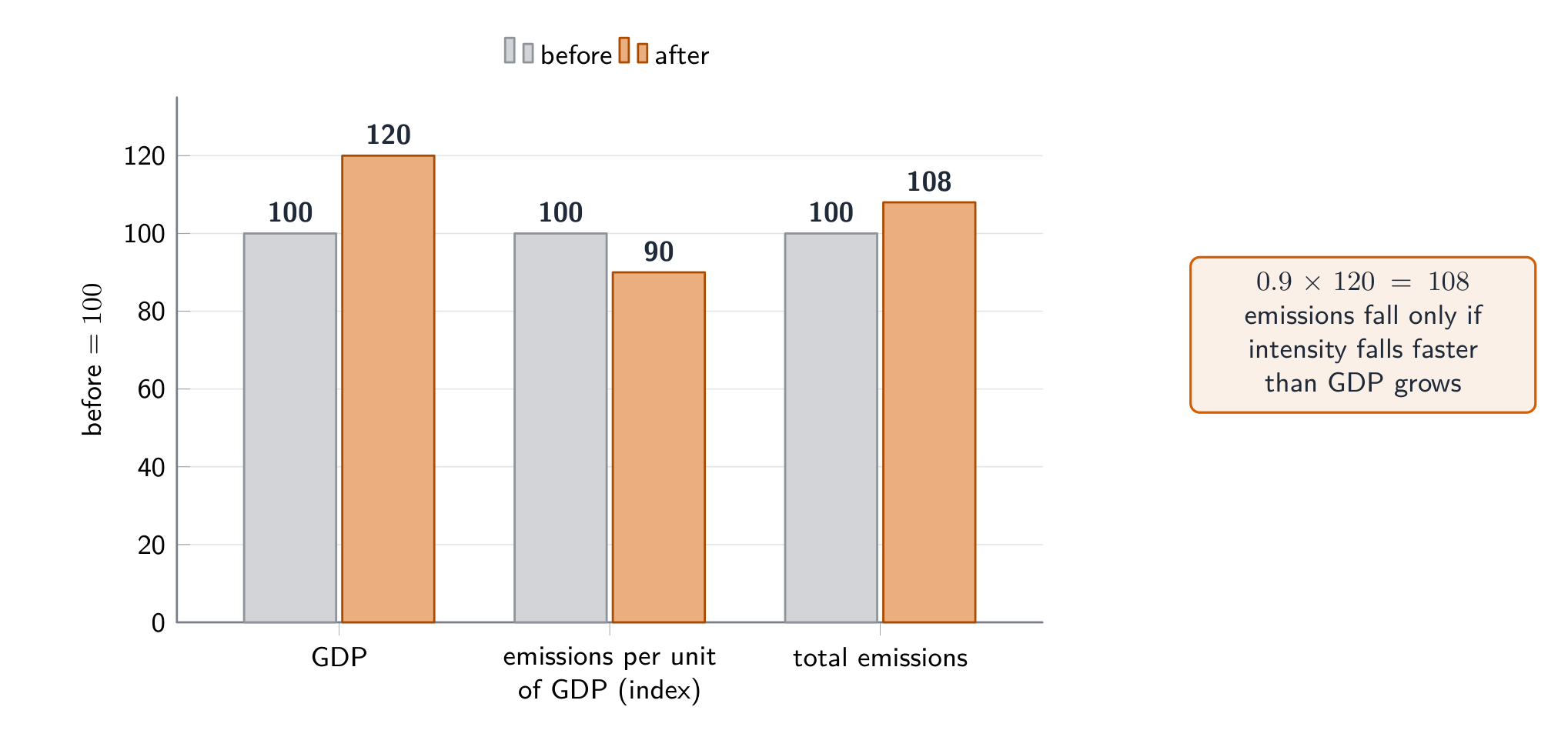
- Emissions intensity 排放强度 is emissions per unit of GDP. Total emissions = intensity × GDP.
Worked example: intensity versus total
GDP is 100 and emissions intensity is 1.0, so emissions are $1.0 \times 100 = 100$.
- GDP grows to 120 and intensity falls by 10% to 0.9.
- New emissions $= 0.9 \times 120 = 108$: an 8% rise, despite cleaner production.
- Total emissions fall only if intensity falls faster than GDP grows.
GDP rises from 200 to 250. Emissions intensity falls from 0.5 to 0.45. What are the new total emissions?
Dificuldade 2/5 · Moedas 140 + pequeno bônus na primeira conclusão hoje
$0.45 \times 250 = 112.5$, up from $0.5 \times 200 = 100$.
If emissions intensity falls, total emissions must fall.
Dificuldade 1/5 · Moedas 100 + pequeno bônus na primeira conclusão hoje
Output growth can more than offset the fall in intensity.
GDP grows by 25%. Emissions intensity must fall to what share of its old level for total emissions to stay the same?
Dificuldade 2/5 · Moedas 140 + pequeno bônus na primeira conclusão hoje
$\dfrac{1}{1.25} = 0.8$, a 20% cut in intensity.
Inequality
- Growth can raise income inequality 收入不平等 when gains go to owners of capital, skilled workers or fast-growing regions.
- In China, coastal cities grew faster than inland villages for decades. Wide gaps can cause social tension.
Inflation and imbalances
- If AD grows faster than capacity, growth brings demand-pull inflation.
- Fast growth can also raise imports faster than exports, worsening the current account.
When is growth most likely to cause inflation?
Dificuldade 1/5 · Moedas 100 + pequeno bônus na primeira conclusão hoje
Demand pressing on capacity raises prices.
Other costs
- Resource depletion: oil, fish stocks and groundwater used today are not available later.
- Long working hours, congestion and stress may lower quality of life even as incomes rise.
Which are possible costs of rapid economic growth?
Dificuldade 2/5 · Moedas 140 + pequeno bônus na primeira conclusão hoje
Growth usually raises tax revenue.
Match each cost to its example.
Dificuldade 2/5 · Moedas 140 + pequeno bônus na primeira conclusão hoje
Each cost conflicts with a different objective.
"Greener" does not automatically mean "less pollution". A fall in emissions intensity is good news, but if GDP grows faster, total emissions still rise. Always multiply intensity by output.
Growth can cost the environment, widen inequality, raise inflation and worsen the current account. These costs can conflict with the benefits, so governments must trade off growth against other objectives.
Explain how China's emissions could rise even though its production has become cleaner per unit of output.
Two changes pull in opposite directions.