Short-run and long-run aggregate supply
Introduzido| English | Significado |
|---|---|
| aggregate supply/ˈæɡrɪɡeɪt səˈplaɪ/ | The total output firms are willing and able to produce at different general price levels over a specified period. |
| short-run aggregate supply/ʃɔːt rʌn ˈæɡrɪɡeɪt səˈplaɪ/ | oferta agregada de curto prazo |
| long-run aggregate supply/lɒŋ rʌn ˈæɡrɪɡeɪt səˈplaɪ/ | oferta agregada de longo prazo |
Gas at ten times the price
- In 2022 European gas prices rose to about ten times their usual level. Factories that make fertiliser, glass and steel cut output or closed.
- Prices rose across the economy while output fell. This is a shift in aggregate supply 总供给, not demand.
Short-run aggregate supply
- Short-run aggregate supply 短期总供给 (SRAS) is the output firms are willing to supply at each price level, with costs such as wages and raw-material prices fixed.
- It slopes up: when the price level rises but costs stay fixed for a while, production is more profitable, so firms supply more.
Why does SRAS slope upward?
Dificuldade 1/5 · Moedas 100 + pequeno bônus na primeira conclusão hoje
Prices rise faster than costs in the short run.
Worked example: a cost shock shifts SRAS
A firm buys $100 of imported energy. The exchange rate moves from 5 to 6 local units per dollar.
- Energy bill $= 100 \times 5 = 500$ before, $100 \times 6 = 600$ after: costs rise by 100.
- At every price level the firm now earns less per unit, so it supplies less.
- SRAS shifts left. With AD unchanged, the price level rises and real output falls.
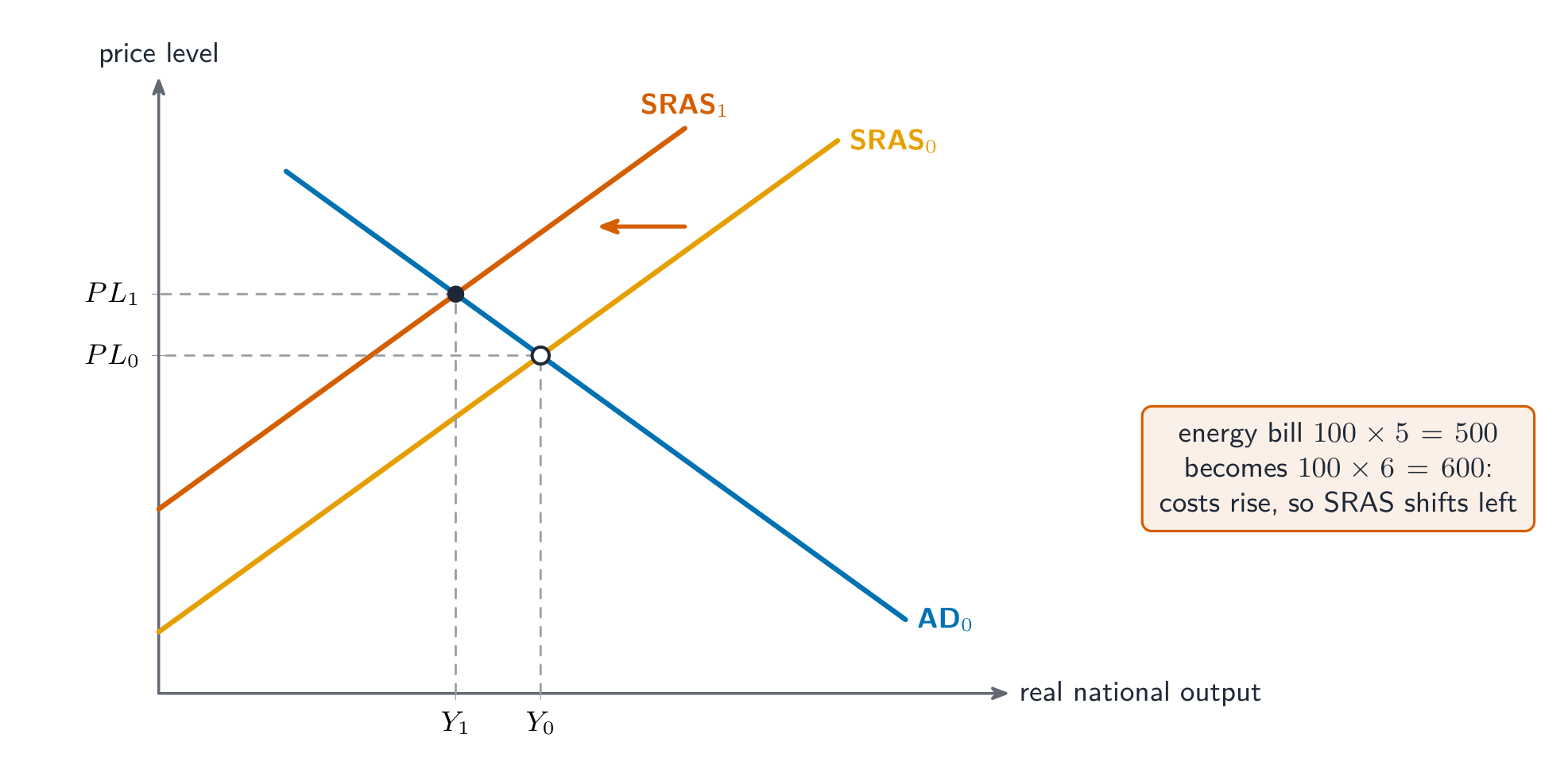
Dearer imported energy raises costs
A firm buys 100 dollars of imported energy. When the quote moves from 5 to 6 local units per dollar, the bill rises from 500 to 600: higher production cost that can shift short-run supply left.
A firm imports $200 of oil. The quote moves from 6 to 7 local units per dollar. By how much does its oil bill rise, in local units?
Dificuldade 2/5 · Moedas 140 + pequeno bônus na primeira conclusão hoje
$200 \times 7 - 200 \times 6 = 1400 - 1200 = 200$.
What shifts SRAS?
- Costs of production: wages, raw materials, energy, import prices (through the exchange rate).
- Taxes and subsidies on firms: a higher tax on production shifts SRAS left.
- A rise in the price level alone causes a movement along SRAS, not a shift.
Which shift SRAS to the LEFT?
Dificuldade 2/5 · Moedas 140 + pequeno bônus na primeira conclusão hoje
A change in the price level is a movement along SRAS.
The classical long run
- Long-run aggregate supply 长期总供给 (LRAS) is output when all prices and wages have adjusted.
- Classical economists say LRAS is vertical at the economy's potential output: in the long run output depends on resources and technology, not the price level. A rise in AD then only raises prices.
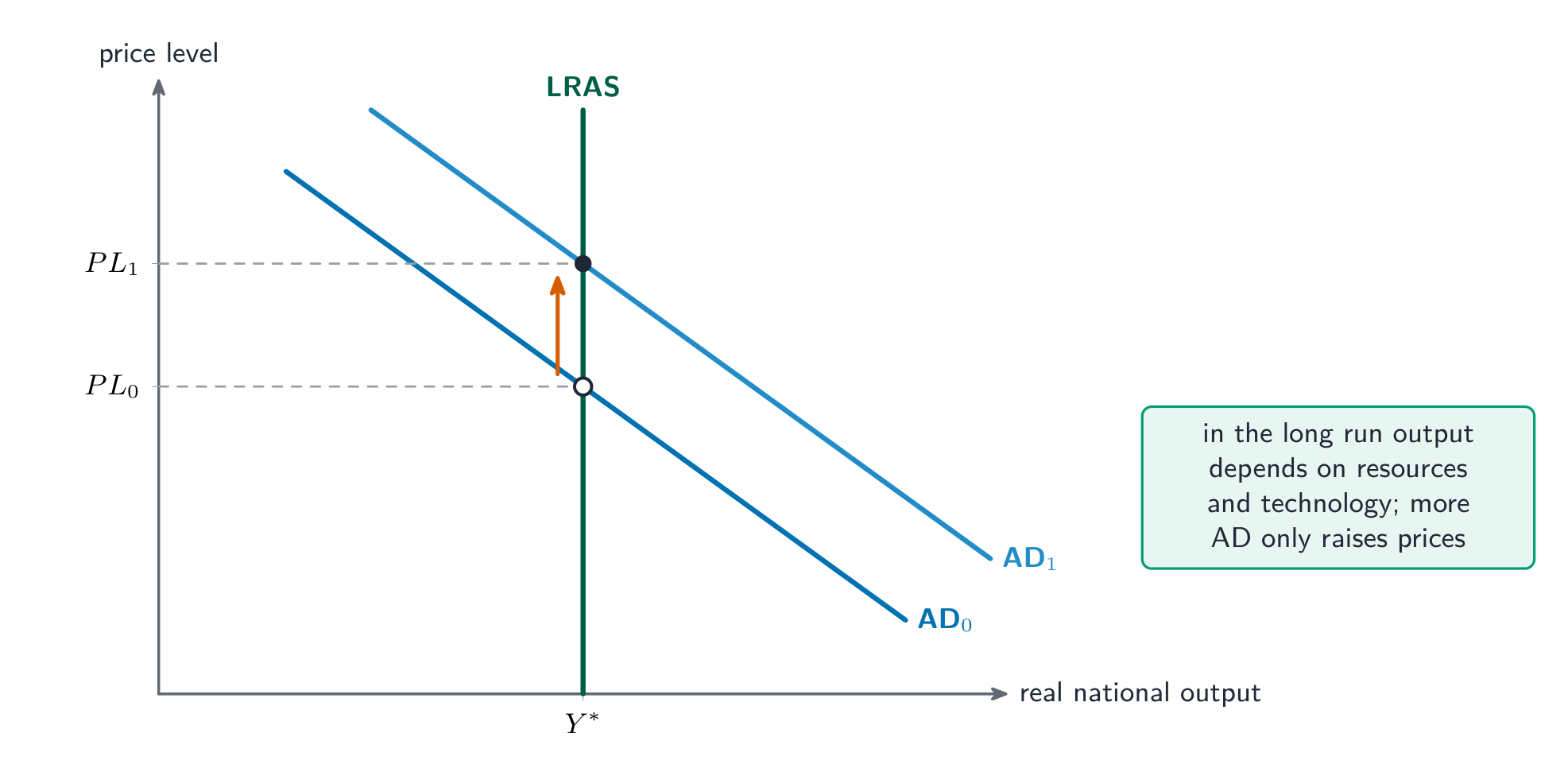
In the classical model, a rise in AD in the long run raises the price level but not real output.
Dificuldade 1/5 · Moedas 100 + pequeno bônus na primeira conclusão hoje
LRAS is vertical at potential output.
The Keynesian view
- Keynes argued that an economy can stay below full capacity for a long time, as in the 1930s.
- His AS curve is flat when there is spare capacity, curves upward as bottlenecks appear, and becomes vertical at full capacity. So more AD can raise output with little inflation in a deep recession.
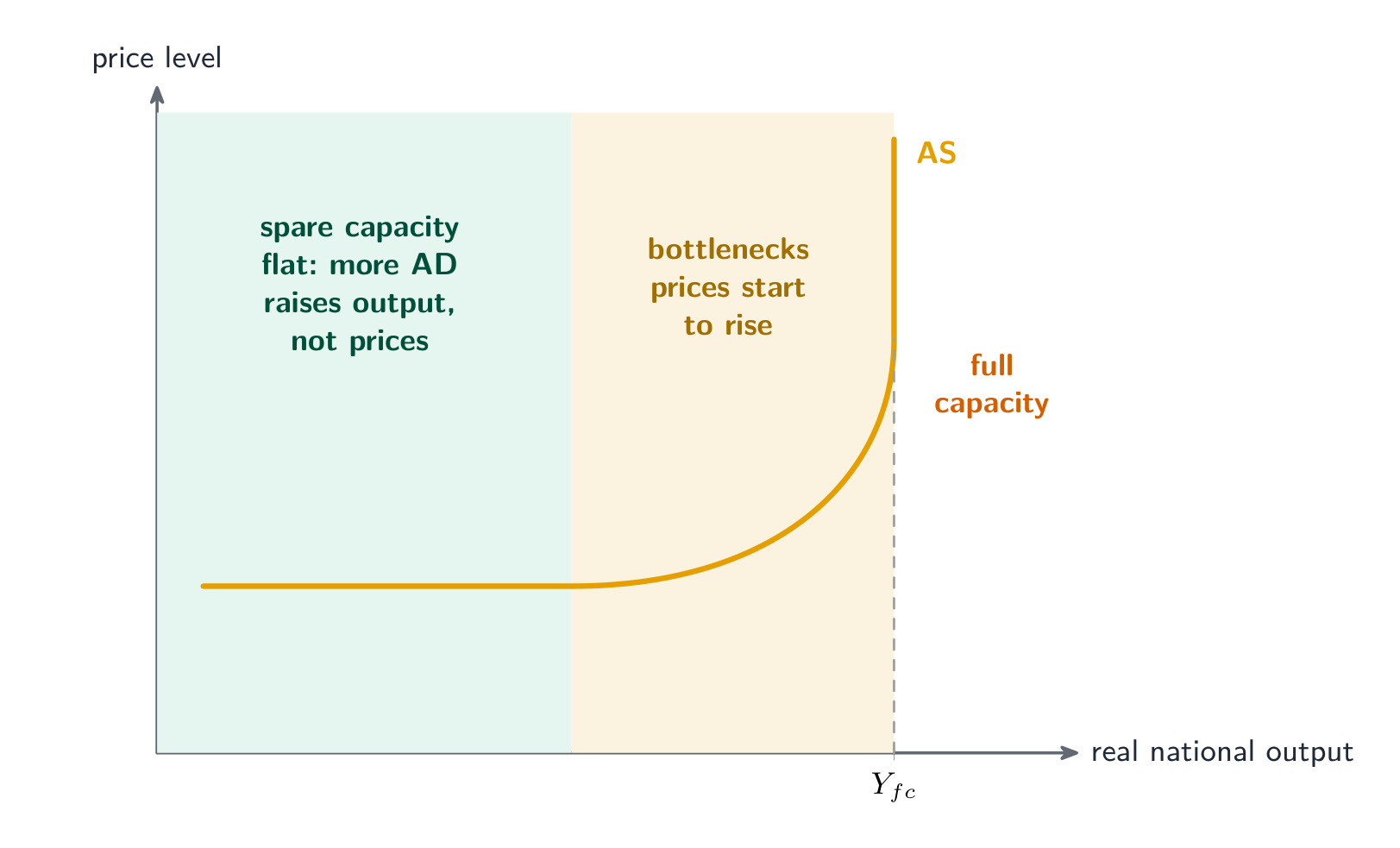
Match each part of the Keynesian AS curve to its result when AD rises.
Dificuldade 2/5 · Moedas 140 + pequeno bônus na primeira conclusão hoje
The effect of AD depends on spare capacity.
A rise in costs shifts SRAS, not AD. Higher energy prices make each unit dearer to produce. Students often draw AD moving left; the correct diagram moves SRAS left, giving higher prices and lower output together.
Energy prices double while AD is unchanged. What happens?
Dificuldade 1/5 · Moedas 100 + pequeno bônus na primeira conclusão hoje
SRAS moves left along an unchanged AD curve.
SRAS slopes up because costs are fixed in the short run; cost changes shift it. Classical LRAS is vertical, so in the long run AD affects only prices. The Keynesian curve is flat with spare capacity, so in a deep slump AD can raise output without much inflation.
Explain why a Keynesian economist might support higher government spending in a deep recession, while a classical economist might not.
The two models predict different results from the same AD shift.