Growth rates, recession and wellbeing
Introduzido| English | Significado |
|---|---|
| recession/rɪˈseʃn/ | A significant, sustained decline in an economy's overall activity. |
| disposable income/dɪˈspəʊzəbl ˈɪŋkʌm/ | renda disponível |
| subjective wellbeing/sʌbˈdʒektɪv ˈwelbiːɪŋ/ | bem-estar subjetivo |
A fifth of the economy, gone in three months
- In the spring of 2020 lockdowns closed shops, factories and offices across much of the world.
- The UK's real GDP fell by about a fifth in one quarter — its largest fall on record.
- Economists measure such changes with growth rates, and decide when a fall counts as a recession 经济衰退.
The growth rate
- Growth is measured on real GDP, so price changes do not count as growth.
- A falling growth rate that stays positive is still growth — just slower.
Real GDP rises from ¥2500 bn to ¥2600 bn. What is the growth rate, in %?
Dificuldade 2/5 · Moedas 140 + pequeno bônus na primeira conclusão hoje
$\dfrac{2600 - 2500}{2500} \times 100 = 4\%$.
If the growth rate falls from 5% to 3%, real output has fallen.
Dificuldade 1/5 · Moedas 100 + pequeno bônus na primeira conclusão hoje
Output is still rising, but more slowly.
Worked example: is it a recession?
Real output in four quarters is 100, 99, 98 and 98.5.
- Q1 to Q2: $\dfrac{99 - 100}{100} \times 100 = -1\%$. Q2 to Q3: $\dfrac{98 - 99}{99} \times 100 \approx -1.01\%$.
- Two quarters of negative growth in a row — a recession, on the common definition.
- Q3 to Q4: $\approx +0.51\%$: growth has returned, but output is still 1.5% below its starting level.
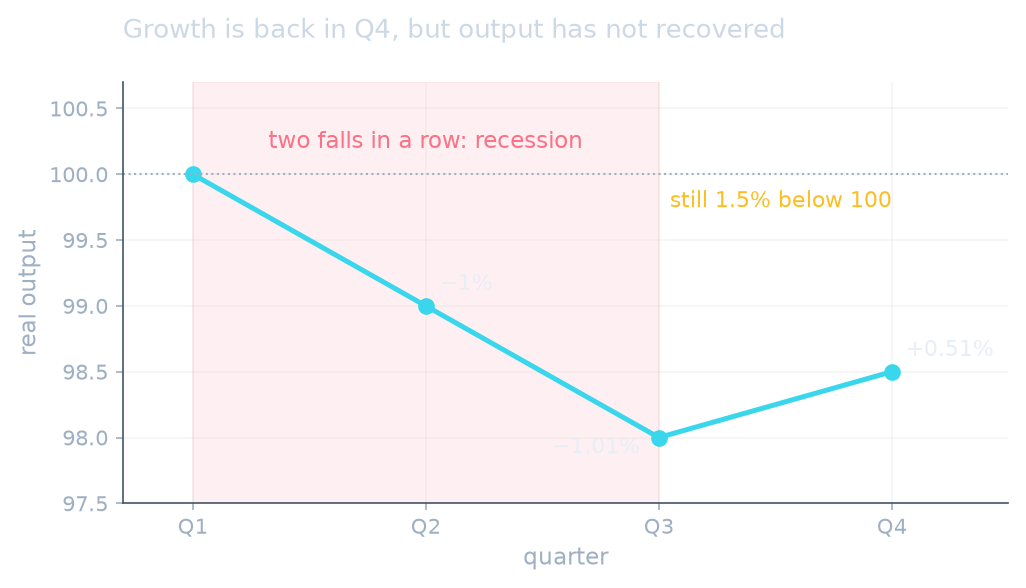
Two contractions then a small rise
Real output 100, 99, 98, 98.5: growth −1%, then about −1.01% (two successive contractions: a recession on the taught criterion), then about +0.51%, leaving output 1.5% below 100.
Quarterly growth rates are +0.4%, −0.2%, +0.1%, −0.3%. Is there a recession?
Dificuldade 1/5 · Moedas 100 + pequeno bônus na primeira conclusão hoje
A recession needs two consecutive quarters of negative growth.
Positive growth does not mean output is back to normal. After a deep fall, the economy can grow for several quarters and still produce less than before the recession. Compare the level of output, not just the latest growth rate.
Output falls from 200 to 180, then grows 5%. What is the new level of output?
Dificuldade 2/5 · Moedas 140 + pequeno bônus na primeira conclusão hoje
$180 \times 1.05 = 189$, still below 200.
GDP and living standards
- Real GDP per head and real disposable income 可支配收入 (income after taxes and benefits) are the usual measures of material living standards.
- Limitations: they ignore inequality, unpaid work, leisure, pollution, and the quality of goods.
Which are limitations of real GDP per head as a measure of living standards?
Dificuldade 2/5 · Moedas 140 + pequeno bônus na primeira conclusão hoje
Real GDP already removes price changes.
Measuring wellbeing directly
- Some governments also survey subjective wellbeing 主观幸福感: how satisfied people say they are with their lives.
- Since 2011 the UK has asked people to rate their life satisfaction from 0 to 10. Bhutan measures "gross national happiness".
- Studies find that, beyond a certain income, extra income adds less to happiness than health, relationships and job security.
What does a survey of subjective wellbeing measure?
Dificuldade 1/5 · Moedas 100 + pequeno bônus na primeira conclusão hoje
It asks people directly, instead of measuring output.
Growth is the percentage change in real GDP, and two consecutive quarters of negative growth are usually called a recession. GDP measures output, not wellbeing: inequality, leisure and the environment are left out, so governments also survey how satisfied people are with their lives.
Explain why a rise in real GDP per head may not raise national happiness.
Link the growth to who receives it and what it costs.