Price elasticity of demand
Introduzido| English | Significado |
|---|---|
| price elasticity of demand/praɪs ɪlæˈstɪsɪti ɒv dɪˈmænd/ | elasticidade-preço da procura |
| price elastic/praɪs ɪˈlæstɪk/ | When quantity demanded changes by a larger percentage than the price. |
| price inelastic/praɪs ɪnɪˈlæstɪk/ | When quantity demanded changes by a smaller percentage than the price. |
| unitary elasticity/ˈjuːnɪtəri ɪlæˈstɪsɪti/ | elasticidade unitária |
| total revenue/ˈtəʊtl ˈrevənjuː/ | The total income from sales, equal to price multiplied by quantity for a single product at one price. |
| substitutes/ˈsʌbstɪtjuːts/ | Goods or services that can be used in place of each other. |
Should the cinema cut its price?
- A cinema cuts tickets from ¥50 to ¥40. Will it earn more or less?
- It depends on how many extra people come — on how responsive demand is to price.
- That responsiveness is the price elasticity of demand 需求价格弹性 (PED).
The formula
- PED is negative for normal demand curves, because price and quantity move in opposite directions.
- Economists usually compare its size, ignoring the minus sign.
The price of a coffee rises by 20% and the quantity demanded falls by 30%. What is the PED?
Dificuldade 2/5 · Moedas 140 + pequeno bônus na primeira conclusão hoje
$\text{PED} = \dfrac{-30}{20} = -1.5$. Demand is price elastic.
Reading the number
- $|\text{PED}| > 1$: price elastic 价格富有弹性 — quantity changes by a bigger percentage than price.
- $|\text{PED}| < 1$: price inelastic 价格缺乏弹性 — quantity changes by a smaller percentage.
- $|\text{PED}| = 1$: unitary elasticity 单位弹性. $0$ is perfectly inelastic; $\infty$ is perfectly elastic.
Match each PED to its description.
Dificuldade 2/5 · Moedas 140 + pequeno bônus na primeira conclusão hoje
Compare the size of PED with 1.
Worked example: one straight line, three elasticities
Demand is $Q = 100 - 2P$.
- At $P = 10$, $Q = 80$. A rise to $P = 11$ (+10%) gives $Q = 78$ (−2.5%). $\text{PED} = \dfrac{-2.5}{10} = -0.25$: inelastic.
- At $P = 25$, $Q = 50$: here $\text{PED} = -1$, unitary.
- At $P = 40$, $Q = 20$: a 10% rise to $44$ cuts $Q$ to $12$ (−40%). $\text{PED} = -4$: elastic.
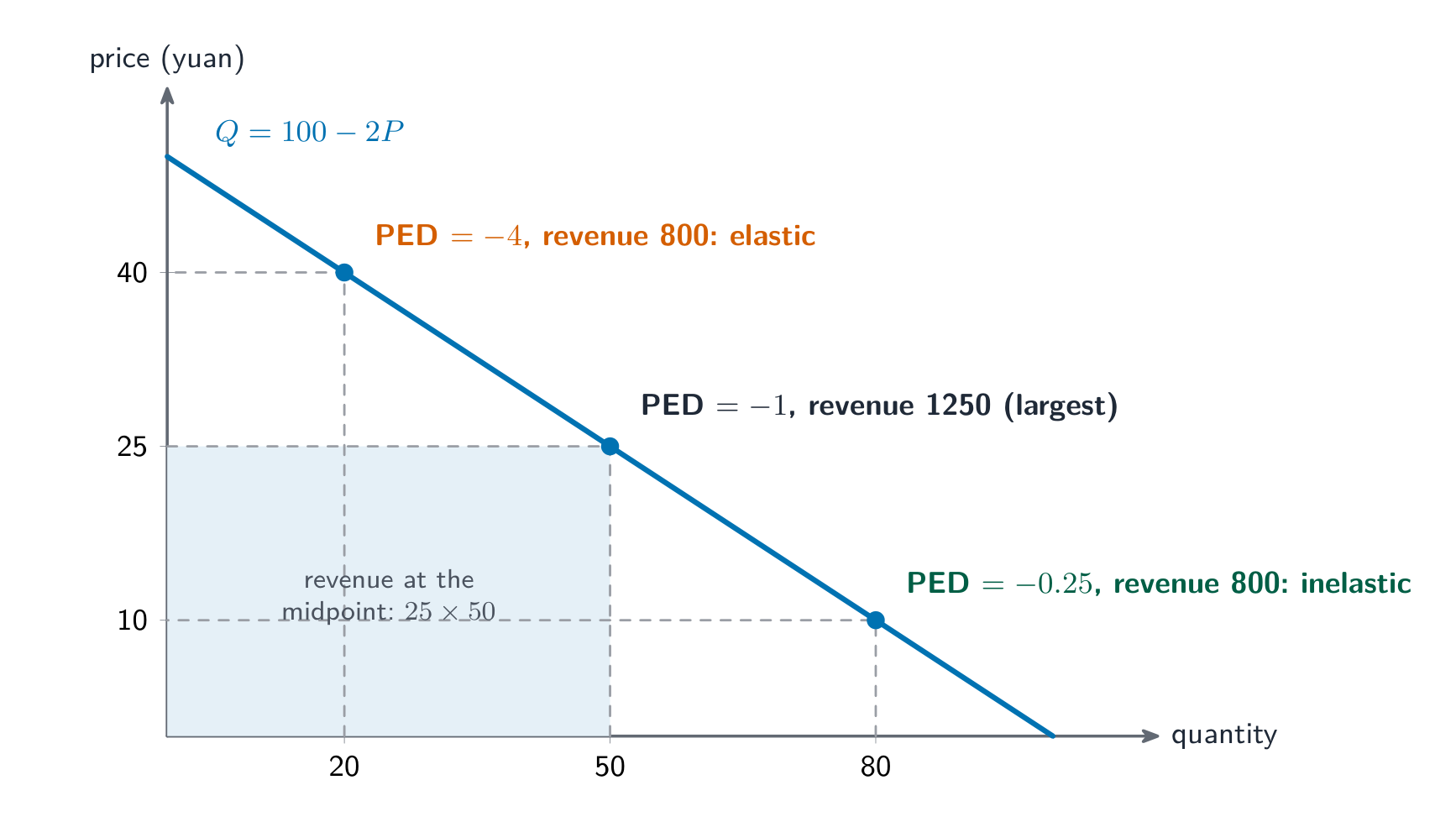
Constant slope, changing elasticity
Move along one straight demand line. Compare local PED and total revenue at different price–quantity points.
Demand is $Q = 100 - 2P$. Price rises from 20 to 22. Calculate the PED at $P = 20$.
Dificuldade 2/5 · Moedas 140 + pequeno bônus na primeira conclusão hoje
$Q$ falls from $60$ até $56$: $-6.67\%$ for a $+10\%$ price change, so PED $\approx -0.67$.
A straight demand line does not have one elasticity. Its slope is constant, but PED changes all along it: inelastic at low prices, unitary at the midpoint, elastic at high prices. Never judge PED from how steep a curve looks.
Every point on a straight-line demand curve has the same PED.
Dificuldade 1/5 · Moedas 100 + pequeno bônus na primeira conclusão hoje
The slope is constant, but PED rises in size as price rises along the line.
PED and total revenue
- Total revenue 总收益 $= P \times Q$.
- If demand is elastic, a price cut raises revenue: buyers respond strongly.
- If demand is inelastic, a price cut lowers revenue. Revenue is highest where PED $= -1$: here $25 \times 50 = 1250$.
Demand for train tickets has a PED of −0.4. The company raises the price. What happens to total revenue?
Dificuldade 1/5 · Moedas 100 + pequeno bônus na primeira conclusão hoje
Demand is inelastic, so quantity falls by a smaller percentage than price rises, and revenue rises.
What makes demand elastic?
- Substitutes 替代品: many close substitutes (one brand of cola) make demand elastic.
- Share of income: a big purchase (a car) is more elastic than a small one (salt).
- Necessity or habit: necessities and addictive goods, such as cigarettes, are inelastic. Time: demand becomes more elastic as buyers find alternatives.
Which factors make demand for a good MORE price elastic?
Dificuldade 2/5 · Moedas 140 + pequeno bônus na primeira conclusão hoje
Addiction makes demand less elastic.
Who uses PED?
- Firms set prices: an airline charges business travellers (inelastic) more than tourists (elastic).
- Governments tax goods with inelastic demand, such as fuel and tobacco, because sales — and tax revenue — fall only a little.
PED is the % change in quantity demanded divided by the % change in price. It varies along a straight demand line and decides whether a price change raises or lowers revenue. Substitutes, share of income, necessity and time decide how elastic demand is.
Explain why governments often put taxes on cigarettes and fuel.
The chain is inelastic demand → small fall in sales → large revenue.