Rational choice and why consumers depart from it
Introduzido| English | Significado |
|---|---|
| rational/ˈræʃənl/ | Acting logically to get the best result for yourself. |
| maximise utility | To get the greatest possible satisfaction from what you buy. |
| habitual behaviour | Doing something out of habit rather than after weighing up the choice. |
| inertia/ɪˈnɜːʃə/ | inércia |
| herd behaviour | Copying what other people do instead of deciding for yourself. |
| framing/ˈfreɪmɪŋ/ | efeito de enquadramento |
The phone plan nobody switches from
- Many people stay on the same phone plan for years, even when a cheaper one is easy to find.
- Standard economic theory says they should switch. So why don't they?
- This lesson compares the rational 理性的 consumer of the textbook with real behaviour.
The rational decision maker
- Traditional theory assumes consumers maximise utility 效用最大化: they choose whatever gives them the most satisfaction for their money.
- It assumes firms maximise profit, and that everyone has full information and calculates perfectly.
- These assumptions make models simple and give clear predictions, such as a downward-sloping demand curve.
Traditional economic theory assumes that consumers aim to —
Dificuldade 1/5 · Moedas 100 + pequeno bônus na primeira conclusão hoje
Consumers maximise utility; firms are assumed to maximise profit.
Worked example: what a rational buyer calculates
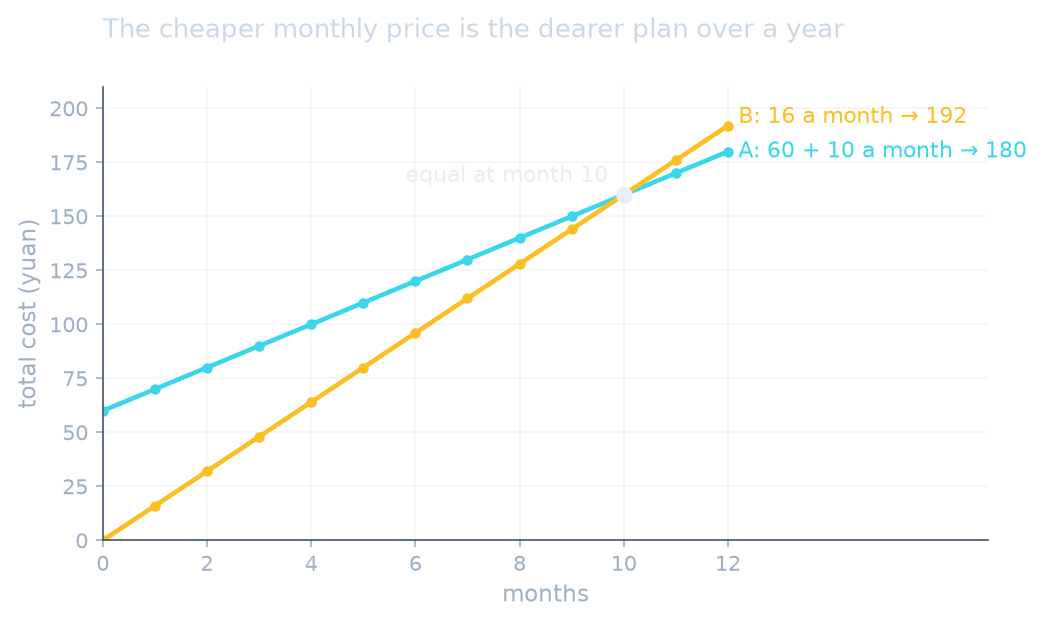
Plan A costs ¥60 to set up and ¥10 a month. Plan B has no set-up fee and costs ¥16 a month.
- Total cost = fixed fee + monthly price × months.
- Over 12 months: A $= 60 + 10 \times 12 = ¥180$; B $= 0 + 16 \times 12 = ¥192$.
- Break-even: $60 + 10m = 16m$ gives $m = 10$ months. A rational buyer who stays a year chooses A.
The full cost of two plans
Plan A costs 10 a month plus 60 to set up: 180 over a year. Plan B costs 16 a month and nothing to set up: 192. The lower monthly price wins only after 10 months, so comparing headline monthly prices misses the full cost.
Plan A costs ¥60 plus ¥10 a month. What does it cost over 6 months?
Dificuldade 2/5 · Moedas 140 + pequeno bônus na primeira conclusão hoje
$60 + 10 \times 6 = ¥120$. Plan B would cost $16 \times 6 = ¥96$, so for 6 months B is cheaper.
Plan C costs ¥90 to set up and ¥8 a month; Plan D costs ¥14 a month. After how many months do they cost the same?
Dificuldade 2/5 · Moedas 140 + pequeno bônus na primeira conclusão hoje
$90 + 8m = 14m$ gives $6m = 90$, so $m = 15$.
Reason 1: habit
- Habitual behaviour 习惯性行为 saves effort. People buy the same brand of milk without comparing every price each week.
- Changing a habit has a cost in time and attention, so people stay with what they know — inertia 惯性.
Reason 2: other people
- People copy friends, family and influencers. A product can sell because "everyone has one", not because it is best value.
- Herd behaviour 从众行为 can push demand up quickly, as when queues form outside a newly opened bubble-tea shop.
Reason 3: weakness at computation
- Many people cannot or will not do the sum in the worked example. They compare the headline monthly price — ¥10 against ¥16 — and miss the set-up fee.
- Firms know this. Framing 框架效应 a price as "only ¥10 a month" can make an expensive deal look cheap.
Match each behaviour to the reason consumers may not act rationally.
Dificuldade 2/5 · Moedas 140 + pequeno bônus na primeira conclusão hoje
These are the three reasons named in the specification.
A gym advertises "only ¥3 a day" instead of "¥1,095 a year". This is an example of —
Dificuldade 1/5 · Moedas 100 + pequeno bônus na primeira conclusão hoje
The price is the same; only the way it is presented changes.
"Irrational" does not mean "stupid". Copying a friend or using a habit can be a sensible shortcut when comparing every option would take hours. Behavioural economics says choices are often not utility-maximising, not that people are foolish.
Using a habit instead of comparing every option can be a sensible shortcut.
Dificuldade 1/5 · Moedas 100 + pequeno bônus na primeira conclusão hoje
Comparing every option has a time cost. A habit is a rule of thumb that saves effort.
Why it matters for policy
- If consumers do not compare prices, firms can charge more without losing customers.
- Governments can respond: requiring clear total-cost labels, or making switching easy, helps consumers act more rationally.
Exam practice: a 4-mark "explain"
Question (4 marks): Explain, using an example, one reason why consumers may not behave rationally.
Model answer: Traditional theory assumes consumers maximise utility by comparing every option with full information. (Knowledge) One reason they do not is weakness at computation: many people cannot or will not work out the total cost of a deal. (Knowledge) For example, a buyer may choose a phone plan that is "only ¥10 a month" without adding its ¥60 set-up fee, even though over a few months a ¥16 plan with no fee is cheaper. (Application) Because the buyer compares only the headline price, they pay more for the same service, so they do not maximise their utility from their income. (Analysis)
- Why it scores: a definition of rational behaviour, one clearly named reason, a numerical example, and a final sentence that links the example back to utility. Listing three reasons briefly would score less than explaining one well.
Which answer would earn the analysis mark in a 4-mark "explain" on herd behaviour?
Dificuldade 1/5 · Moedas 100 + pequeno bônus na primeira conclusão hoje
Analysis is the linked chain that ends with why the choice is not utility-maximising. The others give only a definition, only an example, or a list.
Traditional theory assumes consumers maximise utility with full information. In reality habit, the influence of other people and weakness at computation stop many people from choosing the best-value option. These limits explain why firms frame prices and why governments regulate how prices are shown.
Explain one reason why many customers stay on an expensive phone plan, and one thing a government could do about it.
Link the policy to the reason, not just to "lower prices".