Higher Tier: warming favours the endothermic direction
Introduzido| English | Significado |
|---|---|
| endothermic direction/ˌendəʊˈθɜːmɪk daɪˈrekʃn/ | direção endotérmica |
| exothermic direction/eɡzəˈðɜːmɪk daɪˈrekʃn/ | direção exotérmica |
Hot is fast, but gives less
- The Haber process makes ammonia: $\text{N}_2 + 3\text{H}_2 \rightleftharpoons 2\text{NH}_3$. The forward reaction is exothermic.
- Engineers would like a high temperature for speed, but that gives less ammonia. They compromise at about 450 °C.
- This lesson is Higher Tier.
Raising the temperature
- The equilibrium shifts in the endothermic direction 吸热方向, which takes in the extra energy.
- If the forward reaction is exothermic, raising the temperature shifts it left: less product.
The forward reaction is endothermic. What happens to the yield when the temperature is raised?
Dificuldade 1/5 · Moedas 100 + pequeno bônus na primeira conclusão hoje
Heating favours the endothermic direction.
Lowering the temperature
- The equilibrium shifts in the exothermic direction 放热方向, which releases energy.
- For an exothermic forward reaction, cooling gives more product.
In $2\text{SO}_2 + \text{O}_2 \rightleftharpoons 2\text{SO}_3$ (forward exothermic), what does cooling do?
Dificuldade 1/5 · Moedas 100 + pequeno bônus na primeira conclusão hoje
Cooling favours the exothermic direction.
Which direction is favoured?
Dificuldade 2/5 · Moedas 140 + pequeno bônus na primeira conclusão hoje
Oppose the change.
Worked example: the product share falls
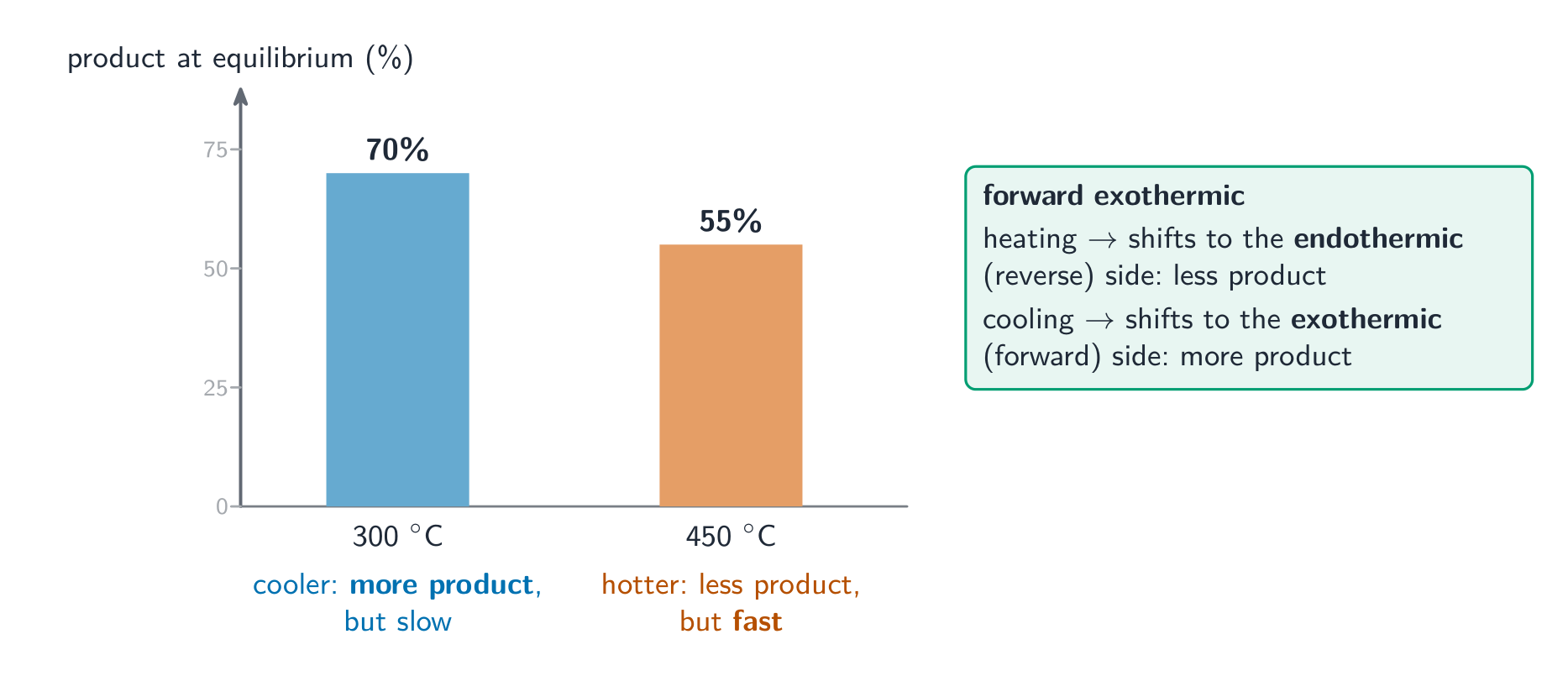
An exothermic forward reaction has 70% product at 300 °C. At 450 °C it has 55%.
- Change $= 70 - 55 = 15$ percentage points less product.
- Why: heating favours the endothermic reverse reaction, which uses up product.
- But the higher temperature makes the reaction reach equilibrium much faster.
Warming favours the endothermic direction
For this exothermic forward reaction, raise the temperature and the product share falls as the endothermic reverse reaction is favoured, as in the lesson's drop from 70% to 55% product.
The product share falls from 64% to 40% when heated. By how many percentage points did it fall?
Dificuldade 2/5 · Moedas 140 + pequeno bônus na primeira conclusão hoje
$64 - 40 = 24$.
The compromise
- Low temperature: high yield but very slow.
- High temperature: fast but low yield.
- A compromise temperature, often with a catalyst, gives a reasonable yield quickly.
Why is a compromise temperature used in the Haber process?
Dificuldade 1/5 · Moedas 100 + pequeno bônus na primeira conclusão hoje
Balance yield and rate.
Don't mix up rate and yield. Heating always increases the rate of both directions. Whether it increases the yield depends on which direction is endothermic.
Increasing the temperature always increases the yield.
Dificuldade 1/5 · Moedas 100 + pequeno bônus na primeira conclusão hoje
It always increases rate, not yield.
Increasing the temperature shifts equilibrium in the endothermic direction; decreasing it shifts it in the exothermic direction. For exothermic forward reactions, high temperatures give faster rates but lower yields, so industry chooses a compromise.
The forward reaction in the Haber process is exothermic. Explain why 450 °C is used rather than a lower temperature.
Yield vs rate.