Reversible reactions: the products can reform the reactants
Introduzido| English | Significado |
|---|---|
| reversible reaction/rɪˈvɜːsɪbl rɪˈækʃn/ | reação reversível |
| reversible arrow/rɪˈvɜːsɪbl ˈærəʊ/ | seta reversível |
White smoke that reforms
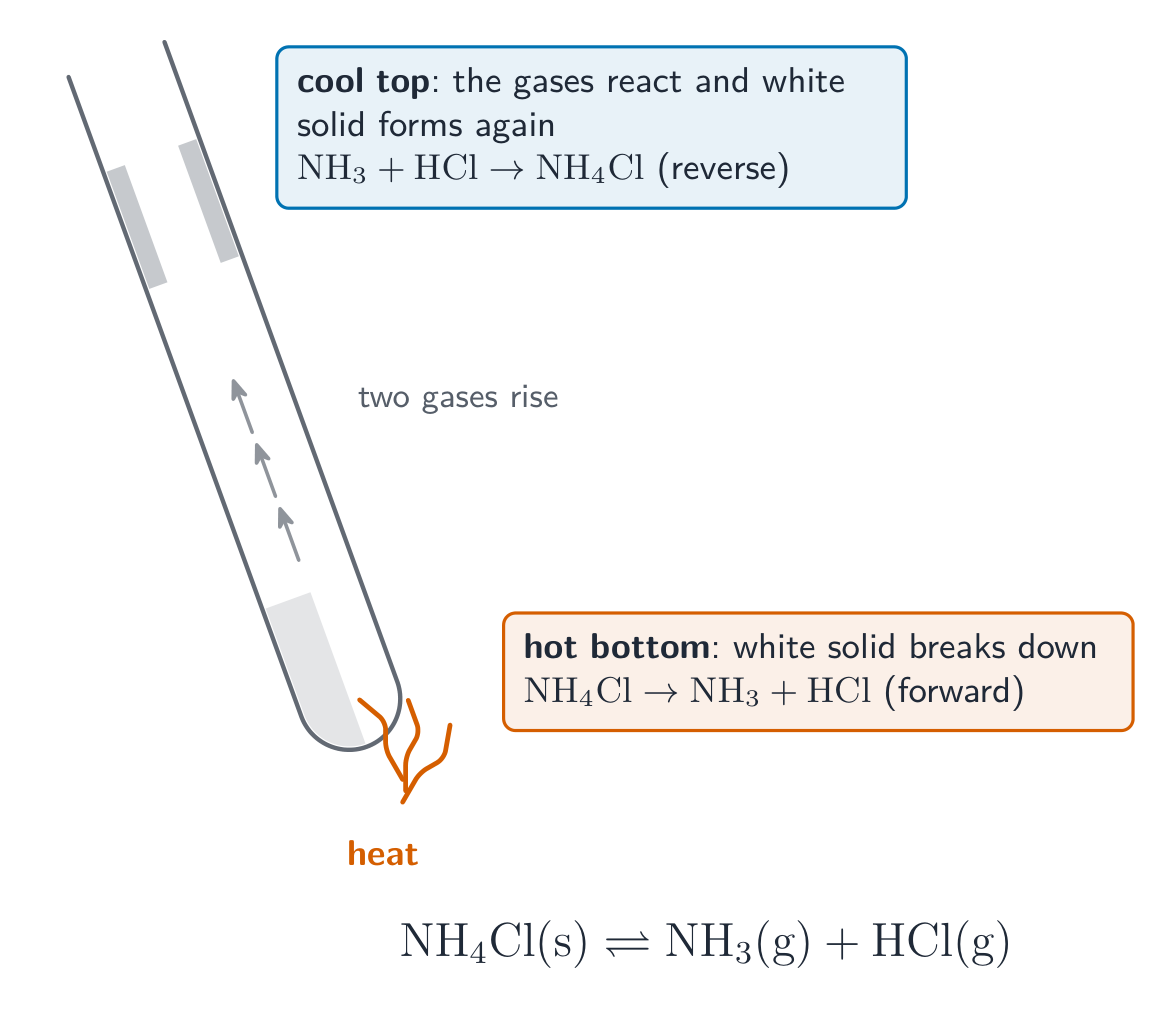
- Heat white ammonium chloride in a test tube. It seems to vanish, then a white solid reappears near the cool top of the tube.
- Heating breaks it into two gases; at the cooler end they join back together. This is a reversible reaction 可逆反应.
The reversible arrow
- A reversible arrow 可逆箭头 ⇌ shows the reaction can go both ways.
- $\text{NH}_4\text{Cl} \rightleftharpoons \text{NH}_3 + \text{HCl}$.
- Forward: heating breaks it down. Reverse: cooling makes it reform.
What does the symbol ⇌ mean?
Dificuldade 1/5 · Moedas 100 + pequeno bônus na primeira conclusão hoje
It goes both ways.
What forms when ammonium chloride is heated?
Dificuldade 2/5 · Moedas 140 + pequeno bônus na primeira conclusão hoje
NH₄Cl ⇌ NH₃ + HCl.
Changing conditions changes direction
- Conditions such as temperature decide which direction is favoured.
- Most reactions are effectively one-way: you cannot "unburn" wood.
Why does a white solid reappear at the top of the tube?
Dificuldade 1/5 · Moedas 100 + pequeno bônus na primeira conclusão hoje
The reverse reaction is favoured when cool.
Worked example: counting particles
10 formula units of NH₄Cl are heated and 6 decompose.
- Atoms: each side has 1 N, 4 H and 1 Cl per formula unit — mass is conserved.
- Gas molecules made: 6 NH₃ + 6 HCl = 12 molecules.
- Left: 4 NH₄Cl. Cooling the gases reforms ammonium chloride.
Heat splits it; cooling reforms it
NH₄Cl ⇌ NH₃ + HCl keeps one N, four H and one Cl on each side. Six decomposed formula units give six of each gas, twelve molecules; cooling the gases reforms ammonium chloride.
8 formula units of NH₄Cl decompose. How many gas molecules form in total?
Dificuldade 2/5 · Moedas 140 + pequeno bônus na primeira conclusão hoje
8 NH₃ + 8 HCl.
Other examples
- Blue hydrated copper sulfate ⇌ white anhydrous copper sulfate + water.
- The Haber process: $\text{N}_2 + 3\text{H}_2 \rightleftharpoons 2\text{NH}_3$.
Which are reversible reactions?
Dificuldade 2/5 · Moedas 140 + pequeno bônus na primeira conclusão hoje
Combustion is one-way.
Ammonium chloride "disappearing" is not sublimation. It is a chemical change: new substances (two gases) form, then react to make it again. Iodine sublimes; ammonium chloride decomposes.
Ammonium chloride sublimes when heated.
Dificuldade 1/5 · Moedas 100 + pequeno bônus na primeira conclusão hoje
It decomposes chemically.
In a reversible reaction, the products can react to form the reactants again, shown by ⇌. The direction depends on conditions such as temperature. Atoms are conserved in both directions.
Describe and explain what you see when ammonium chloride is heated in a test tube.
Two directions, two temperatures.