Rights, Inclusion and Protest
Introduzido| English | Significado |
|---|---|
| end of apartheid/end ɒv əˈpɑːθeɪd/ | Fim do apartheid |
| Rights-based discourses/raɪts beɪst ˈdɪskɔːsɪz/ | Arguments that every person has rights, whatever their race, sex or religion, used to demand equal treatment. |
| Universal Declaration of Human Rights | The United Nations document of 1948 that set out 30 basic rights belonging to all people. |
| liberation theology | A Catholic movement in Latin America, from the 1960s, that taught that the Church should work for the poor against injustice. |
| apartheid | South Africa's system of laws, from 1948 to the early 1990s, that separated people by race and gave power to the white minority. |
A prisoner walks free, February 1990
- On 11 February 1990, Nelson Mandela walked out of Victor Verster prison near Cape Town after 27 years in prison. Crowds lined the road. Four years later, on 27 April 1994, South Africans of all races voted together for the first time, and Mandela became president. The end of apartheid 种族隔离 — legal racial segregation — followed decades of protest and international pressure.
- After 1900, people used the idea of universal rights to demand inclusion, and protested against the costs of change.
Mandela was freed in 1990 and became president after the 1994 election. How many years later?
Dificuldade 2/5 · Moedas 140 + pequeno bônus na primeira conclusão hoje
1994 − 1990.
A new kind of argument
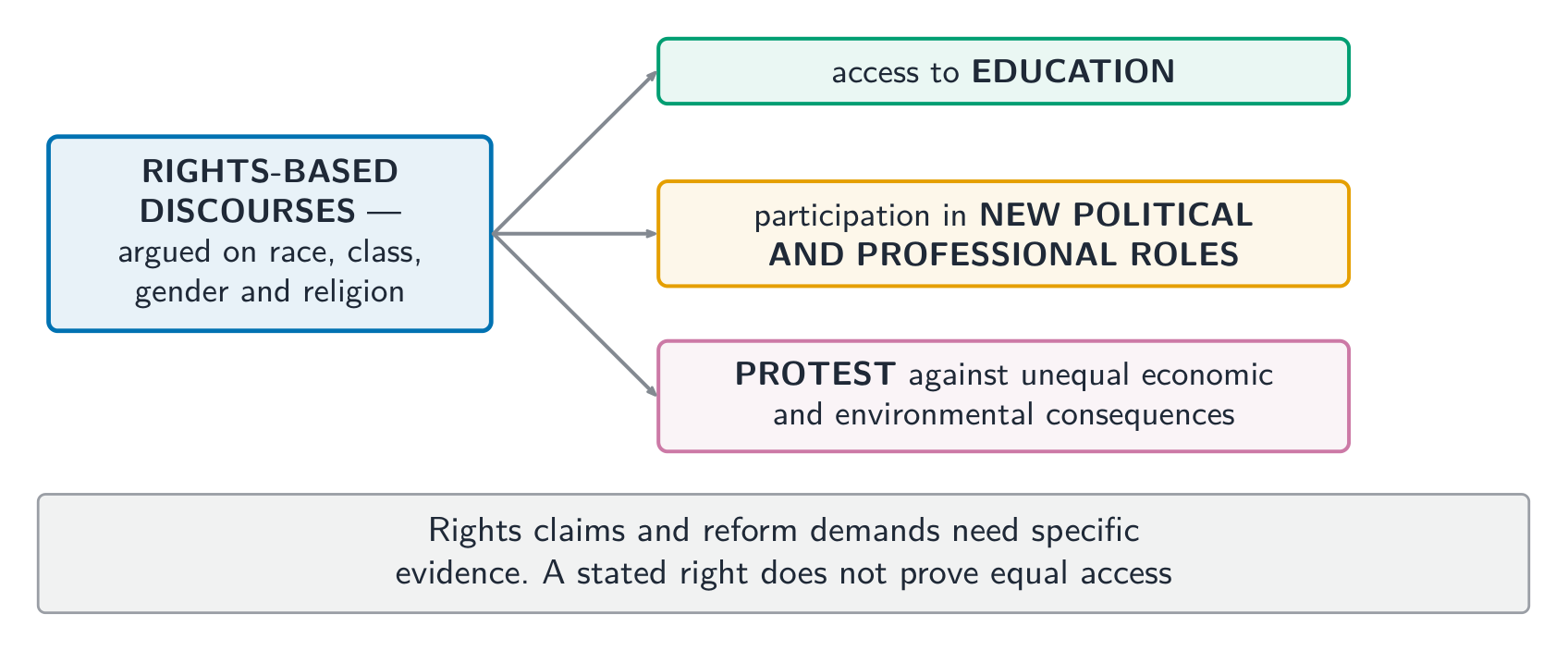
- Rights-based discourses 基于权利的话语 claimed that every person has rights, whatever their race, sex or religion.
- The UN's Universal Declaration of Human Rights 世界人权宣言 (1948) set out 30 articles of rights for all people.
What did the Universal Declaration of Human Rights (1948) do?
Dificuldade 1/5 · Moedas 100 + pequeno bônus na primeira conclusão hoje
30 articles of rights.
Named discourses
- Liberation theology 解放神学: Catholic priests in Latin America argued that the Church should help the poor against injustice.
- Movements for women's rights, the rights of Indigenous peoples and gay rights used the same language of rights.
A discourse, an access change, or a protest?
Sort each item in this subtopic.
Worked example: access widened
- Voting: women gained the vote in New Zealand (1893), Britain (1918 and 1928), India (1950) and Kuwait (2005).
- Education: female literacy rose sharply, and in many countries more women than men now attend university.
- Measure: worldwide, the female adult literacy rate rose from about 50% in 1970 to over 80% by 2015.
Put the women's vote in order.
Dificuldade 3/5 · Moedas 200 + pequeno bônus na primeira conclusão hoje
1893, 1918, 1950, 2005.
Female adult literacy rose from about 50% to over 80%. By at least how many percentage points?
Dificuldade 2/5 · Moedas 140 + pequeno bônus na primeira conclusão hoje
80 − 50.
Protest at the costs
- Greenpeace (1971) protested against nuclear tests and whaling.
- In Kenya, Wangari Maathai's Green Belt Movement (from 1977) organised women to plant over 50 million trees; she won the Nobel Peace Prize in 2004.
Match each to its category.
Dificuldade 2/5 · Moedas 140 + pequeno bônus na primeira conclusão hoje
Three categories.
Maintained and challenged
- Old hierarchies of race, gender and class were challenged, but many continued.
- In South Africa, apartheid laws ended by 1991, yet great inequality between races remained.
Rights declarations did not bring equality by themselves. The 1948 Declaration was not binding; change came from people who used it in protests and courts.
The 1948 Declaration brought equality by itself.
Dificuldade 1/5 · Moedas 100 + pequeno bônus na primeira conclusão hoje
People had to use it.
After 1900, rights-based arguments — the 1948 Declaration, liberation theology, women's movements — widened access to voting and education, and protest movements like Greenpeace and the Green Belt Movement challenged the costs of change. The end of apartheid in 1994 shows both the power and the limits of these changes.
To what extent were social hierarchies challenged after 1900?
Extent.