Causes of World War I
Introduzido| English | Significado |
|---|---|
| Militarism | The belief in a strong army and readiness to use it — grew. |
| Nationalism/ˈnæʃənəlɪzəm/ | Loyalty to a nation and the demand that it govern itself. |
| alliance system/əˈlaɪəns ˈsɪstəm/ | The system of agreements before 1914 by which European powers promised to support one another in war. |
Two shots in Sarajevo, June 1914
- On 28 June 1914, Gavrilo Princip, a 19-year-old Bosnian Serb nationalist, shot dead Archduke Franz Ferdinand, heir to the throne of Austria-Hungary, and his wife Sophie in Sarajevo. Austria-Hungary blamed Serbia. Within six weeks, Austria-Hungary, Germany, Russia, France and Britain were all at war. A murder in one Balkan city had become a world war.
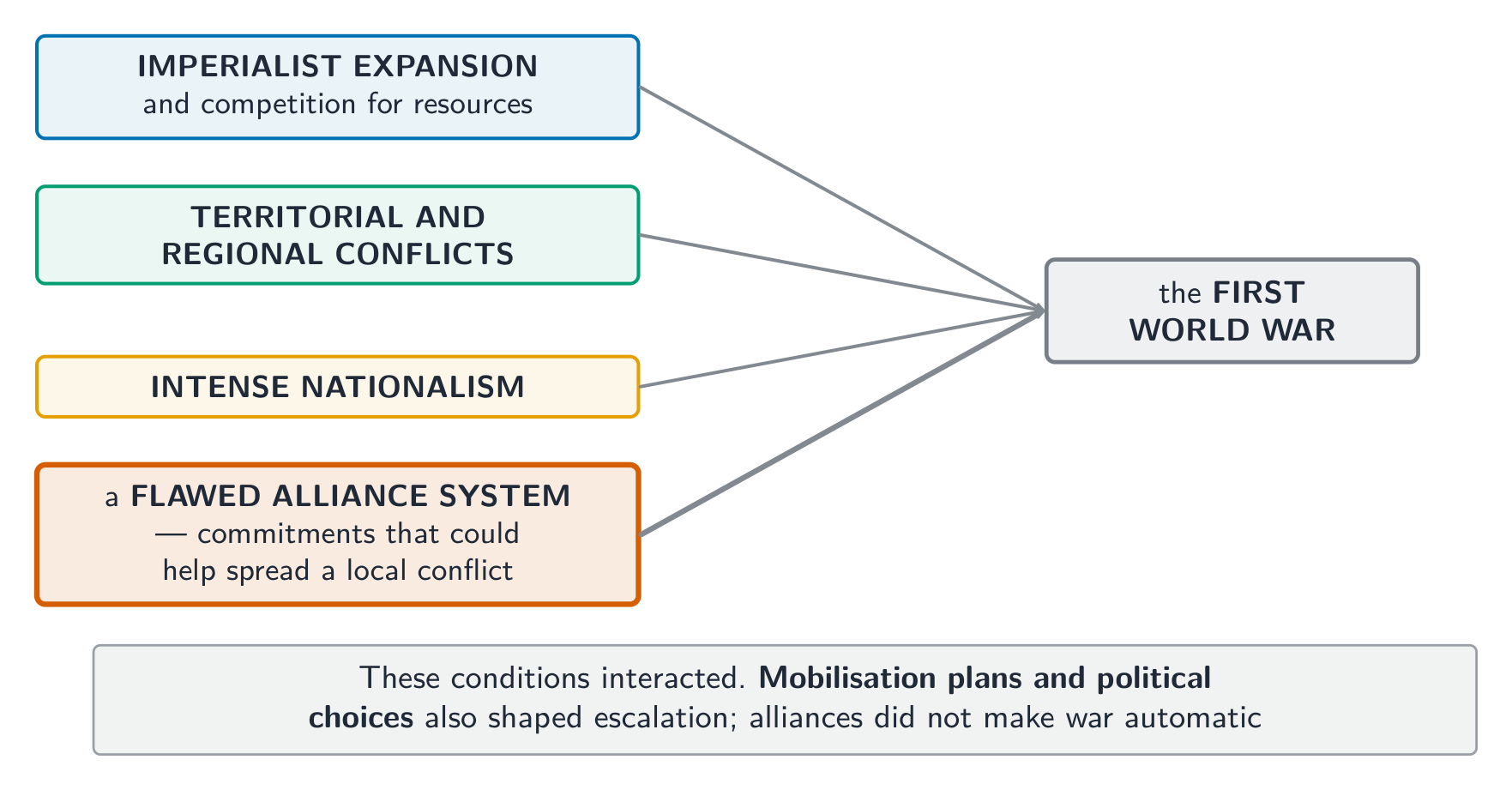
- World War I had four main causes: imperialism, territorial and economic rivalries, militarism and nationalism — and an alliance system that turned a crisis into a general war.
Imperial competition
- Britain, France and Germany competed for colonies, as in the Moroccan crises of 1905 and 1911.
- Germany's naval race with Britain (from 1898) made Britain see Germany as its main rival.
An alliance system that escalated
- The alliance system 同盟体系: the Triple Alliance (Germany, Austria-Hungary, Italy) and the Triple Entente (France, Russia, Britain).
- Each power promised to support its allies, so a local war could quickly become a European one.
Assemble the causes, then find the escalator
Three conditions explain tension; only the alliance system explains escalation.
Match each country to its alliance in 1914.
Dificuldade 2/5 · Moedas 140 + pequeno bônus na primeira conclusão hoje
The alliance system.
Which cause explains why the war spread so fast?
Dificuldade 1/5 · Moedas 100 + pequeno bônus na primeira conclusão hoje
Escalation.
Worked example: from Sarajevo to world war
- 28 July: Austria-Hungary declared war on Serbia.
- 30 July–1 August: Russia, protecting Serbia, mobilised; Germany, allied to Austria-Hungary, declared war on Russia, then on France (3 August).
- 4 August: Germany invaded Belgium to reach France; Britain declared war. In 37 days, a murder had become a war between five great powers.
The assassination was on 28 June and Britain declared war on 4 August. How many days later? (June has 30 days)
Dificuldade 2/5 · Moedas 140 + pequeno bônus na primeira conclusão hoje
2 days in June + 31 in July + 4 in August.
Put these in order.
Dificuldade 3/5 · Moedas 200 + pequeno bônus na primeira conclusão hoje
28 June to 4 August.
Nationalism supplied the intensity
- Nationalism 民族主义 made people ready to fight for their nation; Serb nationalists wanted to unite all Serbs, including those in Austria-Hungary.
- Crowds cheered the declarations of war in Berlin, Paris and London.
Militarism
- Militarism 军国主义 — the belief in a strong army and readiness to use it — grew; Germany's Schlieffen Plan required a fast attack on France through Belgium.
- Army leaders pushed for quick mobilisation, leaving little time for diplomacy.
Match each to the cause.
Dificuldade 2/5 · Moedas 140 + pequeno bônus na primeira conclusão hoje
Long-term causes.
The assassination did not cause the war by itself. It was the trigger; the alliance system, militarism and nationalism turned a Balkan crisis into a world war.
The assassination caused the war by itself.
Dificuldade 1/5 · Moedas 100 + pequeno bônus na primeira conclusão hoje
It was the trigger.
Imperial rivalry, militarism and nationalism created tension before 1914. The assassination at Sarajevo was the trigger, and the alliance system escalated it: in 37 days, five great powers were at war.
Explain how the alliance system turned the Sarajevo assassination into a world war.
Causation.