Economic Imperialism
Introduzido| English | Significado |
|---|---|
| economic imperialism/ˌiːkəˈnɒmɪk ɪmˈpɪərɪəlɪzəm/ | imperialismo econômico |
The nitrate fields, 1880s
- After the War of the Pacific (1879–84), Chile took the nitrate-rich deserts of Bolivia and Peru. Nitrate was used for fertiliser and explosives, and Chile became its main supplier. But British investors, such as John Thomas North, the "Nitrate King", bought most of the mines; by 1890, British firms controlled about 70% of the industry. Chile was independent, yet much of its wealth went abroad.
- In the 19th century, industrial states gained wealth and influence over countries they did not rule — economic imperialism 经济帝国主义.
British firms controlled about 70% of Chile's nitrate industry by 1890. What share did others hold?
Dificuldade 2/5 · Moedas 140 + pequeno bônus na primeira conclusão hoje
100 − 70.
Control without a colony
- Firms and banks from Britain, France and the United States invested in railways, ports and mines in independent states.
- Their governments used diplomacy and sometimes force to protect these interests.
What is economic imperialism?
Dificuldade 1/5 · Moedas 100 + pequeno bônus na primeira conclusão hoje
Control without a colony.
Two named cases
- China: after the Opium Wars (1839–42 and 1856–60), Britain and France forced China to open ports, accept opium imports and give foreigners special rights.
- Argentina: British firms helped build the Port of Buenos Aires and most of the railways, which carried beef and wheat to Britain.
Territorial empire, economic imperialism, or a commodity?
Sort each item by what it is.
Match each case to its method.
Dificuldade 2/5 · Moedas 140 + pequeno bônus na primeira conclusão hoje
Named cases.
Put these in order.
Dificuldade 3/5 · Moedas 200 + pequeno bônus na primeira conclusão hoje
1839, 1860, 1879, 1890.
Worked example: trade organised for advantage
- Commodity: raw cotton from South Asia and Egypt went to British mills, and cloth came back.
- Method: British merchants and banks controlled shipping, prices and credit.
- Effect: producers earned little, while processing profits stayed in Britain. The same pattern held for palm oil from West Africa and copper from Chile.
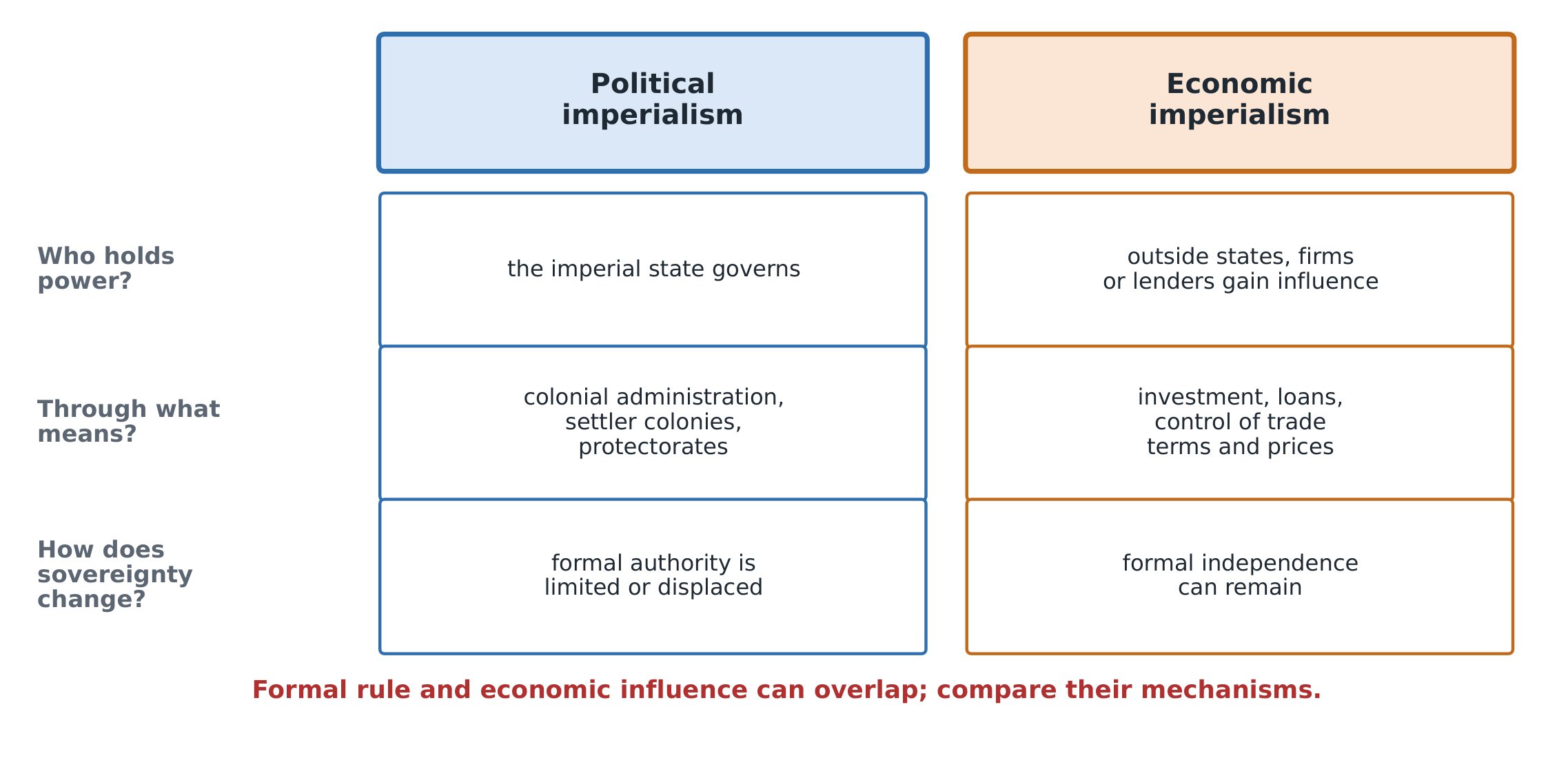
How it differs from territorial empire
- In territorial empire, a colonial government ruled directly, as Britain did in India.
- In economic imperialism, local governments stayed, but foreign firms held key parts of the economy.
Match each to its category.
Dificuldade 2/5 · Moedas 140 + pequeno bônus na primeira conclusão hoje
Territorial or economic.
Why states accepted it
- Many Latin American governments welcomed foreign capital to build railways and grow exports.
- Others, like China, were forced by war to open their markets.
Economic imperialism did not need colonies. Chile and Argentina were independent, yet foreign firms controlled much of their mines and railways.
Economic imperialism required colonies.
Dificuldade 1/5 · Moedas 100 + pequeno bônus na primeira conclusão hoje
Chile and Argentina were independent.
Industrial states and their firms gained influence over independent countries: Britain and France opened China through the Opium Wars, British firms built Argentina's ports and railways and controlled Chile's nitrates, and trade in cotton, palm oil and copper kept profits in Europe and the United States.
Compare economic imperialism with territorial empire.
Comparison.