Continuity and Change, 1450–1750
Introduzido| English | Significado |
|---|---|
| continuity/kɒntɪˈnjuːɪti/ | Something that stays the same over a period of time, as opposed to something that changes. |
A law that bound the peasants, 1649
- In 1649, a new Russian law code, the Ulozhenie, ended the right of peasants to move from one landlord to another. Serfs and their children were now bound to the land for ever, and runaways could be hunted without time limit. Russia was expanding, and its nobles needed labour on their estates. In the same decades, plantations in the Americas were demanding ever more enslaved Africans.
- From 1450 to 1750, most people still farmed, but global connections intensified how labour was used.
What did Russia's 1649 law code do?
Dificuldade 1/5 · Moedas 100 + pequeno bônus na primeira conclusão hoje
Intensified labour.
Still an agricultural world
- In 1750, most people in every region still worked the land; cities held only a small share.
- Continuity 连续性: agriculture remained the base of almost every economy.
Most people in 1750 still worked the land.
Dificuldade 1/5 · Moedas 100 + pequeno bônus na primeira conclusão hoje
A continuity.
Demand intensified labour
- Serfdom tightened in Russia and eastern Europe as grain exports to western Europe grew.
- Plantations in the Americas used coerced labour: about 6 million enslaved Africans were carried across the Atlantic in the 18th century alone.
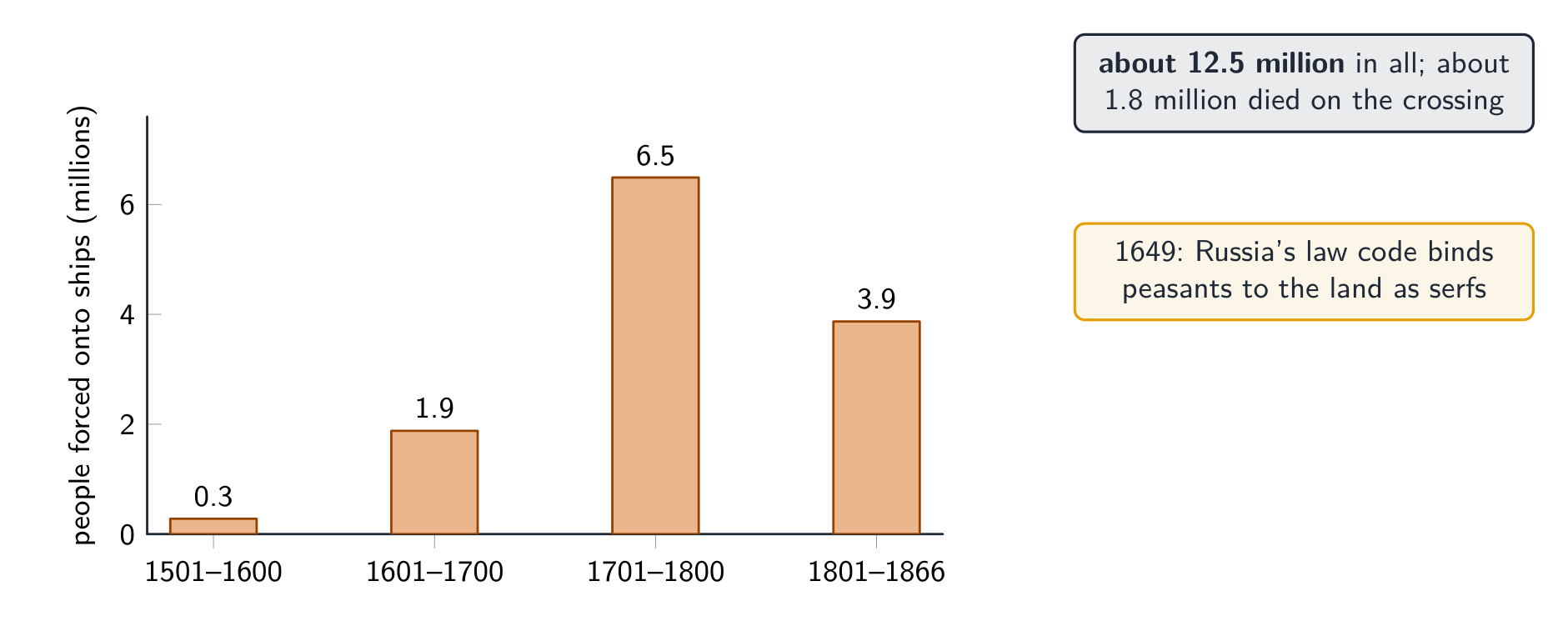
Continuity, change, or the shared cause?
Sort each statement about 1450–1750.
About 6 million enslaved Africans were carried across the Atlantic in the 18th century. About how many per year? (whole number)
Dificuldade 2/5 · Moedas 140 + pequeno bônus na primeira conclusão hoje
6 000 000 ÷ 100.
Worked example: the connection is the cause
- Shared cause: transoceanic voyages linked the hemispheres after 1492, creating global demand.
- Change 1: American crops such as maize and potatoes were grown across Afro-Eurasia.
- Change 2: demand for sugar, tobacco and cotton expanded plantations worked by enslaved people. Both changes came from the same connection.
Match each to its category.
Dificuldade 2/5 · Moedas 140 + pequeno bônus na primeira conclusão hoje
Continuity, change, cause.
Which plantation crops drove demand for enslaved labour?
Dificuldade 2/5 · Moedas 140 + pequeno bônus na primeira conclusão hoje
Potatoes were a food crop.
Empires kept colliding
- Empires competed for land and trade: the Ottomans and Habsburgs, the Mughals and Safavids, the Spanish and English at sea.
- Wars increased rulers' need for taxes, which fell mainly on peasants.
A continuity-and-change routine
- Name what stayed the same (agriculture, coerced labour, empires) and what changed (new crops, plantations, global trade).
- Then name the cause that links them — hemispheric connection.
New trade did not end old labour systems. In many places, global demand made serfdom and slavery harsher, not weaker.
New global trade ended old labour systems.
Dificuldade 1/5 · Moedas 100 + pequeno bônus na primeira conclusão hoje
It often made them harsher.
From 1450 to 1750, agriculture remained the base of life, but global connections spread American crops and expanded plantations, while demand tightened serfdom in Russia — as the 1649 law code shows — and drove the Atlantic slave trade.
Explain continuity and change in labour systems between 1450 and 1750.
Continuity and change.