Trans-Saharan Trade
Introduzido| English | Significado |
|---|---|
| camel saddle/ˈkæml ˈsædl/ | selim de camelo |
| caravans/ˈkærəvænz/ | caravanas |
A king who changed the price of gold, 1324
- In 1324, Mansa Musa, ruler of Mali in West Africa, passed through Cairo on his pilgrimage to Mecca. Arab writers said he travelled with thousands of followers and gave away so much gold that its price in Cairo stayed low for years.
- Mali's wealth came from controlling trade across the Sahara Desert, the largest hot desert in the world.
What did Mansa Musa's journey through Cairo in 1324 show?
Dificuldade 1/5 · Moedas 100 + pequeno bônus na primeira conclusão hoje
He gave away so much gold that its price fell.
How to cross a desert
- The camel can travel for days without water and carry about 150 kg. A new camel saddle 骆驼鞍, first used in North Africa, let riders control camels better and load them more efficiently.
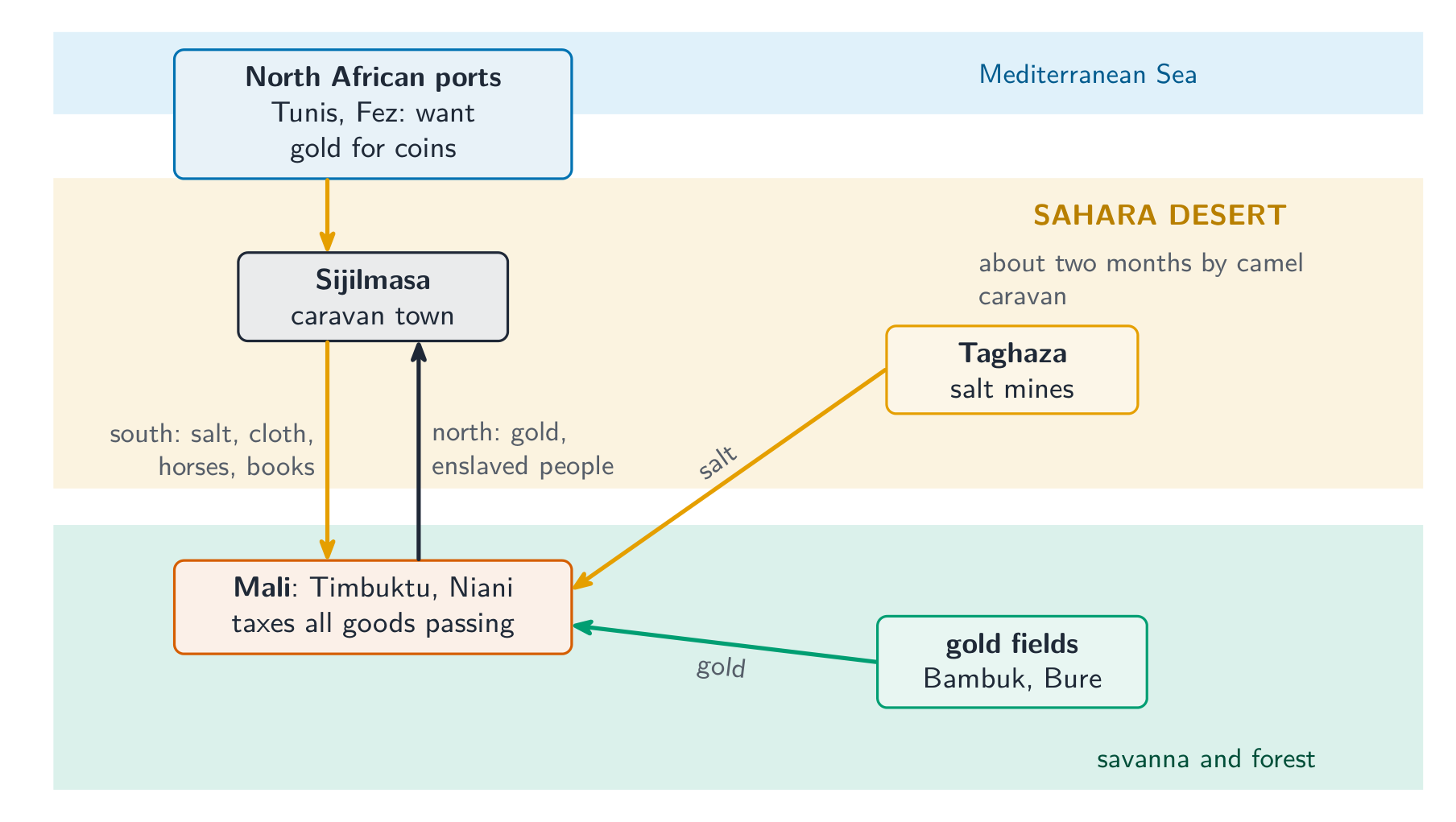
- Merchants travelled in caravans 商队 of hundreds or thousands of camels, for safety, and the crossing took about two months.
Large groups of merchants travelling together with camels are called ____.
Dificuldade 1/5 · Moedas 100 + pequeno bônus na primeira conclusão hoje
They travelled together for safety.
Gold for salt
- West Africa had gold but little salt, which people need in a hot climate. The Sahara had salt mines, such as Taghaza, and North Africa wanted gold for coins.
- So gold and enslaved people went north, while salt, cloth, horses and books went south. Because each side needed what the other had, the trade lasted for centuries.
West Africa had plenty of salt but needed gold.
Dificuldade 1/5 · Moedas 100 + pequeno bônus na primeira conclusão hoje
It was the other way around.
Mali taxed the meeting point
- Mali (about 1235–1600) controlled the area where the desert routes met the gold fields. It taxed goods going in and out, which paid for its army and its rulers.
- Cities such as Timbuktu and Djenné grew as markets and as centres of Islamic learning, with mosques and libraries.
How did Mali grow rich?
Dificuldade 1/5 · Moedas 100 + pequeno bônus na primeira conclusão hoje
It controlled the meeting point of desert routes and gold fields.
Worked example: a cause-and-effect chain. A better saddle and organised caravans made crossing the Sahara cheaper and safer (cause). More gold and salt crossed the desert (effect 1). Mali grew rich by taxing that trade (effect 2), and Muslim merchants brought Islam, which Mali's rulers adopted (effect 3). A strong answer shows each link, not only the first and last.
Put the chain in order.
Dificuldade 3/5 · Moedas 200 + pequeno bônus na primeira conclusão hoje
Cause, then effects.
Islam crossed with the caravans
- North African merchants were Muslims. West African rulers who traded with them often became Muslim too, and learned Arabic for letters and records.
- Most farmers in the countryside kept their own religions for a long time, so Islam was at first a faith of rulers, traders and towns.
Which direction?
Sort the goods that crossed the Sahara by the way they travelled.
Who adopted Islam first in West Africa?
Dificuldade 2/5 · Moedas 140 + pequeno bônus na primeira conclusão hoje
Farmers often kept their own religions for a long time.
Do not describe the trans-Saharan trade as only about gold. It also carried salt, cloth, horses, books and enslaved people, and it spread Islam, writing and new styles of building. Name more than one good and at least one cultural effect.
The trans-Saharan trade carried ideas and religion as well as goods.
Dificuldade 1/5 · Moedas 100 + pequeno bônus na primeira conclusão hoje
Islam, writing and building styles crossed too.
Better camel saddles and organised caravans increased trade across the Sahara. West African gold and enslaved people went north; salt, cloth and horses went south. Mali grew rich by taxing this trade, as Mansa Musa's pilgrimage of 1324 showed, and Muslim merchants spread Islam to West African rulers and cities such as Timbuktu.
Explain the causes and effects of the growth of trans-Saharan trade, 1200-1450.
Causes and effects, each with an example.