Song China: Rule, Belief, Economy
Introduzido| English | Significado |
|---|---|
| Champa rice/ˈtʃæmpə raɪs/ | arroz Champa |
| imperial bureaucracy/ɪmˈpɪərɪəl bjʊəˈrɒkrəsi/ | The government officials who ran an empire for the emperor, in China chosen by civil service exams. |
| Confucianism/kənˈfjuːʃɪənɪzəm/ | confucianismo |
| filial piety/ˈfɪlɪəl ˈpaɪəti/ | piedade filial |
| Neo-Confucianism/ˈniːəʊ kənˈfjuːʃɪənɪzəm/ | neconfucianismo |
| Buddhism/ˈbʊdɪzəm/ | budismo |
| commercialisation/kəˌmɜːʃəlaɪˈzeɪʃn/ | comercialização |
Thirty thousand bushels of seed, 1012
- In 1012, the Song emperor Zhenzong ordered officials to bring 30 000 bushels of a fast-ripening rice from Fujian and hand out the seed in the Yangzi valley. This Champa rice 占城稻, originally from Vietnam, could ripen in about 100 days and survive drought, so farmers could grow two crops a year. Food supplies grew, and China's population passed 100 million.
- From 1200 to 1450, Song China combined a strong state, Confucian traditions and a growing commercial economy.
Why was Champa rice important?
Dificuldade 1/5 · Moedas 100 + pequeno bônus na primeira conclusão hoje
Fast-ripening and drought-resistant.
Governing a hundred million people
- The Song ruled through an imperial bureaucracy 官僚制度 of officials chosen by civil service exams.
- The exams tested knowledge of Confucian texts, so officials shared one set of values.
What did the civil service exams test?
Dificuldade 1/5 · Moedas 100 + pequeno bônus na primeira conclusão hoje
Shared values.
Belief and tradition
- Confucianism 儒家思想 taught order and duty; filial piety 孝道 — respect for parents and ancestors — was central.
- Neo-Confucianism 新儒学 combined Confucian ethics with ideas from Buddhism 佛教 and Daoism.
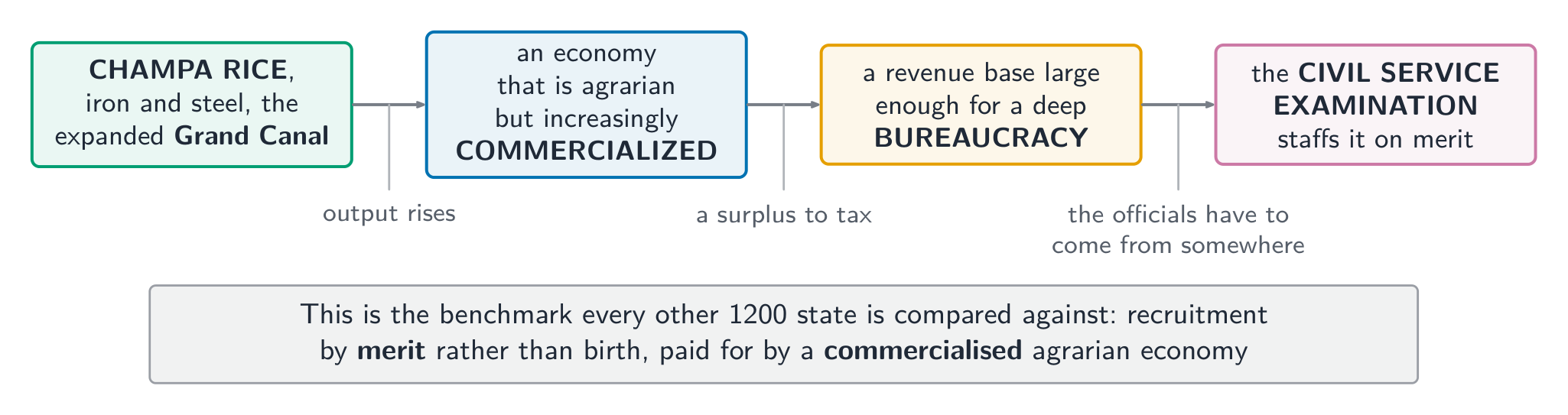
Build the Song engine
Champa rice, the canal and the examination are one chain, not three facts.
Match each term to its meaning.
Dificuldade 2/5 · Moedas 140 + pequeno bônus na primeira conclusão hoje
Belief and economy.
Worked example: two rice harvests
- Known: a field gives one harvest of ordinary rice a year, or two of Champa rice.
- Method: if each harvest gives 1 tonne, Champa rice gives 2 tonnes — twice the food.
- Effect: more food supported a larger population and freed people for crafts and trade, while taxes on the harvest paid for the bureaucracy.
A farm gives 1.5 tonnes per harvest. How many tonnes a year with Champa rice?
Dificuldade 2/5 · Moedas 140 + pequeno bônus na primeira conclusão hoje
2 × 1.5.
A commercial economy
- Commercialisation 商业化: farmers grew crops for sale, and the Song issued paper money.
- Industries grew: iron output may have reached about 125 000 tonnes a year by 1078, and porcelain and silk were made for export.
Chinese traditions travelled
- Korea, Japan and Vietnam adopted Confucian ideas, Chinese writing and Buddhist practices.
- Japan's capital, Heian (Kyoto), was laid out on the model of the Chinese capital.
Which places adopted Chinese traditions?
Dificuldade 2/5 · Moedas 140 + pequeno bônus na primeira conclusão hoje
East and Southeast Asia.
The exams did not mean anyone could rule. Studying for years cost money, so most successful candidates came from wealthy families.
The exams meant anyone, rich or poor, could easily become an official.
Dificuldade 1/5 · Moedas 100 + pequeno bônus na primeira conclusão hoje
Study cost money.
Song China ruled about 100 million people through a Confucian bureaucracy chosen by exams. Champa rice, paper money and growing industries made its economy the largest in the world, and Confucian and Buddhist traditions spread to Korea, Japan and Vietnam.
Explain how Song China's economy and government supported each other.
Connection.