Opposition From Several Directions
Introduzido| English | Significado |
|---|---|
| New Left | Target — the liberal leaders who ran both the war and an unequal society. |
| counterculture | The 1960s youth movement that rejected mainstream values of conformity and consumerism. |
Half a million in a muddy field, August 1969
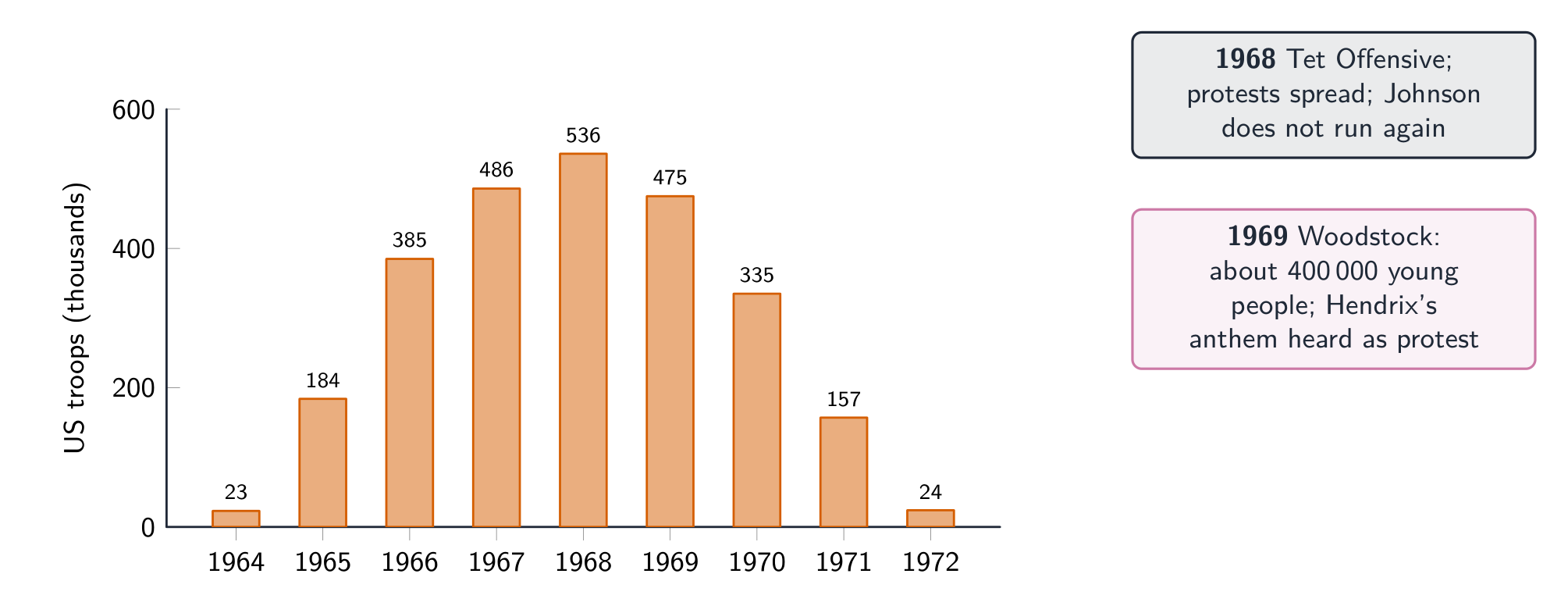
- In August 1969, about 400 000 young people came to a dairy farm near Bethel, New York, for the Woodstock music festival. Rain turned the fields to mud, food ran short, and roads were closed. Yet the three days passed mostly peacefully, and Jimi Hendrix played a distorted "Star-Spangled Banner" that many heard as a protest against the war.
- In the 1960s, opposition came from several directions: anti-war protesters, a New Left and a counterculture.
About how many thousand people came to Woodstock in 1969?
Dificuldade 2/5 · Moedas 140 + pequeno bônus na primeira conclusão hoje
About 400 000.
Anti-war protest was new in scale
- Earlier wars saw little protest at home. As troops in Vietnam grew, so did protest — by 1969, millions joined the Moratorium marches.
- Many young men burned their draft cards; the boxer Muhammad Ali refused the draft in 1967 and lost his title.
Muhammad Ali refused the draft in 1967.
Dificuldade 1/5 · Moedas 100 + pequeno bônus na primeira conclusão hoje
He lost his title.
Criticism from the left
- The New Left 新左派 — students such as Students for a Democratic Society (SDS) — said leaders did too little at home and followed immoral policies abroad. SDS's Port Huron Statement (1962) called for "participatory democracy".
- In 1964, students at Berkeley led the Free Speech Movement against limits on campus politics.
Anti-war, the left, or the counterculture?
Sort each element of 1960s opposition.
What did the Port Huron Statement call for?
Dificuldade 1/5 · Moedas 100 + pequeno bônus na primeira conclusão hoje
The SDS in 1962.
Worked example: three oppositions, three targets
- Anti-war protest: target — the war in Vietnam and the draft.
- New Left: target — the liberal leaders who ran both the war and an unequal society.
- Counterculture: target — mainstream values of work, dress and sex. The counterculture 反主流文化 promoted informality, rock music and changes in sexual norms.
Match each opposition to its target.
Dificuldade 2/5 · Moedas 140 + pequeno bônus na primeira conclusão hoje
Three targets.
The counterculture's effects
- Hippie communities in places such as San Francisco's Haight-Ashbury rejected materialism.
- Lasting effects: more informal dress and speech, and more open attitudes to sex — and a backlash from Americans who saw it as a threat.
Opposition and reaction
- In 1968, riots at the Democratic convention in Chicago and the assassinations of Martin Luther King and Robert Kennedy split the country.
- Nixon won in 1968 by appealing to the "silent majority" that opposed the protests.
Put these in order.
Dificuldade 3/5 · Moedas 200 + pequeno bônus na primeira conclusão hoje
1962, 1964, 1968, 1969.
Most young Americans were not hippies or radicals. Many young people supported the war or stayed out of politics, and in 1968 many voted for Nixon or George Wallace.
Most young Americans in the 1960s were hippies or radicals.
Dificuldade 1/5 · Moedas 100 + pequeno bônus na primeira conclusão hoje
Many supported the war or voted for Nixon.
In the 1960s, anti-war protesters, the New Left and the counterculture each opposed a different target — the war, liberal leaders and mainstream values. Woodstock showed the counterculture at its height, but the protests also produced a backlash that helped Nixon win in 1968.
Compare the targets of the anti-war movement, the New Left and the counterculture.
Comparison.