More Movements
Introduzido| English | Significado |
|---|---|
| feminism/ˈfemɪnɪzəm/ | The movement for women's equal rights with men in law, work and society. |
| counterculture | The 1960s youth movement that rejected mainstream values of conformity and consumerism. |
The grape boycott, 1965–70
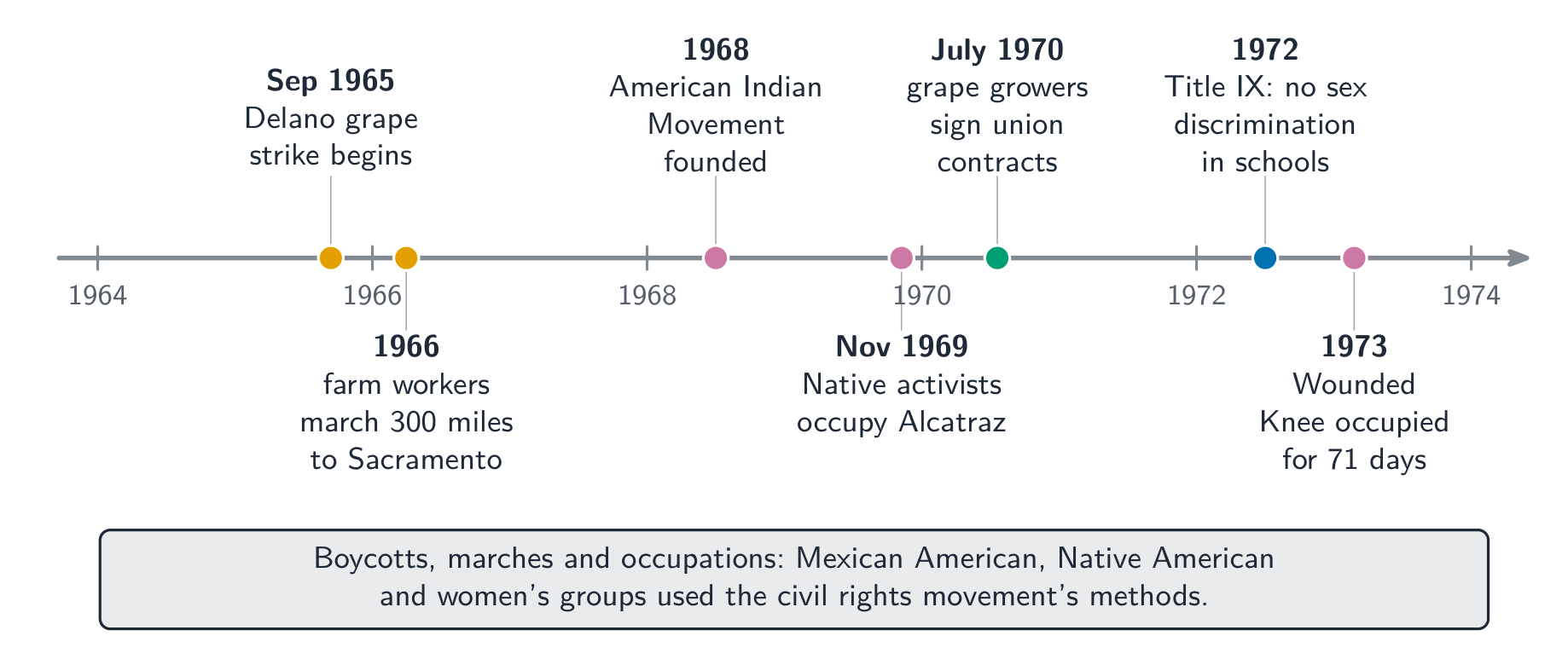
- In 1965, Filipino and Mexican American farm workers in Delano, California, went on strike for better pay. Led by César Chávez and Dolores Huerta of the United Farm Workers, they asked Americans to stop buying table grapes. Millions did, and in 1970 the growers signed union contracts.
- In the 1960s and 1970s, many groups borrowed the civil rights movement's methods.
What method did the United Farm Workers use to pressure grape growers?
Dificuldade 1/5 · Moedas 100 + pequeno bônus na primeira conclusão hoje
Millions stopped buying grapes.
Latino and American Indian movements
- The Chicano movement demanded fair pay, bilingual education and an end to discrimination; in 1968 thousands of students in East Los Angeles walked out of schools.
- The American Indian Movement (1968) demanded treaty rights and self-government. Activists occupied Alcatraz Island (1969–71) and Wounded Knee (1973).
Which places did American Indian activists occupy?
Dificuldade 2/5 · Moedas 140 + pequeno bônus na primeira conclusão hoje
Stonewall and Delano belong to other movements.
Asian American activism
- Students at San Francisco State in 1968 struck for ethnic studies, joining Black, Latino and Asian American groups. The term "Asian American" itself spread from these campaigns.
- Activists also sought redress for wartime internment, won in 1988.
Match each leader or group to its movement.
Dificuldade 2/5 · Moedas 140 + pequeno bônus na primeira conclusão hoje
Several movements.
Worked example: second-wave feminism
- Spark: Betty Friedan's The Feminine Mystique (1963) described the frustration of educated women confined to the home.
- Organization: the National Organization for Women (1966) campaigned for equal pay and against job discrimination.
- Results: Title IX (1972) banned sex discrimination in schools receiving federal money; Roe v. Wade (1973) legalized abortion. The Equal Rights Amendment passed Congress in 1972 but was not ratified after a campaign led by Phyllis Schlafly. Feminism 女权主义 won much, but divided Americans.
Which movement or claim?
Sort each element of 1960s-1970s activism.
Match each feminist milestone to its year.
Dificuldade 2/5 · Moedas 140 + pequeno bônus na primeira conclusão hoje
Second-wave milestones.
The Equal Rights Amendment was ratified and added to the Constitution.
Dificuldade 1/5 · Moedas 100 + pequeno bônus na primeira conclusão hoje
It was not ratified.
Gay rights
- In June 1969, police raided the Stonewall Inn, a gay bar in New York; the patrons fought back for several nights.
- Stonewall inspired gay liberation groups and the first pride marches in 1970.
The counterculture
- The counterculture 反主流文化 of the late 1960s rejected mainstream values: long hair, rock music, communes and opposition to the Vietnam War.
- It overlapped with these movements in questioning authority, though many activists rejected its lifestyle.
These movements did not start in the 1960s. Mexican Americans had organized since the League of United Latin American Citizens (1929); women had campaigned since Seneca Falls (1848). The 1960s made their demands louder and more widely heard.
Latino and women's organizing began only in the 1960s.
Dificuldade 1/5 · Moedas 100 + pequeno bônus na primeira conclusão hoje
LULAC (1929), Seneca Falls (1848).
Inspired by the civil rights movement, Latino, American Indian, Asian American, feminist and gay rights activists used strikes, boycotts, occupations, lawsuits and marches. They won laws such as Title IX and new recognition, but also met a strong conservative backlash.
Explain how the civil rights movement influenced other movements in the 1960s and 1970s.
Continuity and causation.