Civil Rights, 1960-1980
Introduzido| English | Significado |
|---|---|
| sit-in | A protest in which activists occupy seats in a segregated place and refuse to leave. |
| Voting Rights Act | The 1965 US law that sent federal officials to register Black voters and banned literacy tests. |
| Black Power/blæk ˈpaʊə/ | Malcolm X, and from 1966 Stokely Carmichael of SNCC, called for Black pride, self-defence and community control. |
A lunch counter in Greensboro, 1960
- On 1 February 1960, four Black college students sat down at the whites-only lunch counter of a Woolworth's store in Greensboro, North Carolina, and asked for coffee. They were refused but stayed until closing. Within weeks, sit-ins 静坐抗议 had spread to dozens of Southern cities.
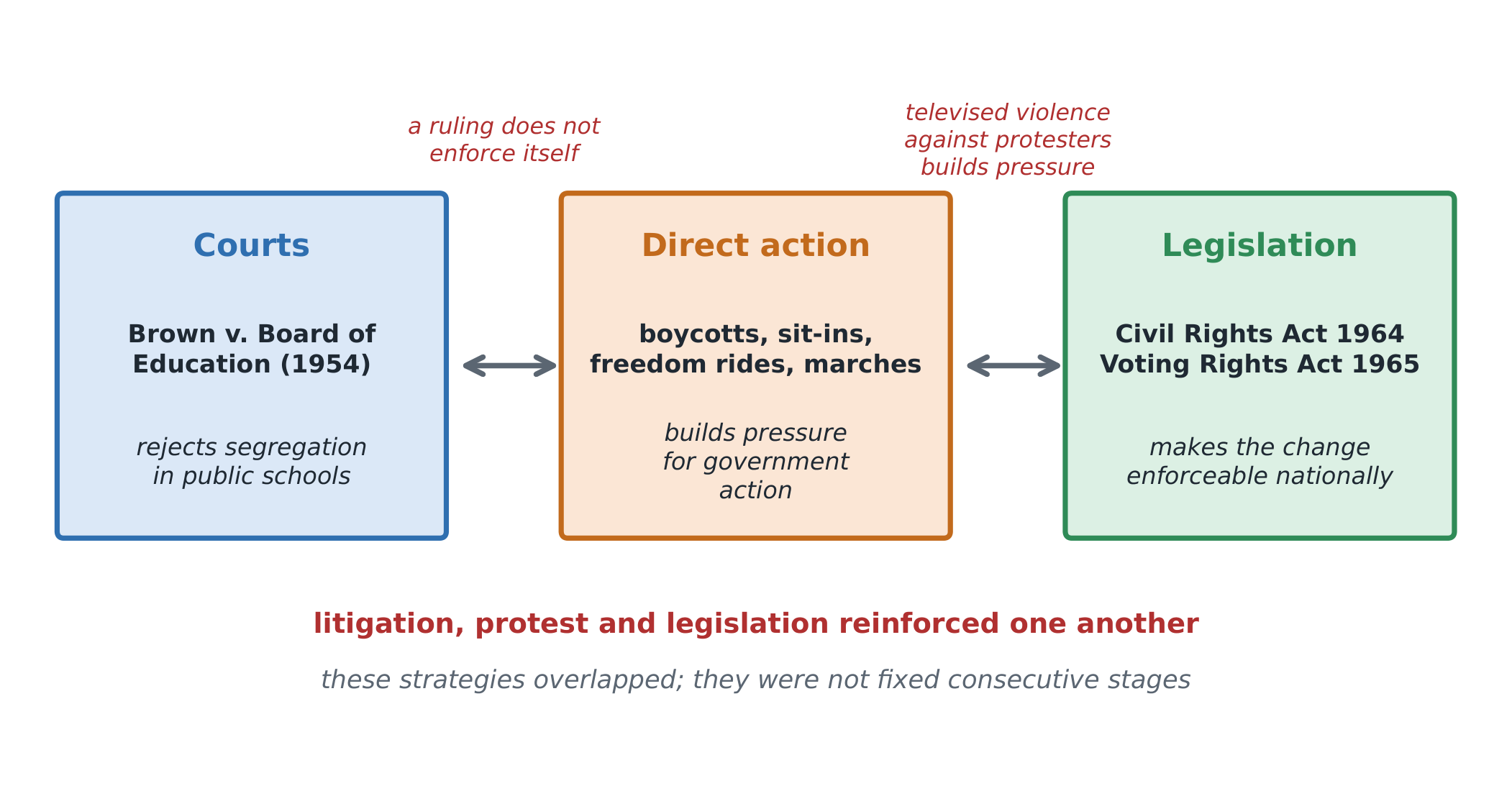
- In the 1960s, the movement used new strategies and won major laws.
Nonviolent direct action
- In 1961 Freedom Riders rode buses across the South to test integration; one bus was burned in Alabama.
- In Birmingham in 1963, police used dogs and fire hoses on marching children; the images shocked the world. That August, about 250 000 people joined the March on Washington, where King gave his "I Have a Dream" speech.
The federal response
- The Civil Rights Act of 1964 banned segregation in public places and discrimination in employment.
- After marchers were beaten at Selma in 1965, Congress passed the Voting Rights Act 选举权法, which sent federal officials to register voters. In Mississippi, Black registration rose from about 7% in 1964 to about 60% in 1968.
Put these events in order.
Dificuldade 3/5 · Moedas 200 + pequeno bônus na primeira conclusão hoje
1960, 1961, 1963, 1964, 1965.
Match each law to what it did.
Dificuldade 2/5 · Moedas 140 + pequeno bônus na primeira conclusão hoje
The two great laws.
Black voter registration in Mississippi rose from about 7% in 1964 to about 60% in 1968. By how many percentage points did it rise?
Dificuldade 2/5 · Moedas 140 + pequeno bônus na primeira conclusão hoje
60 − 7.
Worked example: two strategies compared
- King and nonviolence: integration through moral pressure, mass protest and federal law; the goal was equal rights within American society.
- Black Power 黑人权力运动: Malcolm X, and from 1966 Stokely Carmichael of SNCC, called for Black pride, self-defence and community control.
- Why they differed: laws had passed, but Northern cities still had poor housing, jobs and police violence, which nonviolent protest in the South had not changed.
A strategy, a form of resistance, or a federal measure?
Sort each element of the movement, 1960-1980.
Which ideas did Black Power emphasize?
Dificuldade 2/5 · Moedas 140 + pequeno bônus na primeira conclusão hoje
Impatience with gradual change.
Unrest in the cities
- Riots broke out in Watts, Los Angeles (1965), Detroit and Newark (1967). The Kerner Commission (1968) blamed "white racism" and warned of "two societies, one black, one white".
- King was assassinated in Memphis in April 1968, and riots followed in over 100 cities.
The Kerner Commission warned of "two societies, one black, one white".
Dificuldade 1/5 · Moedas 100 + pequeno bônus na primeira conclusão hoje
1968.0
Continuing debates
- In the 1970s, courts ordered busing to integrate schools, which met strong resistance, as in Boston in 1974.
- Affirmative action in hiring and universities became a lasting debate.
The movement was not one strategy with one leader. King, SNCC students, the NAACP's lawyers and Black Power activists disagreed about methods and goals. Explain the differences, not just the famous speeches.
All civil rights activists agreed on nonviolent integration as the only method.
Dificuldade 1/5 · Moedas 100 + pequeno bônus na primeira conclusão hoje
Strategies differed.
From 1960, sit-ins, Freedom Rides and mass marches pushed Congress to pass the Civil Rights Act (1964) and the Voting Rights Act (1965). Frustration with continuing inequality, especially in Northern cities, led to Black Power and urban unrest, and debates over busing and affirmative action continued.
Explain why some activists turned from nonviolence to Black Power after 1965.
Causation.