Conformity and Its Challengers
Introduzido| English | Significado |
|---|---|
| conformity/kənˈfɔːmɪti/ | Changing one's behaviour or expressed beliefs to align with a group or its perceived expectations. |
| youth culture/juːθ ˈkʌltʃə/ | Styles and music identified with teenagers in the postwar decades. |
| Beat | A 1950s group of writers, such as Ginsberg and Kerouac, who rejected materialism and conformity. |
A poem on trial, 1957
- In 1957, police in San Francisco arrested the bookseller Lawrence Ferlinghetti for selling Allen Ginsberg's poem Howl, which described drugs, sex and despair among young Americans. "I saw the best minds of my generation destroyed by madness," it began. In October, a judge ruled the poem was not obscene because it had "redeeming social importance". Sales soared.
- In the 1950s, mass media spread a culture of conformity — and artists, young people and others challenged it.
What did the judge rule about Howl in 1957?
Dificuldade 1/5 · Moedas 100 + pequeno bônus na primeira conclusão hoje
Sales soared.
Television spreads a shared culture
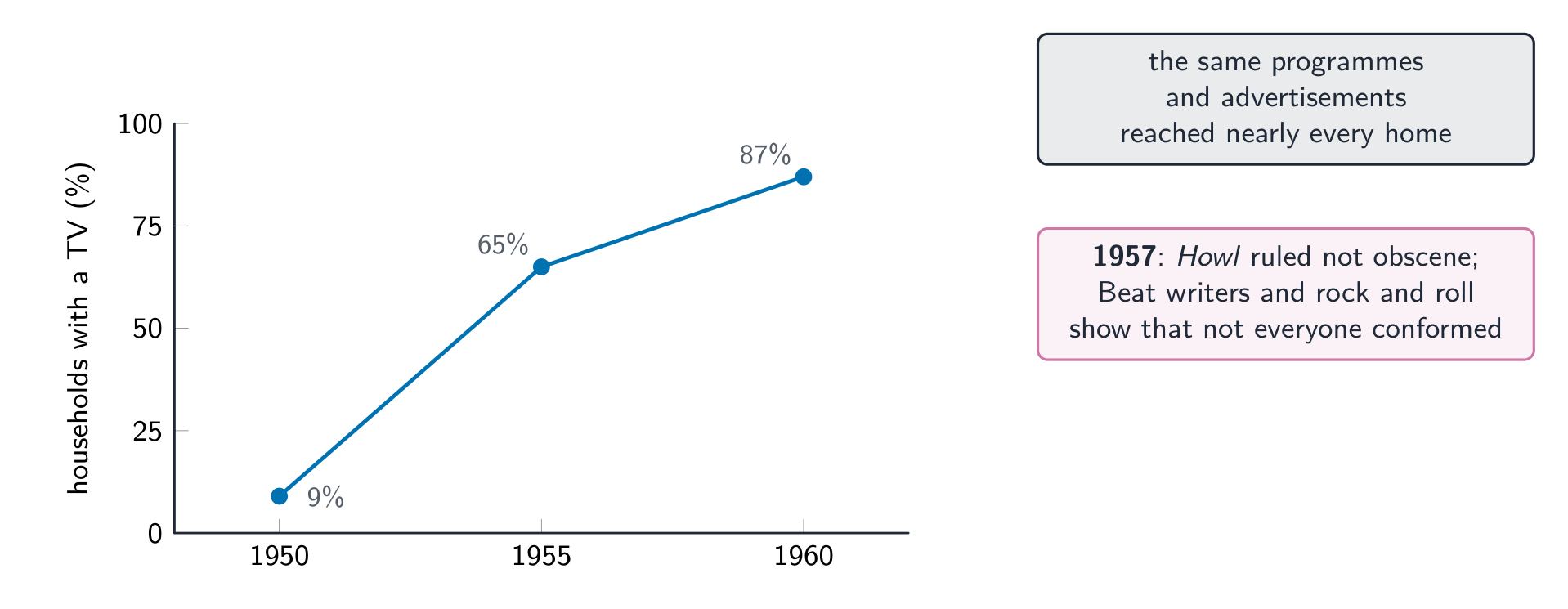
- Television ownership rose from about 9% of households in 1950 to about 87% in 1960. Shows such as Leave It to Beaver presented white suburban families with a working father and a homemaker mother.
- Advertising on television encouraged everyone to buy the same products.
TV ownership rose from about 9% to about 87% of households. By how many percentage points?
Dificuldade 2/5 · Moedas 140 + pequeno bônus na primeira conclusão hoje
87 − 9.
Conformity and its critics
- Conformity 从众 meant fitting in — in dress, work, religion and family life. Many Americans valued it after the Depression and war.
- Critics such as William Whyte, in The Organization Man (1956), warned that corporate life crushed individuality.
The dominant culture, a challenger, or the demographic reason?
Sort each element of postwar culture.
Worked example: youth as a separate culture
- Music: rock and roll, drawing on Black rhythm and blues, reached white teenagers. About 60 million people watched Elvis Presley on The Ed Sullivan Show in 1956.
- Film: Rebel Without a Cause (1955) showed teenagers rejecting their parents' values.
- Why youth stood out: teenagers had more money and free time than any generation before, so businesses created a separate youth culture 青年文化 for them.
Why did a separate youth culture develop?
Dificuldade 1/5 · Moedas 100 + pequeno bônus na primeira conclusão hoje
Businesses created products for them.
The Beats and other challengers
- Beat 垮掉的一代 writers such as Ginsberg and Jack Kerouac (On the Road, 1957) rejected materialism and conformity.
- Many women felt trapped in the homemaker role — a feeling Betty Friedan would describe in 1963.
Match each person or work to its challenge.
Dificuldade 2/5 · Moedas 140 + pequeno bônus na primeira conclusão hoje
Challengers.
Maintained and challenged
- Conformity remained strong: church membership reached record levels in the 1950s.
- But the challengers of the 1950s laid the groundwork for the counterculture and movements of the 1960s.
Church membership reached record levels in the 1950s.
Dificuldade 1/5 · Moedas 100 + pequeno bônus na primeira conclusão hoje
Conformity remained strong.
The 1950s were not simply a decade of conformity. Rock and roll, the Beats, civil rights activists and unhappy homemakers all challenged the dominant culture.
Nobody challenged conformity in the 1950s.
Dificuldade 1/5 · Moedas 100 + pequeno bônus na primeira conclusão hoje
Many challengers.
Television spread a shared culture of suburban conformity, and many Americans valued fitting in. But critics, rock and roll, a new youth culture and Beat writers like Ginsberg challenged it, preparing the way for the movements of the 1960s.
To what extent was American culture in the 1950s one of conformity?
Extent.