Growth and the Suburbs
Introduzido| English | Significado |
|---|---|
| suburb/ˈsʌbɜːb/ | A residential area at the edge of a city, from which people often travel to work in the city. |
| Sun Belt/sʌn belt/ | The southern and western states that gained people and jobs after mid-century. |
| redlining | The refusal of banks and federal agencies to lend in neighbourhoods marked as risky, usually Black neighbourhoods. |
Thirty houses a day on Long Island, 1947
- In 1947, the builder William Levitt began building houses on potato fields on Long Island, New York. His workers moved from plot to plot like an assembly line, finishing up to 30 houses a day. Levittown grew to about 17 000 homes, sold mostly to young veterans with GI Bill loans. The contracts banned sales to Black families.
- After 1945, the United States enjoyed the longest economic boom in its history, and millions moved to suburbs and the Sun Belt.
Who was banned from buying homes in Levittown?
Dificuldade 1/5 · Moedas 100 + pequeno bônus na primeira conclusão hoje
Contracts banned sales to Black families.
Causes of growth
- Spending: consumers spent wartime savings, and Cold War military spending stayed high.
- Energy and technology: cheap oil and new technologies such as television and computers; American industry faced little foreign competition after the war.
Which caused the postwar boom?
Dificuldade 2/5 · Moedas 140 + pequeno bônus na primeira conclusão hoje
Little foreign competition after the war.
Mobility moved people twice
- Families moved from cities to suburbs 郊区, using cars and new roads. The Interstate Highway Act (1956) funded about 66 000 km of highways.
- Black families were largely shut out of the suburbs by redlining 红线政策 — banks and the federal government refusing loans in Black neighbourhoods.
A cause of growth, a driver of mobility, or a result?
Sort each element of postwar affluence.
What was redlining?
Dificuldade 1/5 · Moedas 100 + pequeno bônus na primeira conclusão hoje
It shaped who could move.
Worked example: the Sun Belt
- Jobs: defence and aerospace industries grew in California, Texas and Florida.
- Comfort: air conditioning made hot regions pleasant to live and work in all year.
- Result: California became the most populous state by 1962, and the South and West gained seats in Congress — the Sun Belt 阳光地带 became a political force.
Match each cause to the Sun Belt's growth.
Dificuldade 2/5 · Moedas 140 + pequeno bônus na primeira conclusão hoje
The Sun Belt.
Education as an engine
- The GI Bill sent millions to college. After the Soviet satellite Sputnik (1957), the National Defense Education Act (1958) funded science, maths and languages.
- College enrolment grew from about 2.4 million in 1949 to about 8 million by 1970.
College enrolment grew from about 2.4 million in 1949 to about 8 million by 1970. By how many million did it grow?
Dificuldade 2/5 · Moedas 140 + pequeno bônus na primeira conclusão hoje
8 − 2.4.
Who was left out
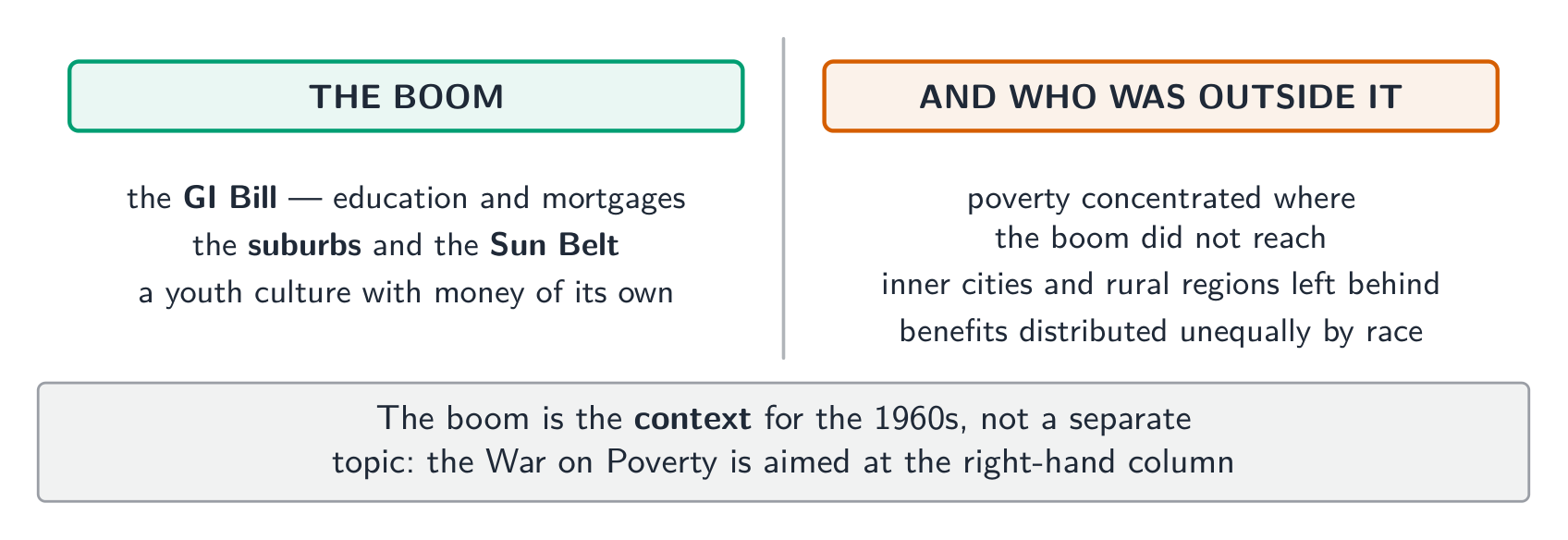
- Inner cities lost jobs and taxpayers as white families moved out. Rural Appalachia and many Native reservations stayed poor.
- Prosperity reached white middle-class families far more than others.
Suburban growth was shaped by government policy. Federal loans, highways and redlining decided who could move to the suburbs, not only free choice.
Suburban growth was purely the result of free choice, without government policy.
Dificuldade 1/5 · Moedas 100 + pequeno bônus na primeira conclusão hoje
Loans, highways and redlining.
Consumer spending, military spending, cheap energy and new technology drove a long postwar boom. Federal loans and highways helped families move to suburbs like Levittown, while redlining excluded Black families. The Sun Belt rose, and education expanded — but cities and the rural poor were left behind.
Explain how federal policy shaped the growth of the suburbs after 1945.
Causation.