The Postwar Red Scare
Introduzido| English | Significado |
|---|---|
| Lavender Scare | The firing of gay and lesbian government workers as so-called security risks in the 1950s. |
| blacklist | A list of people who are refused work, as in the Hollywood blacklist of suspected communists. |
| McCarthyism/mə ˈkɑːðiɪzəm/ | Accusations of disloyalty, often with little evidence, in the early 1950s. |
"I have here in my hand a list", February 1950
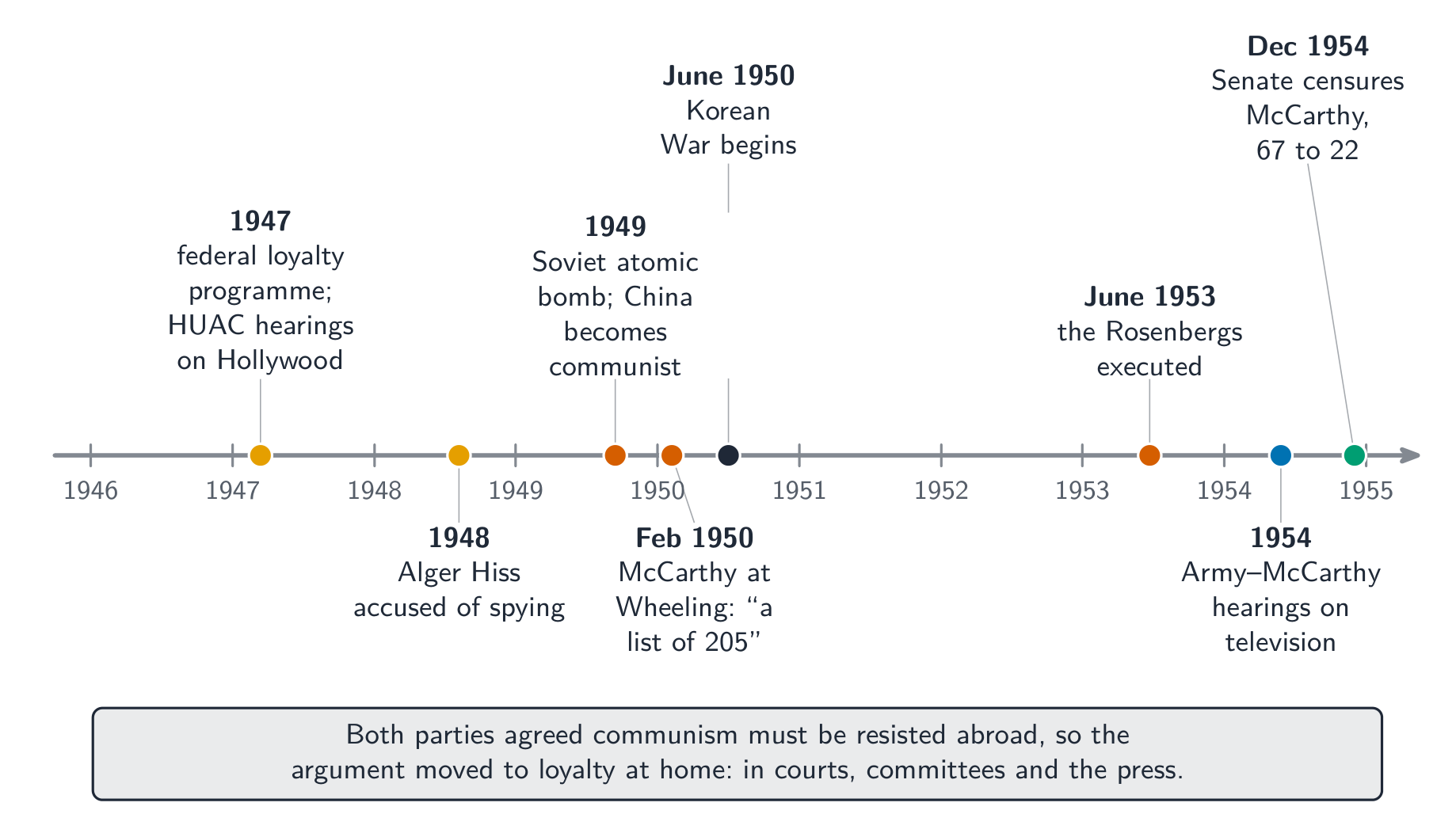
- On 9 February 1950, Senator Joseph McCarthy of Wisconsin told a women's Republican club in Wheeling, West Virginia, that he had a list of 205 State Department employees who were members of the Communist Party. He never produced the list, and the number changed in later speeches. But the charge made him famous, and for four years he led a campaign of accusations.
- After 1945, fear of communism at home led to a second Red Scare.
What did McCarthy claim at Wheeling in 1950?
Dificuldade 1/5 · Moedas 100 + pequeno bônus na primeira conclusão hoje
He never produced the list.
Agreement on ends, dispute over means
- Most Democrats and Republicans agreed that communism must be contained abroad and resisted at home.
- They argued about how far to go: how much to investigate, and whose rights to limit.
A second Red Scare
- In 1947, President Truman ordered loyalty checks for federal workers. The House Un-American Activities Committee (HUAC) investigated Hollywood; ten writers and directors who refused to answer were jailed.
- Spy cases, such as the conviction of Alger Hiss (1950) and the execution of Julius and Ethel Rosenberg (1953), increased fears.
The agreed strategy, the disputed methods, or the pattern?
Sort each element of the postwar Red Scare.
Truman's loyalty checks began before McCarthy's campaign.
Dificuldade 1/5 · Moedas 100 + pequeno bônus na primeira conclusão hoje
1947.0
Worked example: who the methods reached
- Government: thousands of federal employees were investigated; many lost jobs on weak evidence. Thousands of gay and lesbian workers were also fired as "security risks" — the Lavender Scare 薰衣草恐慌.
- Culture: Hollywood studios created a blacklist 黑名单 of writers and actors who could not get work.
- Unions and teachers: unions expelled communist members, and many states required teachers to sign loyalty oaths.
Match each group to how the Red Scare reached it.
Dificuldade 2/5 · Moedas 140 + pequeno bônus na primeira conclusão hoje
Who the methods reached.
McCarthy's fall
- In 1954, the Army–McCarthy hearings were shown on television. When the army's lawyer Joseph Welch asked, "Have you no sense of decency, sir?", public opinion turned.
- The Senate censured McCarthy in December 1954 by 67 votes to 22.
The Senate censured McCarthy by 67 votes to 22. How many senators voted?
Dificuldade 2/5 · Moedas 140 + pequeno bônus na primeira conclusão hoje
67 + 22.
Causes and effects
- Causes: the Soviet atomic bomb (1949), China's communist revolution (1949), the Korean War and real spy cases.
- Effects: fear limited free speech and political debate for years; McCarthyism 麦卡锡主义 became a word for unfair accusations.
Which events increased fear of communism?
Dificuldade 2/5 · Moedas 140 + pequeno bônus na primeira conclusão hoje
Causes of the second Red Scare.
The Red Scare was not only McCarthy. Truman's loyalty program, HUAC and state laws began before him and continued after him. Both parties took part.
The Red Scare was carried out by McCarthy alone.
Dificuldade 1/5 · Moedas 100 + pequeno bônus na primeira conclusão hoje
Both parties and many institutions took part.
Both parties agreed on fighting communism but argued over methods. Loyalty checks, HUAC, spy trials and McCarthy's accusations made a second Red Scare that reached federal workers, Hollywood, unions and gay Americans, until televised hearings and censure ended McCarthy's power in 1954.
Explain the causes and effects of the second Red Scare.
Cause and effect.