The Great Depression
Introduzido| English | Significado |
|---|---|
| liberalism/ˈlɪbərəlɪzəm/ | A political tradition emphasising individual rights, constitutional government and limits on arbitrary power. |
| New Deal | President Franklin Roosevelt's programs of the 1930s for relief, recovery and reform during the Great Depression. |
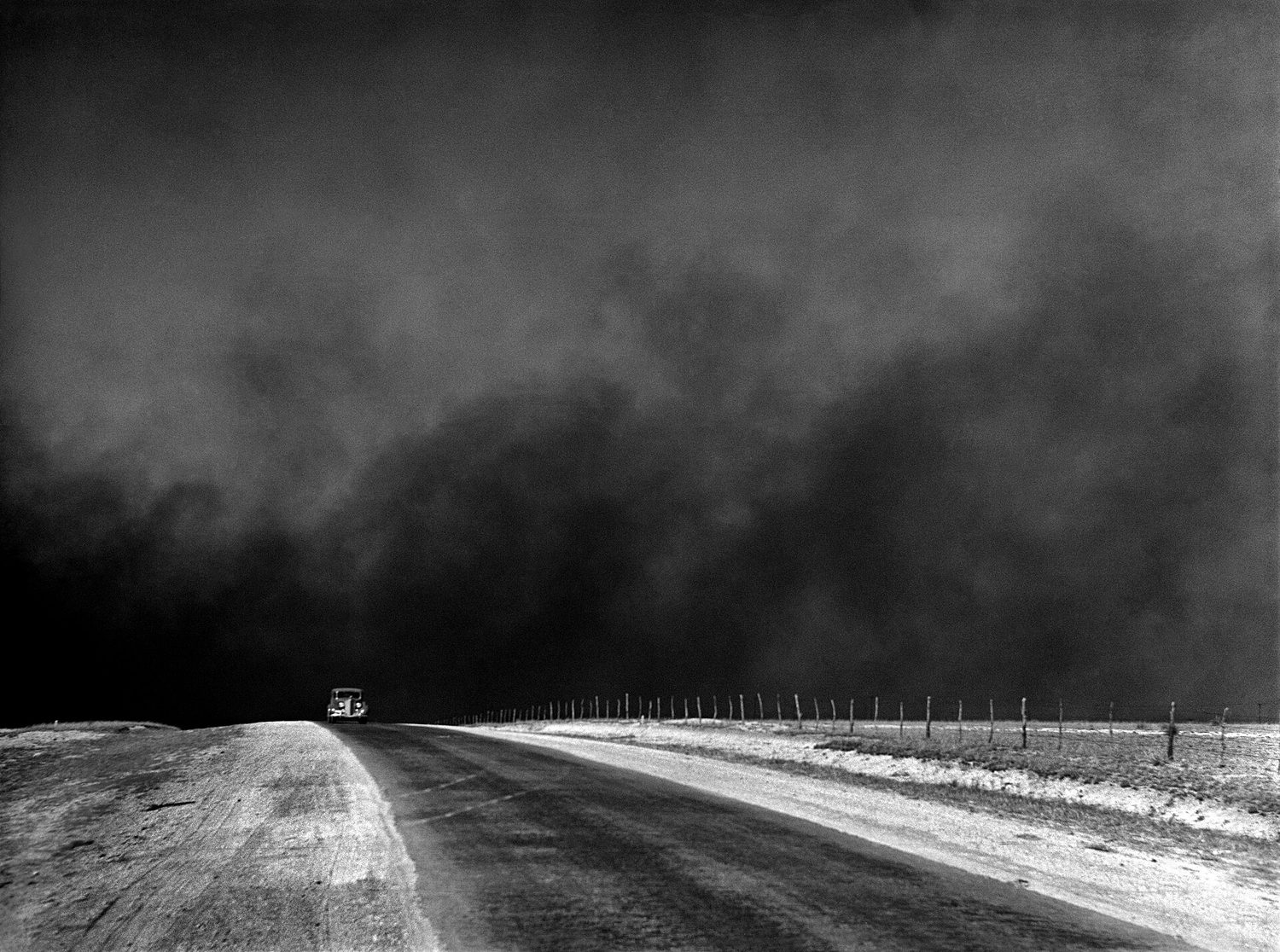
Black Sunday, 14 April 1935
- On the afternoon of 14 April 1935, a black wall of dust thousands of feet high rolled across the southern Great Plains. People in Oklahoma and Texas could not see their own hands. The storm carried millions of tons of topsoil from farms ploughed during the wheat boom of the 1920s. A reporter called the region the "Dust Bowl".
- The Great Depression (1929–41) was the worst economic crisis in American history, and the response changed the meaning of liberalism.
What caused the Dust Bowl?
Dificuldade 1/5 · Moedas 100 + pequeno bônus na primeira conclusão hoje
Nothing held the soil.
Instability, not a single crash
- The stock market crashed in October 1929, but the deeper causes were weak banks, too much debt, falling farm prices and unequal incomes that limited buying.
- About 9000 banks failed between 1930 and 1933, and savers lost their money.
Which were deeper causes of the Depression?
Dificuldade 2/5 · Moedas 140 + pequeno bônus na primeira conclusão hoje
Instability, not a single crash.
About how many banks failed between 1930 and 1933?
Dificuldade 2/5 · Moedas 140 + pequeno bônus na primeira conclusão hoje
Savers lost their money.
The human cost
- By 1933, about a quarter of the workforce — some 13 million people — was unemployed.
- Families lost homes and farms; shanty towns called "Hoovervilles" grew in cities.
Follow the Depression from crash to politics
The economic collapse is the context; the political response is what the exam asks about.
About what fraction of the workforce was unemployed by 1933? Give it as a percentage.
Dificuldade 2/5 · Moedas 140 + pequeno bônus na primeira conclusão hoje
About 13 million people.
Worked example: the Dust Bowl
- Cause: farmers ploughed up the grasslands of the southern Plains to grow wheat; when drought came in the 1930s, nothing held the soil.
- Effect: dust storms destroyed crops; about 2.5 million people left the Plains states, many for California.
- Response: the government created the Soil Conservation Service (1935) and paid farmers to plant trees and change ploughing methods.
The response redefined liberalism
- Earlier, liberalism had meant limited government. Franklin Roosevelt's New Deal 罗斯福新政 used federal power for relief, recovery and reform.
- Now liberalism 自由主义 came to mean an active government that protected people against economic hardship.
The New Deal changed liberalism to mean active government protecting people.
Dificuldade 1/5 · Moedas 100 + pequeno bônus na primeira conclusão hoje
Redefined liberalism.
A transition still under way
- The Depression sped up the move from farms to cities and from small firms to large ones.
- Many African Americans moved from the Republican Party to the Democrats because of New Deal relief.
The 1929 crash did not cause the Depression on its own. Bank failures, debt, falling farm prices and unequal incomes turned a stock crash into a long depression.
The stock market crash alone caused the Great Depression.
Dificuldade 1/5 · Moedas 100 + pequeno bônus na primeira conclusão hoje
Many causes.
Weak banks, debt, farm troubles and inequality turned the 1929 crash into a depression: 9000 banks failed and a quarter of workers lost their jobs. The Dust Bowl drove millions from the Plains. The New Deal's response redefined liberalism as active government protecting people.
Explain the causes of the Great Depression.
Causation.