War, Fear and the Great Migration
Introduzido| English | Significado |
|---|---|
| Sedition Act | the 1918 law that made it a crime to criticise the government, the war or the armed forces |
| Red Scare | The 1919-20 wave of fear of communists and radicals, marked by the Palmer Raids and deportations. |
| Great Migration/ɡreɪt maɪˈɡreɪʃn/ | The early-twentieth-century movement of African Americans out of the South to cities in the North and the West. |
A speech in Canton, Ohio, June 1918
- On 16 June 1918 the Socialist leader Eugene Debs told a crowd in Canton, Ohio, that wars were fought by workers for the profit of the rich. He was arrested under the Sedition Act and sentenced to ten years in prison. In 1920 he ran for president from his cell and won almost a million votes.
- During and after the First World War, fear of radicals and immigrants restricted freedoms, while war work set off a great movement of people inside the country.
Why was Eugene Debs sent to prison in 1918?
Dificuldade 1/5 · Moedas 100 + pequeno bônus na primeira conclusão hoje
Ten years for a speech.
Speech restricted
- The Espionage Act (1917) and the Sedition Act 煽动法 (1918) made it a crime to criticise the war, the draft or the government. In Schenck v. United States (1919) the Supreme Court upheld them: speech that created a "clear and present danger" could be punished.
- German Americans were harassed, and some states banned teaching German.
In Schenck v. United States (1919), speech that created a "clear and present ____" could be punished.
Dificuldade 1/5 · Moedas 100 + pequeno bônus na primeira conclusão hoje
The Court upheld the Espionage Act.
The Red Scare
- After the Russian Revolution, a wave of strikes in 1919 and a series of bombs sent to officials, Attorney General A. Mitchell Palmer ordered raids. In January 1920 thousands of suspected radicals were arrested, and hundreds of immigrants were deported. This was the first Red Scare 红色恐慌.
- In 1921 the Italian immigrants Sacco and Vanzetti were convicted of murder after a trial many saw as biased against foreign-born anarchists. They were executed in 1927.
The Palmer Raids of 1920 arrested thousands of suspected radicals.
Dificuldade 1/5 · Moedas 100 + pequeno bônus na primeira conclusão hoje
Hundreds of immigrants were deported.
Worked example: how the 1924 quota worked. The Immigration Act of 1924 let in each year 2% of the number of people from each country living in the US in 1890. Because few Italians and Poles lived in America in 1890, their quotas were tiny, while Britain's and Germany's were large. Immigrants from Asia were almost entirely barred. The date 1890 was chosen on purpose: it cut the "new immigrants" from southern and eastern Europe.
Why did the 1924 Act base its quotas on the 1890 census?
Dificuldade 1/5 · Moedas 100 + pequeno bônus na primeira conclusão hoje
It cut the "new immigrants".
The Great Migration
- With immigration cut off by the war, Northern factories recruited Black workers from the South. About half a million Black Southerners moved north between 1916 and 1919, escaping Jim Crow laws and lynching. This was the beginning of the Great Migration 大迁徙.
- Chicago's Black population grew from about 44 000 in 1910 to 109 000 in 1920; Detroit's grew sevenfold.
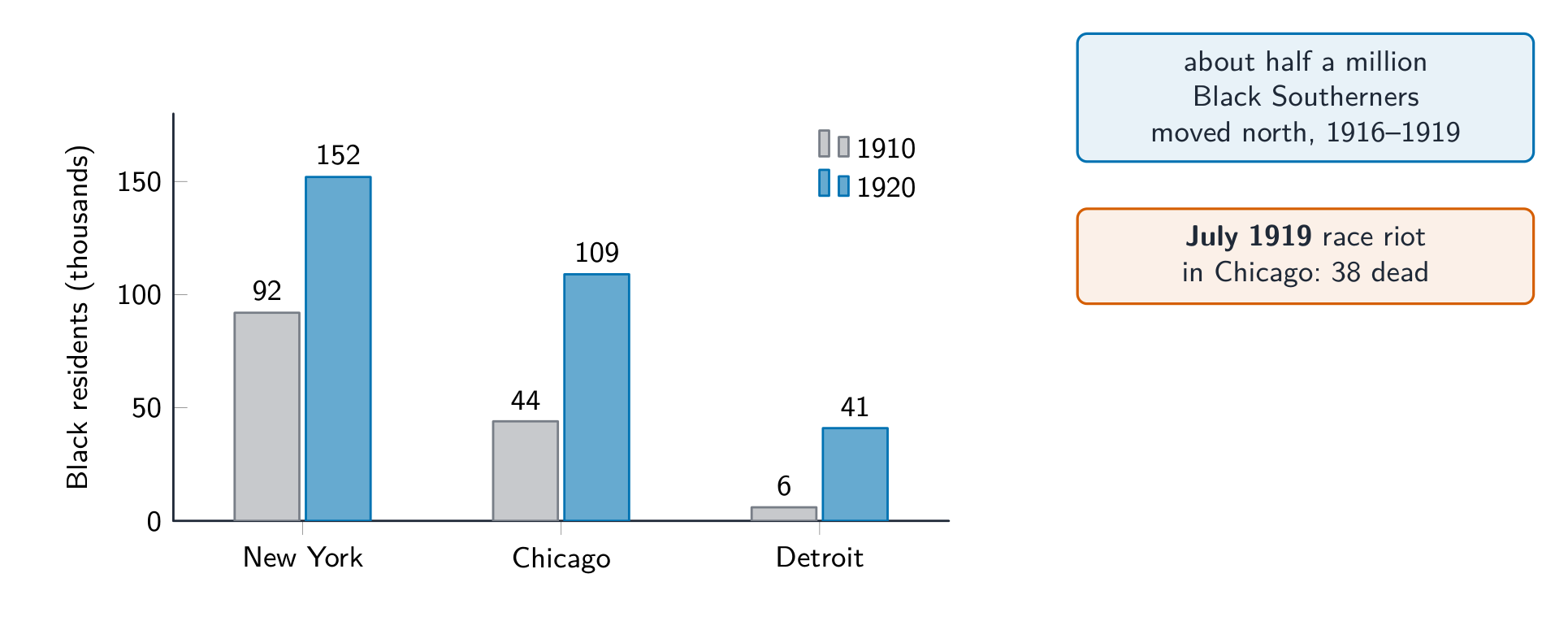
About how did Chicago's Black population change from 1910 to 1920?
Dificuldade 1/5 · Moedas 100 + pequeno bônus na primeira conclusão hoje
More than doubled.
The Red Summer of 1919
- Competition for jobs and housing led to violence. In July 1919 a Black teenager swimming in Lake Michigan drifted towards a "white" beach and was stoned and drowned; in the riot that followed in Chicago, 38 people died.
- Black veterans who had fought in France were less willing to accept second-class citizenship, and the NAACP grew quickly.
Restriction or movement?
Sort each development of 1917-1924.
Put these in order.
Dificuldade 3/5 · Moedas 200 + pequeno bônus na primeira conclusão hoje
1917, 1918, 1919, 1920, 1924.
Connect the international and the internal. The war cut immigration, which pulled Black Southerners north; the Russian Revolution fed the Red Scare at home. An answer that treats the home front separately from the war misses the cause.
During and after the First World War, the Espionage and Sedition Acts punished criticism (Debs got ten years), and the Red Scare of 1919–20 led to the Palmer Raids and deportations. Quotas in 1921 and 1924 cut immigration from southern and eastern Europe and Asia, while about half a million Black Southerners moved to Northern cities, where they met both opportunity and the violence of 1919.
Explain how the First World War changed both civil liberties and migration in the United States.
International and internal together.