The First World War
Introduzido| English | Significado |
|---|---|
| neutrality | The policy of not taking sides in a war between other countries. |
| League of Nations/liːɡ ɒv ˈneɪʃnz/ | The international organisation proposed by Wilson after the First World War, which the United States never joined. |
| isolationism | A policy of staying out of other countries' affairs and alliances. |
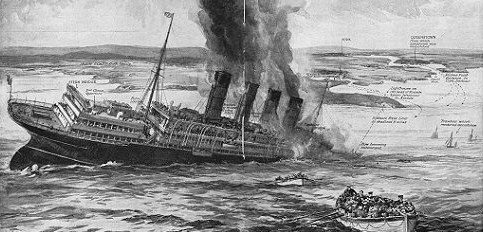
The Lusitania, 1915
- On 7 May 1915, a German submarine sank the British liner Lusitania off Ireland. 1198 people died, 128 of them Americans. Many Americans were outraged, but President Woodrow Wilson kept the country neutral for nearly two more years.
- The United States entered the First World War late, but its role was decisive.
Neutrality
- When war broke out in 1914, Wilson declared neutrality 中立. Many Americans had family ties to Germany or Ireland and wanted no part in Europe's war.
- But American banks lent heavily to Britain and France, and trade with them boomed.
The United States declared neutrality when the war began in 1914.
Dificuldade 1/5 · Moedas 100 + pequeno bônus na primeira conclusão hoje
Wilson's policy until 1917.
Into the war, 1917
- In February 1917 Germany resumed unrestricted submarine warfare, sinking American ships. The Zimmermann Telegram, published in March, revealed a German offer to help Mexico regain Texas, New Mexico and Arizona.
- Congress declared war in April 1917; Wilson said the world "must be made safe for democracy".
Which events in 1917 led directly to the US declaring war?
Dificuldade 2/5 · Moedas 140 + pequeno bônus na primeira conclusão hoje
The Lusitania was 1915.
Worked example: why the US went to war
- Long-term: economic ties to Britain and France; anger since the Lusitania.
- Short-term triggers: unrestricted submarine warfare (February 1917) and the Zimmermann Telegram (March 1917).
- Ideals: Wilson framed war as a fight for democracy. The triggers explain the timing; the ties and ideals explain the side.
Follow the United States into the war and out of it
The war's domestic effects are what a period-7 prompt usually asks about, not the fighting.
Put these events in order.
Dificuldade 3/5 · Moedas 200 + pequeno bônus na primeira conclusão hoje
1915, 1917, 1917, 1918, 1919–20.
A late but decisive role
- About 2 million American soldiers reached France by November 1918. Fresh troops and supplies helped stop Germany's last offensives.
- About 116 000 Americans died, far fewer than the millions lost by European powers.
About how many American soldiers reached France by November 1918?
Dificuldade 1/5 · Moedas 100 + pequeno bônus na primeira conclusão hoje
Fresh troops helped decide the war.
The peace and the Senate
- Wilson's Fourteen Points (1918) proposed open diplomacy, free trade, self-determination and a League of Nations 国际联盟.
- Senators led by Henry Cabot Lodge feared the League would drag the US into future wars. The Senate rejected the Treaty of Versailles, and the US never joined the League — a return to isolationism 孤立主义.
Why did senators such as Henry Cabot Lodge oppose the League of Nations?
Dificuldade 1/5 · Moedas 100 + pequeno bônus na primeira conclusão hoje
Concerns about sovereignty and war.
The Lusitania did not bring the US into the war. It sank in 1915; the US declared war in 1917. Unrestricted submarine warfare and the Zimmermann Telegram were the immediate causes.
The US declared war immediately after the Lusitania sank.
Dificuldade 1/5 · Moedas 100 + pequeno bônus na primeira conclusão hoje
Almost two years later.
The US stayed neutral from 1914 but grew tied to Britain and France. Unrestricted submarine warfare and the Zimmermann Telegram brought it into the war in 1917, where fresh troops helped decide the outcome. The Senate's rejection of the League showed the debate over America's world role was far from over.
Explain why the United States entered the First World War in 1917 and not earlier.
Causation.