Progressives, and Their Divisions
Introduzido| English | Significado |
|---|---|
| muckraker | A journalist of the Progressive era who exposed corruption and abuses in business and government. |
| initiative and referendum | Progressive reforms that let voters propose new laws and approve or reject them directly. |
A novel that hit the stomach, 1906
- In 1906, Upton Sinclair published The Jungle, a novel about immigrant workers in Chicago's meatpacking plants. He wanted readers to feel for the workers. Instead, they were horrified by his descriptions of rats, filth and diseased meat. "I aimed at the public's heart," Sinclair said, "and by accident I hit it in the stomach." Within months, Congress passed the Meat Inspection Act and the Pure Food and Drug Act.
- From about 1890 to 1920, Progressives used journalism, laws and government to fix the problems of industrial America — though they disagreed among themselves.
What was a result of The Jungle?
Dificuldade 1/5 · Moedas 100 + pequeno bônus na primeira conclusão hoje
1906.0
Journalists and reformers
- Muckrakers 揭发丑闻的记者 exposed corruption and abuse: Ida Tarbell investigated Standard Oil (1902–04), and Jacob Riis photographed New York's slums in How the Other Half Lives (1890).
- Most Progressives were middle-class, educated and urban.
Match each muckraker to their subject.
Dificuldade 2/5 · Moedas 140 + pequeno bônus na primeira conclusão hoje
Exposing abuses.
Divided on four issues
- Race: most white Progressives ignored or supported segregation; President Wilson segregated federal offices in 1913.
- Immigration, prohibition and women's suffrage: some Progressives wanted to restrict immigrants or ban alcohol; others defended immigrants; many, but not all, supported votes for women.
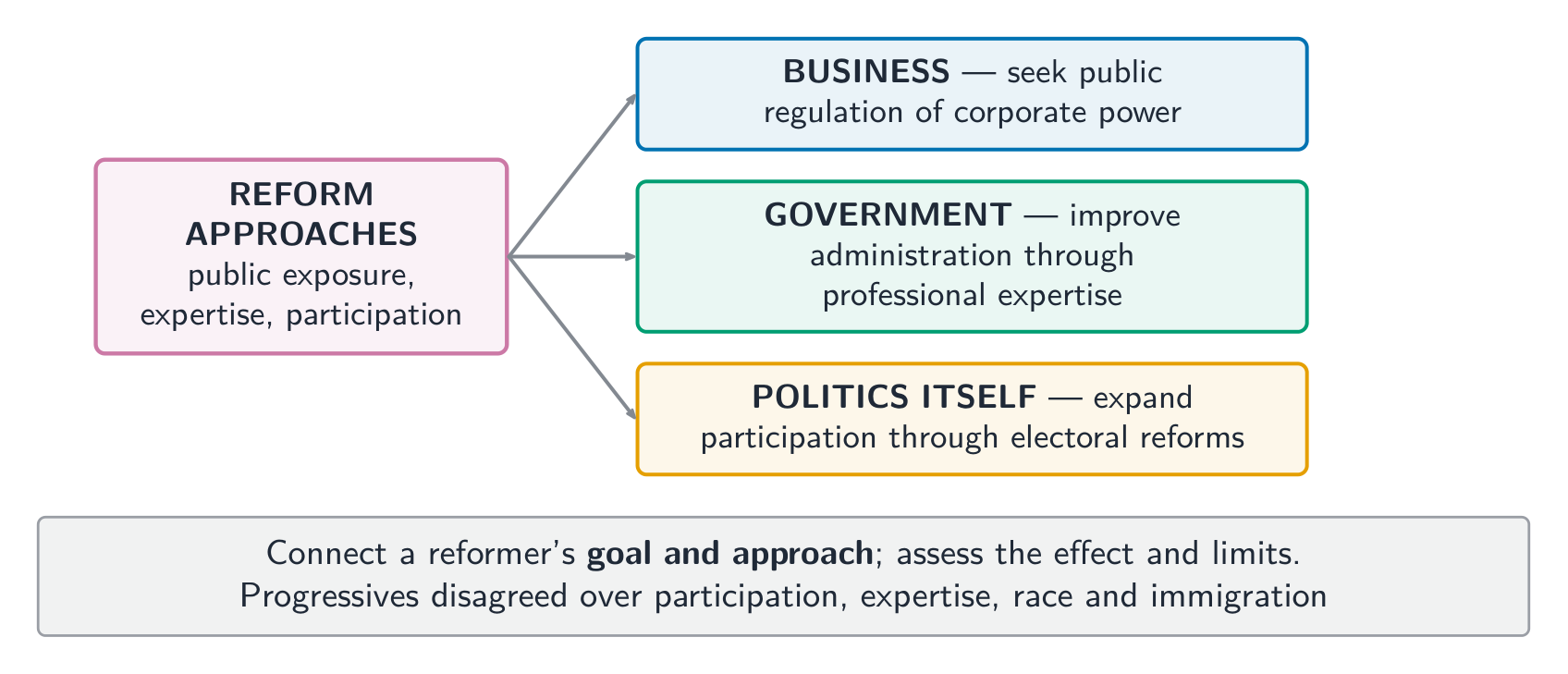
A method, a division, or a national aim?
Sort each element of Progressive reform.
President Wilson segregated federal offices in 1913.
Dificuldade 1/5 · Moedas 100 + pequeno bônus na primeira conclusão hoje
A Progressive limit on race.
Worked example: what they won nationally
- Business: Theodore Roosevelt used the Sherman Act to break up the Northern Securities railroad trust (1904); the Federal Reserve (1913) regulated banking.
- Government: the Sixteenth Amendment (1913) allowed a federal income tax; the Seventeenth (1913) let voters elect senators directly.
- Voting: the Nineteenth Amendment (1920) gave women the vote. States adopted the initiative and referendum 创制权和复决权, letting voters propose and approve laws.
Put these amendments in order.
Dificuldade 3/5 · Moedas 200 + pequeno bônus na primeira conclusão hoje
1913, 1913, 1920 — by number.
Conservation and preservation
- Conservationists such as Gifford Pinchot wanted to manage natural resources wisely for use; preservationists such as John Muir wanted to protect wilderness untouched.
- They clashed over damming the Hetch Hetchy valley in Yosemite, approved in 1913.
How did conservationists differ from preservationists?
Dificuldade 1/5 · Moedas 100 + pequeno bônus na primeira conclusão hoje
Pinchot and Muir.
Goals and effects
- Progressives expanded the government's role in regulating business and protecting consumers.
- But many reforms excluded African Americans, and some, like literacy tests, reduced voting by the poor.
Progressives were not one united movement. They disagreed about race, immigration, alcohol and women's suffrage. Specify which Progressives and which reform.
Progressives were united on race, immigration and prohibition.
Dificuldade 1/5 · Moedas 100 + pequeno bônus na primeira conclusão hoje
They were divided.
Muckrakers such as Sinclair, Tarbell and Riis exposed abuses, and Progressives won food safety laws, trust-busting, the income tax, direct election of senators, the Federal Reserve and women's suffrage. But they were divided over race, immigration and prohibition, and conservationists and preservationists disagreed about nature.
Explain how Progressives tried to reform American society and government.
Process.