How Much Changed, 1877 to 1898
Introduzido| English | Significado |
|---|---|
| industrial capitalism | An economic system in which private companies own large factories and businesses and use wage workers to produce goods for profit. |
| Populist | a member of the People's Party of the 1890s, which spoke for farmers and workers against banks and railways |
A white city in Chicago, 1893
- In 1893 Chicago held the World's Columbian Exposition. About 27 million visits were made to its white palaces, electric lights and the first Ferris wheel. At a meeting there, the historian Frederick Jackson Turner argued that the frontier had closed: the 1890 census could no longer draw a line where settlement ended.
- How much had the United States changed between the end of Reconstruction and 1898?
What did Frederick Jackson Turner argue in 1893?
Dificuldade 1/5 · Moedas 100 + pequeno bônus na primeira conclusão hoje
The 1890 census showed no frontier line.
The economy changed most
- Steel, oil, electricity and railways created giant corporations: by 1900 the US produced more steel than Britain and Germany together. Railway track grew from about 53 000 miles in 1870 to 193 000 in 1900.
- Industrial capitalism 工业资本主义 also brought sharp cycles: the depressions of 1873 and 1893 threw millions out of work.
By 1900 the United States produced more steel than Britain and Germany together.
Dificuldade 1/5 · Moedas 100 + pequeno bônus na primeira conclusão hoje
Industry changed most.
Society: the cities grew
- In 1870 about a quarter of Americans lived in towns and cities; by 1900 about two-fifths did. Millions of immigrants from southern and eastern Europe and migrants from farms filled the new industrial cities.
- In the West, the Plains nations lost their land and the bison; in the South, Jim Crow laws and lynching enforced segregation.
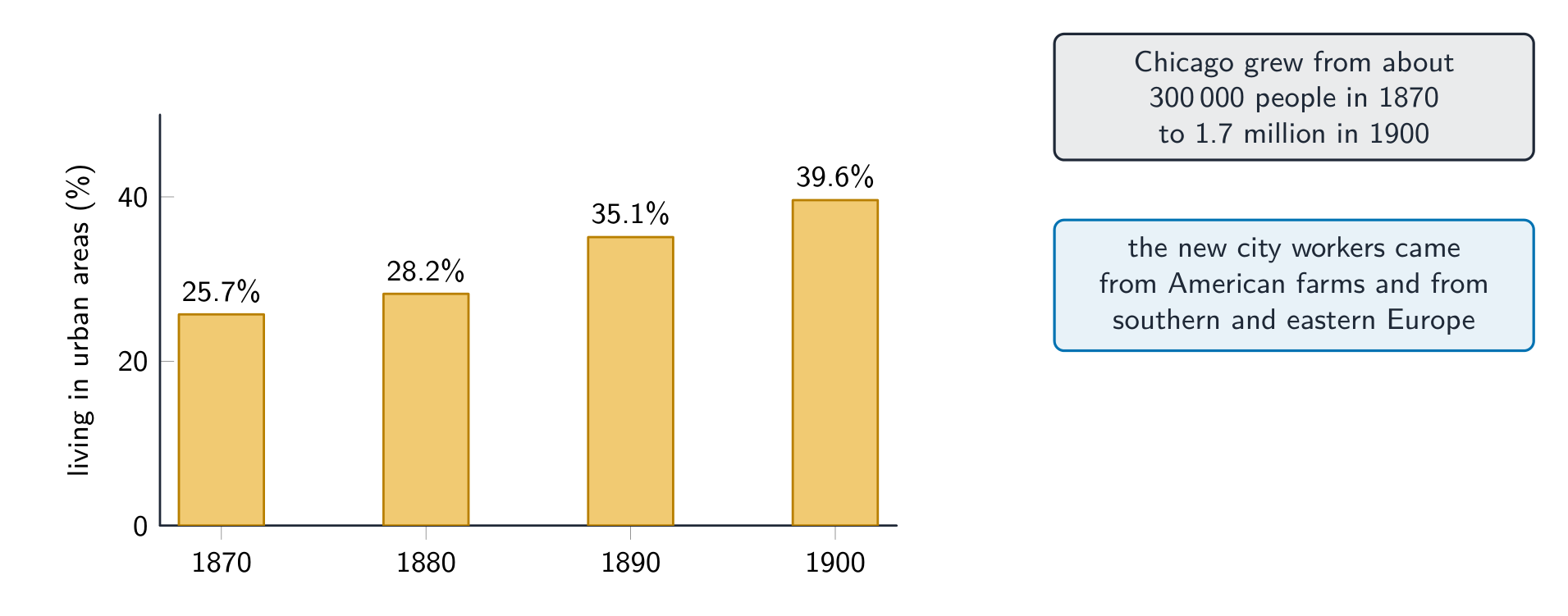
About what share of Americans lived in urban areas in 1900?
Dificuldade 1/5 · Moedas 100 + pequeno bônus na primeira conclusão hoje
It was about a quarter in 1870.
Worked example: measure the change. Urban share rose from 26% (1870) to 40% (1900): an increase of 14 percentage points, or more than half again. By contrast, the two main parties were the same in 1898 as in 1877, and presidential elections stayed close — in 1876 and 1888 the winner lost the popular vote. So the economy and society changed far more than the party system did.
The urban share rose from 26% to 40%. That is a rise of ____ percentage points.
Dificuldade 1/5 · Moedas 100 + pequeno bônus na primeira conclusão hoje
40 − 26 = 14.
Politics changed least — until the 1890s
- From 1877 to 1896 Republicans and Democrats were evenly matched, and party machines and patronage ran many cities. Neither party did much about trusts, wages or farm debt.
- Discontent grew outside the parties: the Populist 人民党 Omaha Platform of 1892 demanded free silver, a graduated income tax and government ownership of railways. In 1896 the Democrats took up free silver, and lost.
Which demands were in the Populists' Omaha Platform (1892)?
Dificuldade 2/5 · Moedas 140 + pequeno bônus na primeira conclusão hoje
Farmers wanted more money and fairer rates.
Looking outward by 1898
- With the frontier "closed", some leaders looked overseas for markets. In 1898 the US annexed Hawaii and, after the war with Spain, took Puerto Rico, Guam and the Philippines.
- So the period ends with a new question — should a republic rule colonies? — that the next unit takes up.
Economy, society or politics?
Sort each change by the area it belongs to.
Put these in order.
Dificuldade 3/5 · Moedas 200 + pequeno bônus na primeira conclusão hoje
1873, 1892, 1893, 1896, 1898.
"To what extent" asks you to rank change. Say which area changed most and which least, and give a number or case for each. A list of changes without a ranking does not answer the question.
Between 1877 and 1898 the economy changed most (giant corporations, steel and railways), society changed almost as much (cities grew from a quarter to two-fifths of the population, immigration, segregation and the loss of Native lands), and party politics changed least until the Populist challenge of the 1890s. In 1898 the country turned to overseas expansion.
To what extent did the United States change between 1877 and 1898?
Rank and support.