Alternative Visions
Introduzido| English | Significado |
|---|---|
| Populist Party | A US farmers' party of the 1890s that demanded silver money, an income tax and government control of railroads. |
| socialism/ˈsəʊʃəlɪzəm/ | A family of political and economic ideas advocating social or collective control of productive resources and a more equal distribution of their benefits. |
| Social Gospel | A late-1800s Protestant movement that called on Christians to fight poverty and injustice in society. |
"A cross of gold", 1896
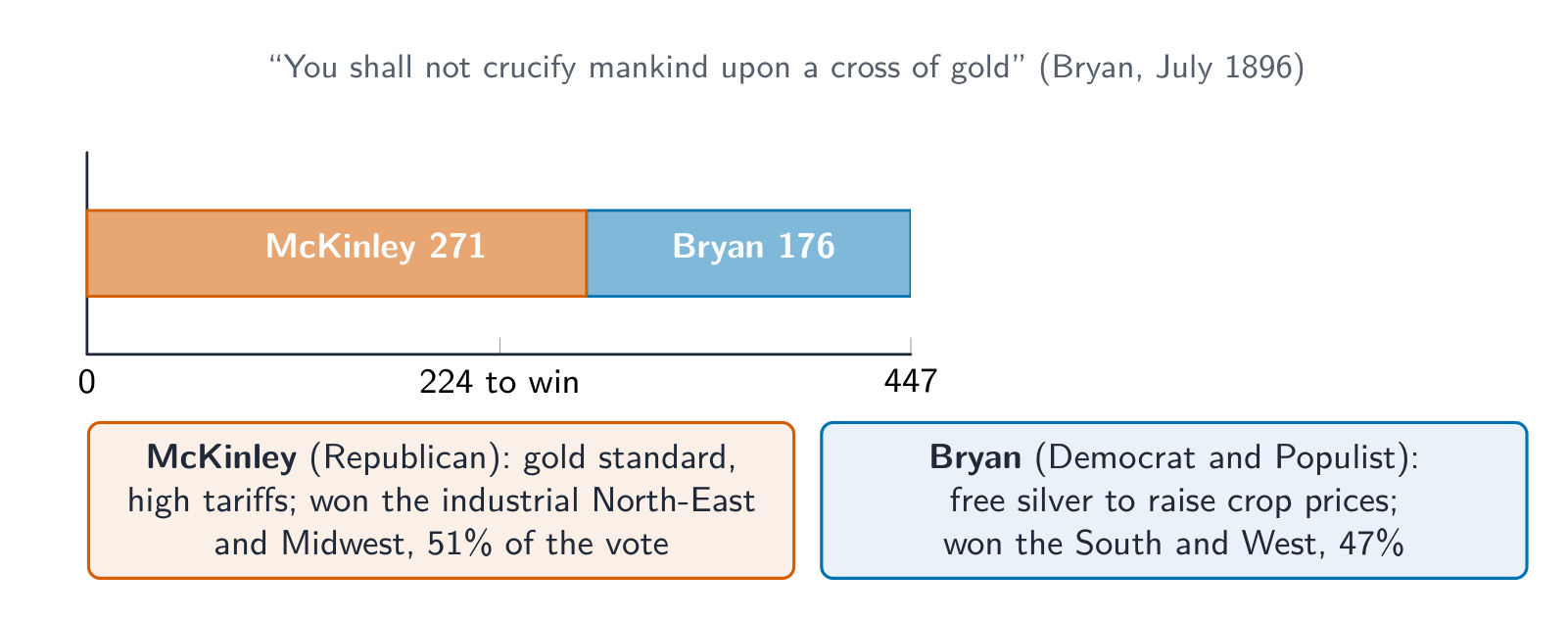
- At the Democratic convention of 1896, the 36-year-old William Jennings Bryan ended a speech for coining silver money with: "You shall not crucify mankind upon a cross of gold." The hall erupted, and he won the nomination. Farmers wanted more money in circulation to raise crop prices and ease their debts.
- Critics of industrial capitalism offered several alternative visions.
Why did farmers want more silver coins?
Dificuldade 1/5 · Moedas 100 + pequeno bônus na primeira conclusão hoje
Inflation helps debtors.
Farmers and the Populists
- Crop prices fell for decades after the Civil War, while railroads and banks charged farmers high rates.
- Farmers' Alliances formed the Populist Party 人民党. Its Omaha Platform (1892) demanded free coinage of silver, a graduated income tax, government ownership of railroads and the direct election of senators.
Which were demands of the Populists' Omaha Platform (1892)?
Dificuldade 2/5 · Moedas 140 + pequeno bônus na primeira conclusão hoje
They kept private property.
Socialists and labour radicals
- Socialism 社会主义 aimed to change who owned production — workers or the public instead of private owners.
- Eugene Debs, jailed after the Pullman Strike of 1894, became the Socialist Party's leader; in 1912 he won about 900 000 votes for president.
Worked example: reform or replace?
- Populists: kept private property but wanted government to control railroads, money and banks — reform.
- Socialists: wanted public or worker ownership of industry — replacement.
- Utopians: Edward Bellamy's novel Looking Backward (1888) imagined a cooperative America in the year 2000; it sold hundreds of thousands of copies. The Social Gospel 社会福音运动 of ministers such as Walter Rauschenbusch said Christians must fix poverty in this world. Each answered the same problem — inequality — with a different degree of change.
Which alternative vision?
Sort each proposal to the group that made it.
Match each person to their movement.
Dificuldade 2/5 · Moedas 140 + pequeno bônus na primeira conclusão hoje
Alternative visions.
Match each movement to its aim.
Dificuldade 2/5 · Moedas 140 + pequeno bônus na primeira conclusão hoje
Degree of change.
Women's reform
- The Woman's Christian Temperance Union, led by Frances Willard, campaigned against alcohol and for women's suffrage.
- The National American Woman Suffrage Association (1890) worked state by state; Wyoming gave women the vote in 1869 as a territory.
What happened to these visions
- The Populists faded after Bryan lost in 1896, but many of their demands — the income tax (1913) and direct election of senators (1913) — became law.
- Socialists stayed a minority, but pushed mainstream reformers towards labour laws.
Some Populist demands, such as the income tax, later became law.
Dificuldade 1/5 · Moedas 100 + pequeno bônus na primeira conclusão hoje
Both in 1913.
The Populists were not socialists. They wanted government to regulate railroads, money and banks for small farmers, not to abolish private property. Keep reform and replacement distinct.
The Populists wanted to abolish private property.
Dificuldade 1/5 · Moedas 100 + pequeno bônus na primeira conclusão hoje
That was the socialist aim.
Populists, socialists, utopian writers and Social Gospel ministers all challenged Gilded Age inequality, with different degrees of change. Women reformers fought alcohol and for suffrage. Many Populist demands later became law in the Progressive Era.
Explain how Populists and socialists differed in their response to industrial capitalism.
Comparison.