Lincoln and the War's Purpose
Introduzido| English | Significado |
|---|---|
| contraband | In the Civil War, the name for enslaved people who escaped to Union lines and were not returned. |
| Emancipation Proclamation/ɪˌmænsɪˈpeɪʃn ˌprɒkləˈmeɪʃn/ | Lincoln's 1863 order declaring enslaved people in Confederate-held areas free. |
A letter to a newspaper, 1862
- In August 1862, the editor Horace Greeley publicly demanded that Lincoln free the enslaved. Lincoln replied: "If I could save the Union without freeing any slave I would do it." What he did not say was that a draft emancipation order was already in his desk.
- During the war, its purpose changed from saving the Union to ending slavery.
A war for the Union
- In 1861 Lincoln said the war was to restore the Union, not to end slavery. He needed the loyal slave states — Kentucky, Missouri, Maryland and Delaware — to stay in the Union.
- Many Northern soldiers fought for the Union, not for emancipation.
What was Lincoln's stated war aim in 1861?
Dificuldade 1/5 · Moedas 100 + pequeno bônus na primeira conclusão hoje
He needed the border states.
Which were loyal slave states?
Dificuldade 2/5 · Moedas 140 + pequeno bônus na primeira conclusão hoje
Virginia seceded.
Enslaved people forced the question
- From 1861 enslaved people fled to Union lines. General Benjamin Butler refused to return them, calling them "contraband 违禁品(战时逃奴)" of war.
- By escaping, working for the army and later enlisting, African Americans made slavery impossible to ignore.
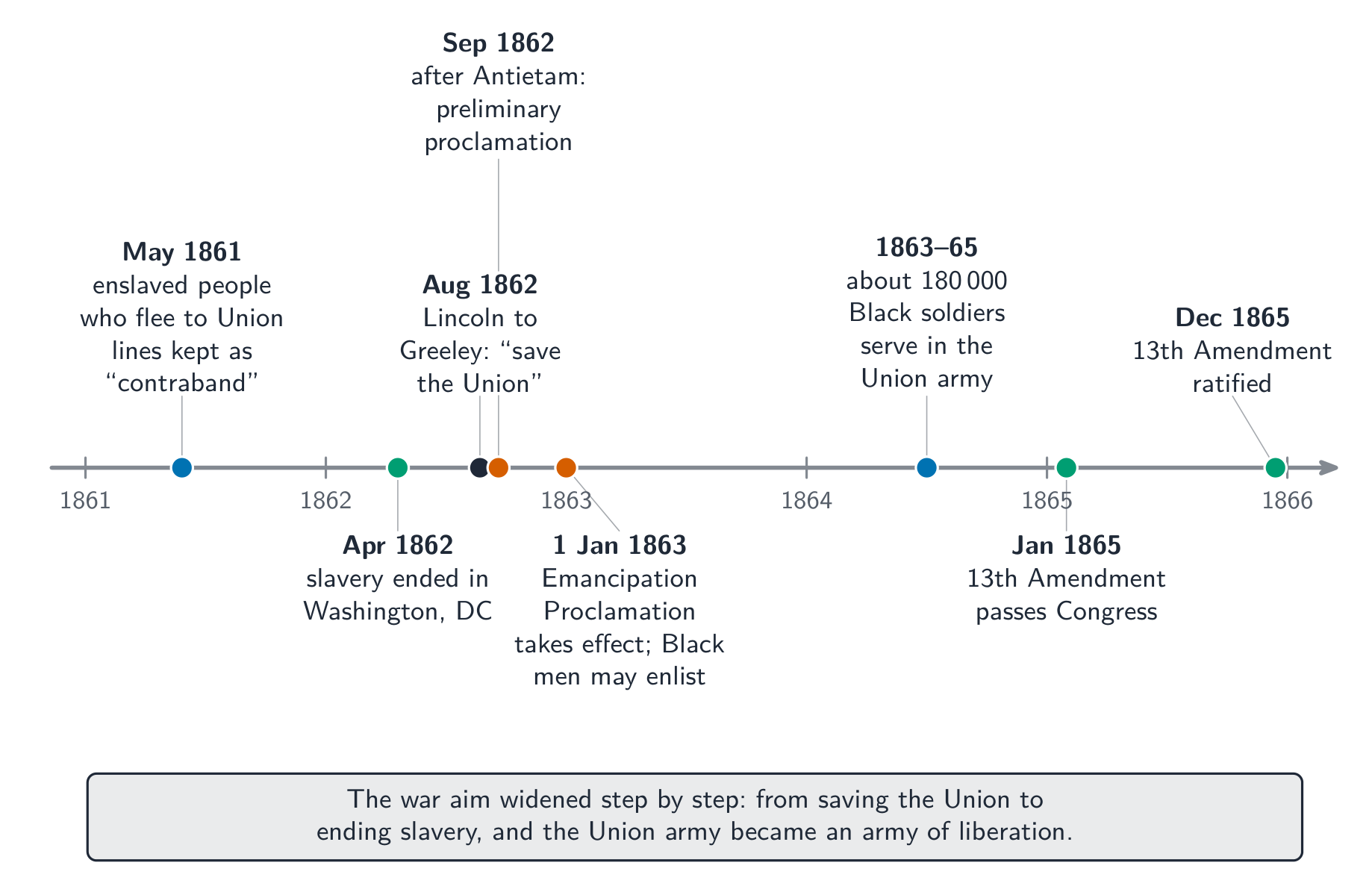
Enslaved people who fled to Union lines helped change the war's purpose.
Dificuldade 1/5 · Moedas 100 + pequeno bônus na primeira conclusão hoje
They forced the question.
Worked example: what the Proclamation did and did not do
The Emancipation Proclamation 解放黑人奴隶宣言, 1 January 1863.
- Did not: free anyone in the loyal border states or in Union-held areas; it applied only to areas in rebellion.
- Did: make freedom a Union war aim, let Black men join the army, and free people wherever Union troops advanced.
- Effect abroad: Britain and France, where opinion opposed slavery, found it harder to support the Confederacy. Limited in law, it was large in consequence.
The reframing, African American action, or the rhetorical strategy?
Sort each element of Lincoln's wartime leadership.
Where did the Emancipation Proclamation free enslaved people?
Dificuldade 1/5 · Moedas 100 + pequeno bônus na primeira conclusão hoje
Only Confederate areas.
The Gettysburg Address
- In November 1863, in 272 words, Lincoln described the war as a test of whether a nation "conceived in liberty" could survive, and promised "a new birth of freedom".
- He tied the war to the Declaration of Independence's claim that all men are created equal.
Ending slavery for good
- The Thirteenth Amendment, passed by Congress in January 1865 and ratified that December, abolished slavery everywhere in the United States.
- In his second inaugural address (March 1865) Lincoln called for peace "with malice toward none".
Put these in order.
Dificuldade 3/5 · Moedas 200 + pequeno bônus na primeira conclusão hoje
1862, 1863, 1863, 1865.
The Emancipation Proclamation did not free every enslaved person. It did not apply to the loyal border states. The Thirteenth Amendment ended slavery nationwide in 1865.
The Emancipation Proclamation freed all enslaved people in the United States.
Dificuldade 1/5 · Moedas 100 + pequeno bônus na primeira conclusão hoje
The Thirteenth Amendment did that.
The war began to save the Union. Enslaved people's escapes, military needs and politics led Lincoln to issue the Emancipation Proclamation, making freedom a war aim. The Gettysburg Address linked the war to the nation's founding ideals, and the Thirteenth Amendment abolished slavery.
Explain how and why the purpose of the Civil War changed between 1861 and 1865.
Change over time.