Why the Union Won
Introduzido| English | Significado |
|---|---|
| blockade | Using warships to stop goods and people from entering or leaving an enemy's ports. |
| total war/ˈtəʊtl wɔː/ | War that targets an enemy's whole society — farms, railroads and supplies — not only its armies. |
Appomattox, April 1865
- On 9 April 1865, Confederate general Robert E. Lee surrendered his army to Ulysses S. Grant at Appomattox Court House, Virginia. Lee's men were starving; the Confederate capital, Richmond, had fallen a week earlier. Four years of war had killed about 620 000 soldiers.
- Why did the Union win?
Resources
- The Union had about 22 million people against the Confederacy's 9 million (3.5 million of them enslaved).
- It had about 90% of the country's factories and most of its railroads, so it could make weapons and move armies.
Which were Union advantages?
Dificuldade 2/5 · Moedas 140 + pequeno bônus na primeira conclusão hoje
Cotton was the South's hope.
Strategy
- The Union navy enforced a blockade 封锁 of Southern ports, cutting cotton exports and imports of weapons.
- In July 1863 Union victories at Gettysburg and Vicksburg ended Lee's invasion of the North and gave the Union control of the Mississippi River.
Which July 1863 victories are seen as the war's turning point?
Dificuldade 1/5 · Moedas 100 + pequeno bônus na primeira conclusão hoje
The invasion ended; the Mississippi fell.
Worked example: ranking the causes
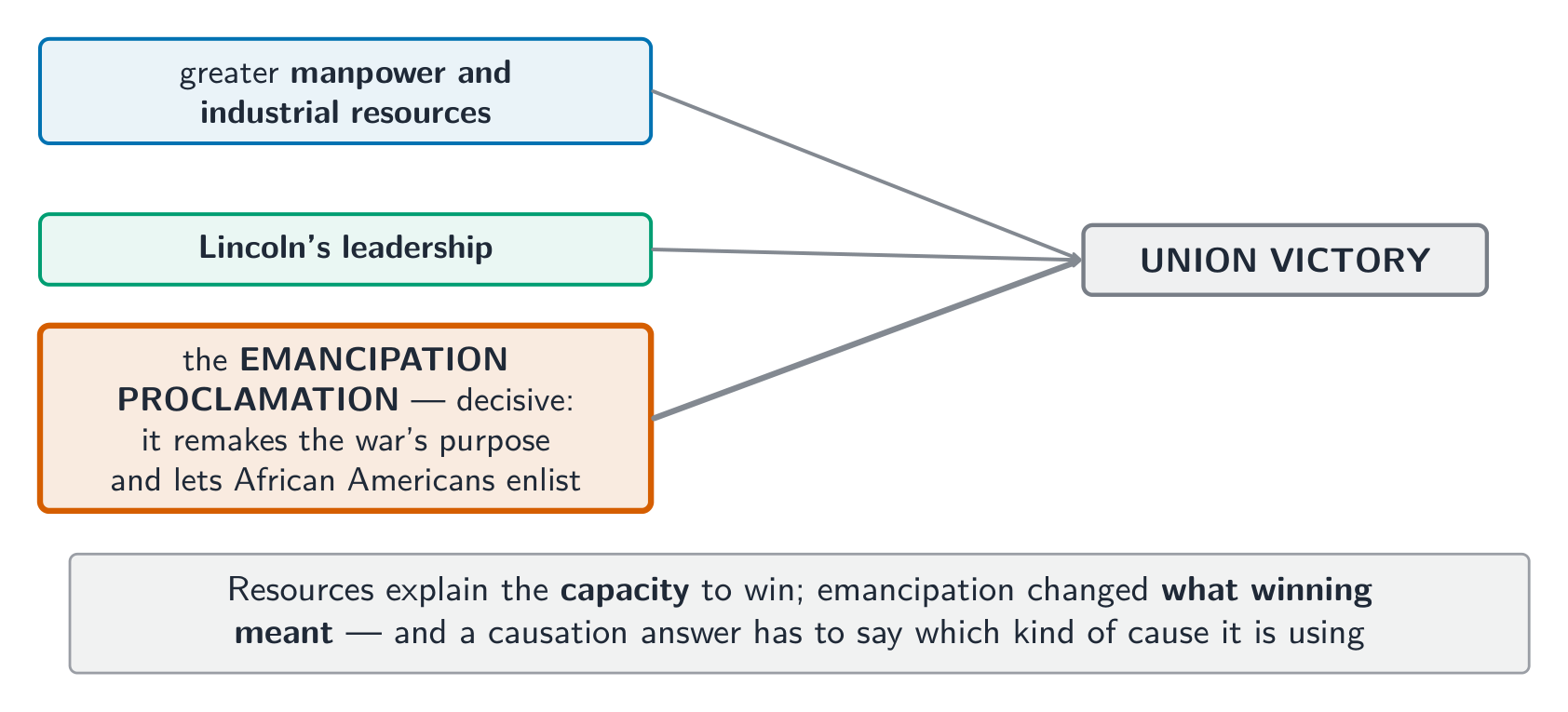
Claim: The Union's resources made victory likely, but leadership and emancipation made it happen.
- Resources: industry and population let the Union replace losses the South could not.
- Leadership: Lincoln kept the war going through defeats; from 1864 Grant attacked continuously, and Sherman's march through Georgia destroyed railroads and supplies.
- Emancipation: from 1863 about 180 000 Black soldiers joined the Union army, and Britain and France — where opinion opposed slavery — stayed out. Resources alone did not win early battles; together these factors did.
Assemble the Union's advantages, then rank them
Resources explain the capacity to win; emancipation changed what winning meant.
About how many Black soldiers served in the Union army?
Dificuldade 2/5 · Moedas 140 + pequeno bônus na primeira conclusão hoje
About 180 000.
Total war
- Sherman's March to the Sea (1864) was total war 全面战争: destroying farms, railroads and supplies to break the South's ability and will to fight.
- Confederate soldiers deserted as their families suffered at home.
Sherman's March to the Sea is an example of
Dificuldade 1/5 · Moedas 100 + pequeno bônus na primeira conclusão hoje
Destroying the means to fight.
The Confederacy's weaknesses
- States' rights made it hard for the Confederate government to raise taxes and troops; inflation reached about 9000% by 1865.
- Hopes that Britain would intervene for cotton failed, as Britain found other sources.
States' rights made it harder for the Confederacy to raise taxes and troops.
Dificuldade 1/5 · Moedas 100 + pequeno bônus na primeira conclusão hoje
Weak central government.
The Union's resources did not guarantee victory. The South won many early battles, and the North almost gave up in 1864. Leadership, emancipation and strategy turned advantages into victory.
The Union's resources guaranteed victory from the start.
Dificuldade 1/5 · Moedas 100 + pequeno bônus na primeira conclusão hoje
The South won many early battles.
The Union won through greater population and industry, the naval blockade, victories at Gettysburg and Vicksburg, Lincoln's and Grant's leadership, total war, and emancipation, which added Black soldiers and kept Europe out. The Confederacy suffered from shortages, inflation and internal division.
Evaluate the relative importance of resources and leadership in the Union's victory.
Argumentation.