The Mexican Cession and the Compromise of 1850
Introduzido| English | Significado |
|---|---|
| Wilmot Proviso | A 1846 proposal to ban slavery in all land taken from Mexico; it passed the House but never the Senate. |
| Mexican Cession | The land Mexico gave up in 1848, including California and most of the present Southwest. |
| popular sovereignty/ˈpɒpjʊlə ˈsɒvərɪnti/ | Letting the settlers of a territory decide by vote whether to allow slavery. |
| Fugitive Slave Act/ˈfjuːdʒɪtɪv sleɪv ækt/ | The 1850 law requiring Northerners to help capture and return people who had escaped from slavery. |
One sentence in a spending bill, August 1846
- On 8 August 1846, three months into the war with Mexico, Congressman David Wilmot of Pennsylvania added one sentence to a spending bill: slavery would be banned in any land taken from Mexico. The Wilmot Proviso 威尔莫特附文 passed the House, where the North had more seats, and failed in the Senate, where the sections were equal. It was voted on again and again for four years.
- The war had not ended, and Congress was already divided by region over what to do with its prize.
Why did the Wilmot Proviso pass the House but fail in the Senate?
Dificuldade 1/5 · Moedas 100 + pequeno bônus na primeira conclusão hoje
Population decided the House.
The Mexican Cession
- In the Treaty of Guadalupe Hidalgo (1848), Mexico gave up about half its territory — California and most of today's South-West — for 15 million dollars. This was the Mexican Cession 墨西哥割让地.
- Gold was found in California in January 1848. By 1849 about 100 000 people had arrived, and California asked to join the Union as a free state, which would give the North a majority in the Senate.
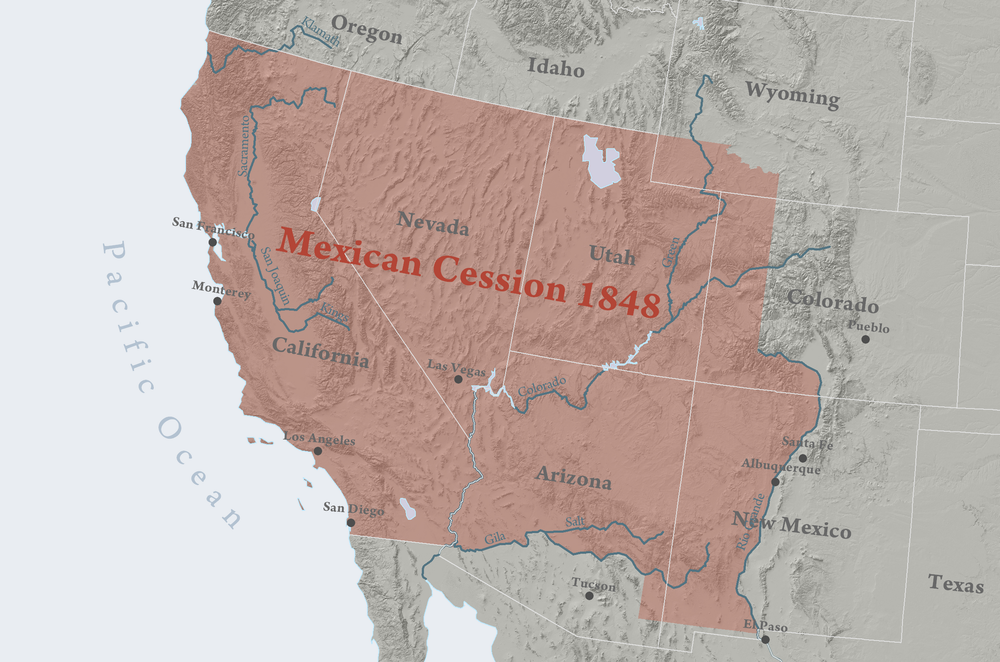
California's request to join as a free state threatened the balance of free and slave states in the Senate.
Dificuldade 1/5 · Moedas 100 + pequeno bônus na primeira conclusão hoje
It would give the North a majority.
Four answers to one question
- Ban it (Wilmot, most Northerners): no slavery in the new land. Protect it (John C. Calhoun): Congress has no power to keep slaveholders' property out of a territory.
- Extend the 1820 line at 36°30′ to the Pacific. Let the settlers vote — popular sovereignty 人民主权, proposed by Lewis Cass in 1848.
Match each proposal to its idea.
Dificuldade 2/5 · Moedas 140 + pequeno bônus na primeira conclusão hoje
Four answers to one question.
Worked example: the Compromise of 1850. Senator Henry Clay and Stephen Douglas passed five laws. The North got California as a free state and an end to the slave trade (not slavery) in Washington, DC. The South got a much stronger Fugitive Slave Act 逃亡奴隶法, which made Northern officials help catch people who had escaped. New Mexico and Utah would decide by popular sovereignty, and Texas gave up land in exchange for 10 million dollars of its debt being paid.
Which were parts of the Compromise of 1850?
Dificuldade 2/5 · Moedas 140 + pequeno bônus na primeira conclusão hoje
Only the slave trade ended in DC, not slavery.
The compromise made the North angrier
- Under the Fugitive Slave Act, a person accused of escaping could not testify, and a judge was paid 10 dollars for sending them south but 5 for setting them free. Crowds in Boston and elsewhere tried to rescue captured people.
- Harriet Beecher Stowe's Uncle Tom's Cabin (1852) sold 300 000 copies in its first year and turned many Northern readers against slavery.
Harriet Beecher Stowe's novel ____ (1852) turned many Northern readers against slavery.
Dificuldade 1/5 · Moedas 100 + pequeno bônus na primeira conclusão hoje
300 000 copies in its first year.
Similar methods, opposite aims
- Similarity: both sections wanted federal power to protect their own economy, and both quoted the Constitution — the North on Congress's power over territories, the South on property rights.
- Difference: what each needed was incompatible. The North wanted slavery kept out of the West; the South wanted it allowed in.
Who gained what in 1850?
Sort each part of the Compromise of 1850 by the section it favoured.
What did the North and South have in common in these debates?
Dificuldade 1/5 · Moedas 100 + pequeno bônus na primeira conclusão hoje
Same method, opposite aims.
A compromise splits something that can be divided. A territory could not be partly slave and partly free for the people living in it, so each compromise only postponed the decision until the next piece of land was organised.
The Mexican Cession (1848) forced the question of slavery in the West. Northerners wanted it banned (the Wilmot Proviso), Calhoun said it could not be, and others proposed the 36°30′ line or popular sovereignty. The Compromise of 1850 admitted California as a free state but gave the South a harsh Fugitive Slave Act, which angered the North instead of settling the issue.
Explain one similarity and one difference in how the North and South tried to shape federal policy on slavery in the territories after 1848.
Comparison.