Expansion, Division, Aftermath
Introduzido| English | Significado |
|---|---|
| Mexican Cession | The land Mexico gave up in 1848, including California and most of the present Southwest. |
"A house divided", June 1858
- On 16 June 1858, Abraham Lincoln accepted the Republican nomination for the Senate in Illinois. "A house divided against itself cannot stand," he said. "I believe this government cannot endure, permanently half slave and half free." He lost that election. Two years later, he was elected president, and within months the house had split.
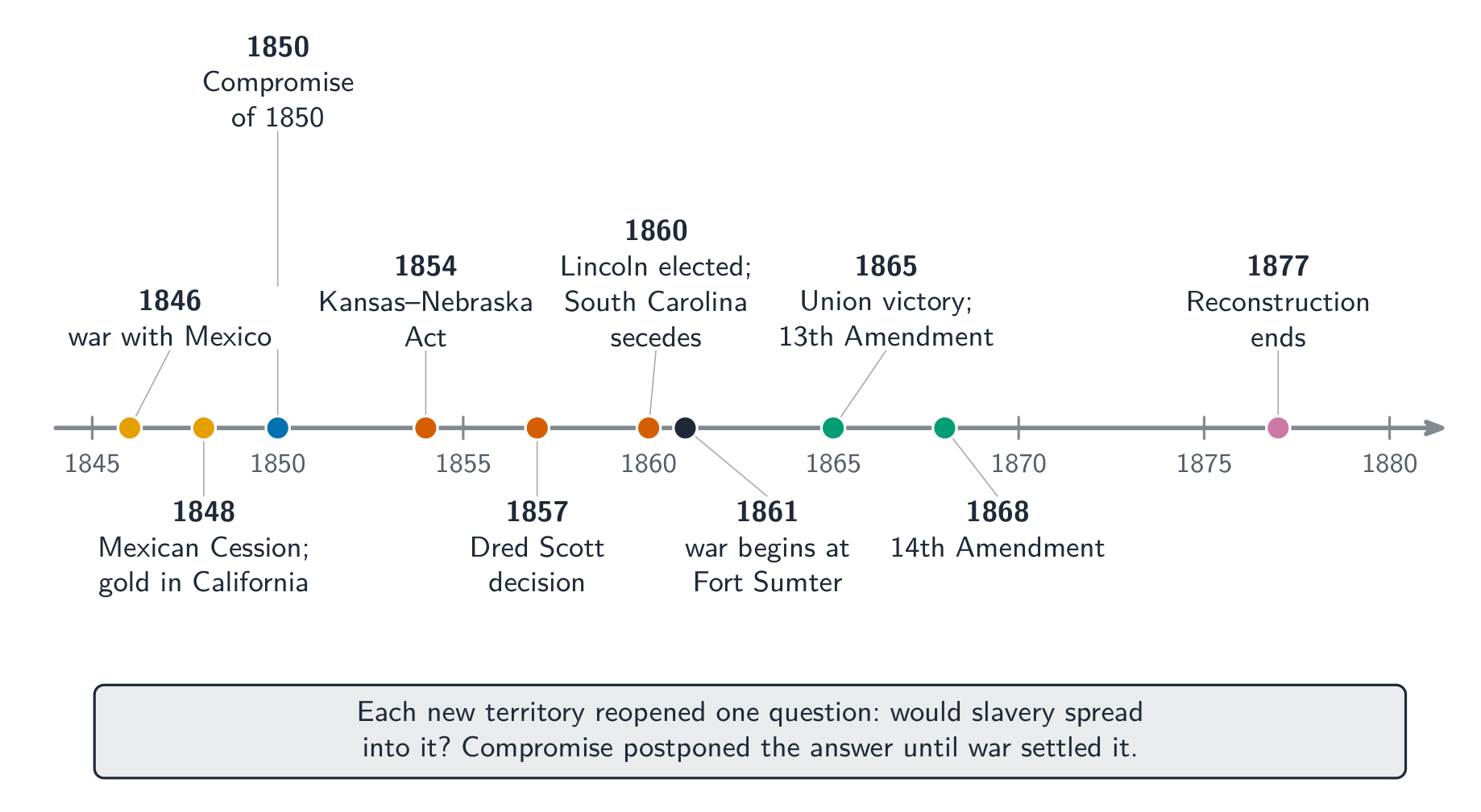
- Between 1844 and 1877, expansion led to division over slavery, a civil war and Reconstruction.
What did Lincoln mean by "a house divided"?
Dificuldade 1/5 · Moedas 100 + pequeno bônus na primeira conclusão hoje
June 1858.
Three claims for the period
- Expansion: the US gained Texas, Oregon and the Mexican Cession 墨西哥割让地 in 1845–48.
- Division: arguments over slavery in the new lands destroyed compromises and parties; aftermath: the Civil War (1861–65) and Reconstruction (1865–77) changed the Union and its citizens.
Match each claim to its example.
Dificuldade 2/5 · Moedas 140 + pequeno bônus na primeira conclusão hoje
Three claims.
Expansion caused the division
- Each new territory forced the question: slave or free? The Mexican Cession reopened the issue the Missouri Compromise had settled.
- Every attempt at compromise — 1850, 1854 — made the conflict worse.
Which of unit 5's threads?
Sort each statement into its thread.
Worked example: settled, but unresolved
- Settled: the Union could not be broken by secession, and slavery was abolished by the Thirteenth Amendment (1865).
- Unresolved: what citizenship meant for 4 million freed people, and how far the federal government would protect their rights.
- The end: by 1877, federal troops had left the South, and white Southern governments took away many of the rights Black Americans had won.
Which questions did the Civil War settle?
Dificuldade 2/5 · Moedas 140 + pequeno bônus na primeira conclusão hoje
The war answered two questions.
About how many million people were freed from slavery?
Dificuldade 2/5 · Moedas 140 + pequeno bônus na primeira conclusão hoje
The Thirteenth Amendment, 1865.
Federal troops left the South by 1877.
Dificuldade 1/5 · Moedas 100 + pequeno bônus na primeira conclusão hoje
The end of Reconstruction.
Migration
- Millions of immigrants, especially Irish and Germans, arrived in the 1840s and 1850s, and nativists opposed them.
- Settlers and gold-seekers moved west, to Oregon and California, displacing Native peoples.
Who gained
- Freedpeople won citizenship and, for men, the vote on paper — real changes even after 1877.
- Native nations in the West lost land as the government pushed settlement after the war.
The Civil War did not settle every question. It ended slavery and secession, but left the rights of freed people unprotected after Reconstruction ended in 1877.
The Civil War settled every question about freed people's rights.
Dificuldade 1/5 · Moedas 100 + pequeno bônus na primeira conclusão hoje
Their rights were left unprotected.
From 1844 to 1877, expansion into new territories raised the question of slavery, which broke compromises and parties and led to civil war. The war ended slavery and secession, but Reconstruction left the rights of freed people unresolved, while immigration and westward migration also reshaped the nation.
Explain how territorial expansion led to the Civil War.
Causation.