An American Identity by 1848
Introduzido| English | Significado |
|---|---|
| suffrage/ˈsʌfrɪdʒ/ | The right to vote in political elections. |
| nullification | the claim that a state could declare a federal law void inside its own borders |
| section | one of the large regions of the United States, such as the North or the South, seen as having its own interests |
| sectionalism | loyalty to one's own region of the country above loyalty to the nation |
| manifest destiny/ˈmænɪfest ˈdestɪni/ | the 1840s belief that the United States was meant to spread across the whole continent |
An American dictionary, 1828
- In 1828 the teacher Noah Webster published An American Dictionary of the English Language, with about 70 000 words. He spelled "color" and "center" the American way and added words such as "skunk" and "chowder". He wanted the new nation to have its own language, not borrow Britain's.
- Between 1800 and 1848 Americans built a national identity — and, at the same time, regional identities that pulled against it.
Why did Noah Webster publish an American dictionary in 1828?
Dificuldade 1/5 · Moedas 100 + pequeno bônus na primeira conclusão hoje
Color, center, skunk, chowder.
A national culture
- Writers and painters chose American subjects: James Fenimore Cooper's The Last of the Mohicans (1826) and Thomas Cole's Hudson River landscapes made the frontier and the wilderness national symbols.
- The Second Great Awakening's revivals crossed state lines, and reform societies organised across the whole country.
Democracy for white men
- By the 1830s most states had dropped the property test for voting, so almost all adult white men could vote. Turnout in presidential elections rose from about 27% in 1824 to 80% in 1840.
- The vote was not extended to women, and several states took it away from free Black men — Pennsylvania did so in 1838. Wider suffrage 选举权 was a white men's democracy.
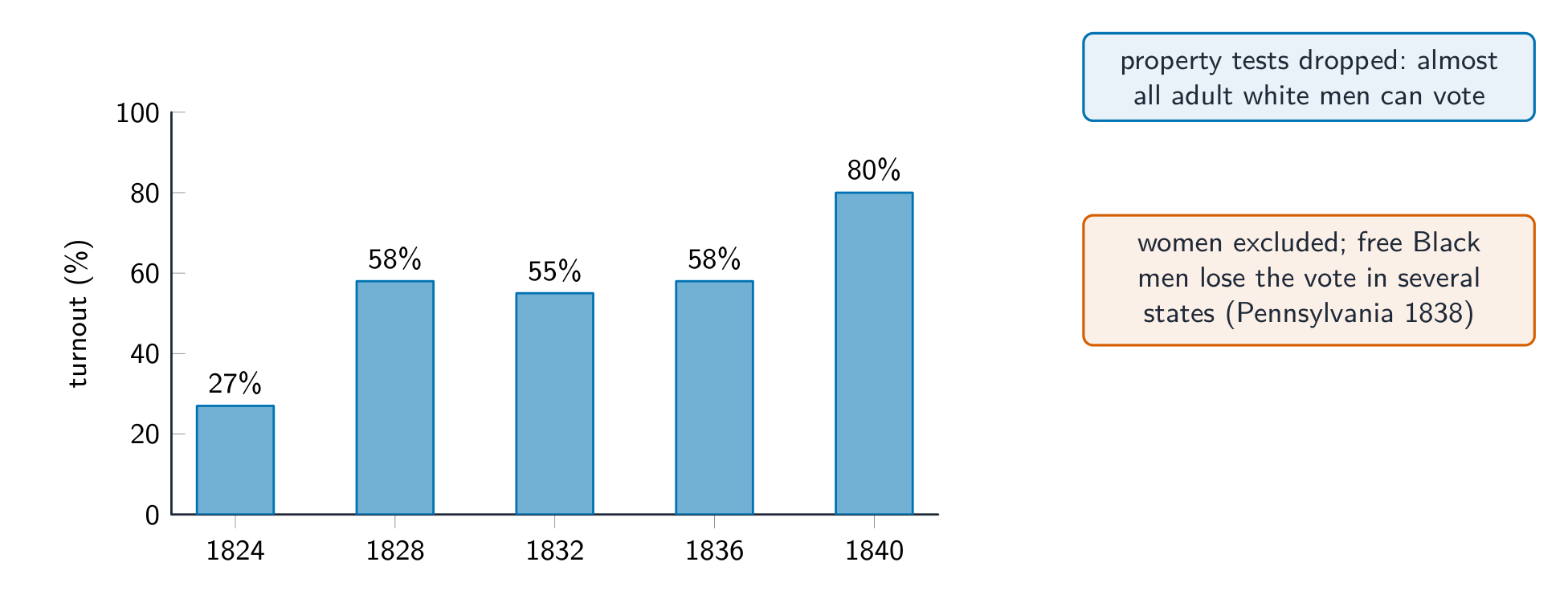
Turnout in presidential elections rose to about 80% in 1840.
Dificuldade 1/5 · Moedas 100 + pequeno bônus na primeira conclusão hoje
It was about 27% in 1824.
Who was still denied the vote in most states in the 1830s?
Dificuldade 2/5 · Moedas 140 + pequeno bônus na primeira conclusão hoje
Property tests for white men were dropped.
Worked example: one economy, two identities. The Erie Canal (1825) and the first railroads tied Midwestern farms to New York and the North-East. In the South, cotton grown by enslaved people was sent abroad: by 1840 it made up more than half of all US exports. The same national market therefore made the North and West more alike, and made the South more different. Both changes belong in an answer about American identity.
By 1840, roughly how much of all US exports was cotton?
Dificuldade 1/5 · Moedas 100 + pequeno bônus na primeira conclusão hoje
Grown by enslaved people and sold abroad.
Sectional identity: the Nullification Crisis
- In 1832 South Carolina declared the federal tariffs of 1828 and 1832 void inside the state. Its leaders said a state could cancel a federal law — nullification 拒绝执行联邦法.
- President Jackson threatened to send troops; a lower tariff in 1833 ended the crisis. Some Southerners now spoke of their section 地区 before the nation: sectionalism 地域主义.
South Carolina's claim that a state could cancel a federal law inside its borders is called ____.
Dificuldade 1/5 · Moedas 100 + pequeno bônus na primeira conclusão hoje
1832, over the tariffs.
Expansion and removal
- The Indian Removal Act (1830) forced Native nations west of the Mississippi; on the Trail of Tears (1838–39) about 4000 Cherokee died. In 1845 the editor John O'Sullivan wrote that it was America's manifest destiny 天定命运 to spread across the continent.
- Each new territory raised the same question — would slavery spread there? — and so expansion strengthened both national pride and sectional conflict.
National or sectional?
Sort each development by the identity it strengthened most.
Put these events in order.
Dificuldade 3/5 · Moedas 200 + pequeno bônus na primeira conclusão hoje
1825, 1828, 1832, 1838, 1845.
"To what extent" needs a judgement with a limit. Do not argue only that a national identity grew. The strongest answer says it grew a great deal, but unevenly: the same decades built a distinct Southern identity, which is why the period ends with a quarrel over territory, not with unity.
Between 1800 and 1848 Americans built a national culture (Webster, Cooper, Cole, the revivals) and a mass democracy for white men (turnout 80% in 1840). The national market linked North and West, while cotton exports and the Nullification Crisis hardened a Southern identity. Expansion and Indian removal fed both national pride and the slavery quarrel.
To what extent did a national identity develop in the United States between 1800 and 1848?
Extent needs both sides.