Land, Cotton and a Southern Identity
Introduzido| English | Significado |
|---|---|
| cotton gin | Eli Whitney's 1793 machine that separated cotton fibre from seeds, making cotton farming far more profitable. |
| domestic slave trade | The buying and selling of enslaved people within the United States, which forced about a million people from the Upper South to the Deep South. |
Sold in Richmond
- By the 1850s, Richmond, Virginia, held some of the busiest slave markets in the country. Enslaved people from tired tobacco lands were sold and sent south to grow cotton. Between 1790 and 1860, about one million people were forced to move this way.
- Cotton made slavery the centre of the Southern economy.
The cotton gin
- Eli Whitney's cotton gin 轧棉机 (1793) removed seeds from short-staple cotton quickly, so cotton could be grown profitably across the inland South.
- The enslaved population grew from about 700 000 in 1790 to nearly 4 million in 1860.
What was the main effect of the cotton gin?
Dificuldade 1/5 · Moedas 100 + pequeno bônus na primeira conclusão hoje
Faster seed removal.
The enslaved population grew from about 0.7 million in 1790 to about 4 million in 1860. By roughly how many times did it grow? (Round to the nearest whole number.)
Dificuldade 2/5 · Moedas 140 + pequeno bônus na primeira conclusão hoje
4 ÷ 0.7 ≈ 5.7.
The domestic slave trade
- After Congress banned importing enslaved people in 1808, the domestic slave trade 国内奴隶贸易 moved people from Virginia and Maryland to Alabama, Mississippi and Louisiana.
- Families were broken apart at auctions; traders marched people hundreds of miles in chained lines called coffles.
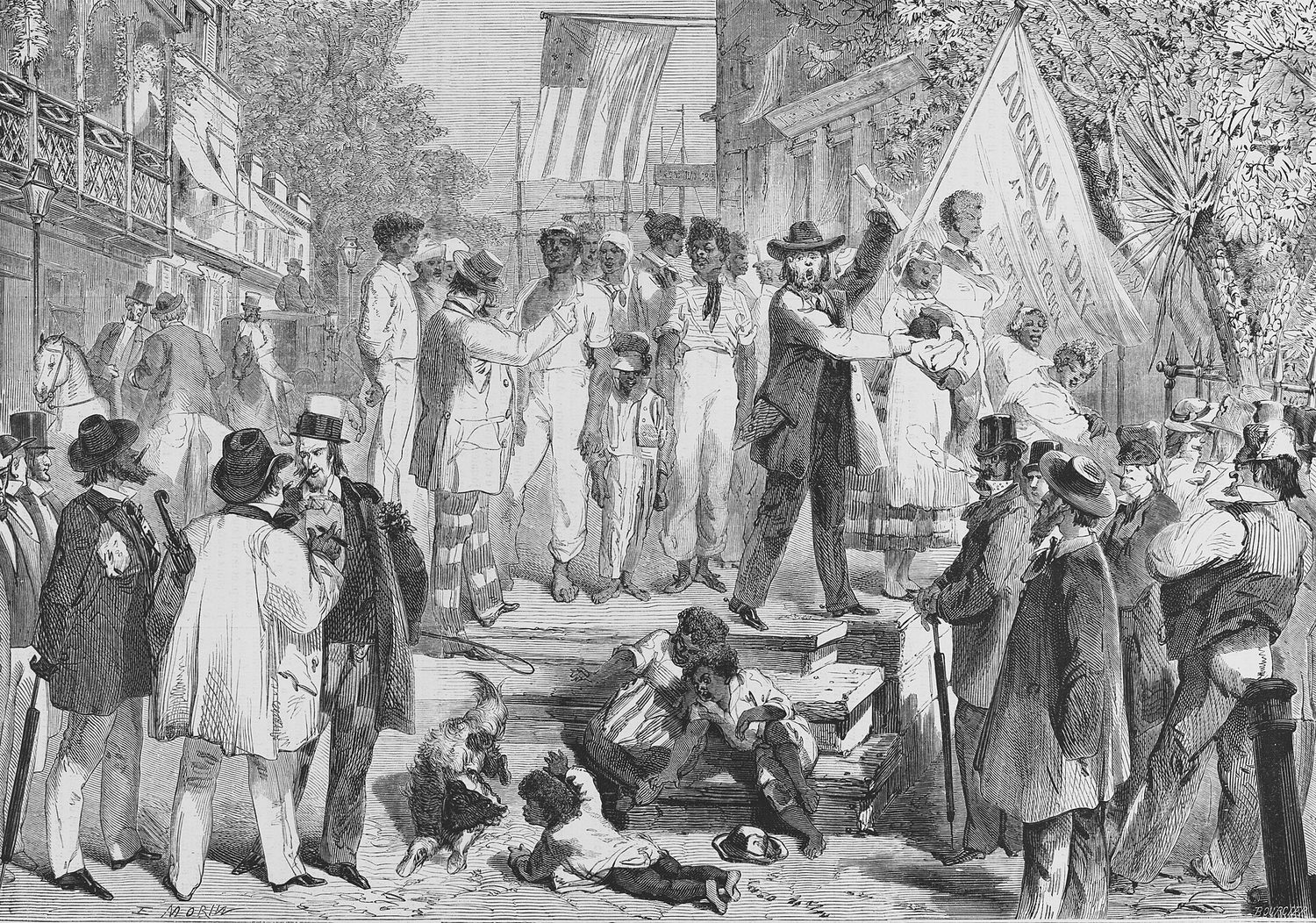
What was the domestic slave trade?
Dificuldade 1/5 · Moedas 100 + pequeno bônus na primeira conclusão hoje
About one million people moved.
Worked example: who owned enslaved people?
In 1860, about a quarter of white Southern families owned enslaved people; most owned fewer than ten.
- So: most white Southerners were not slaveholders.
- But: political leaders were mostly large planters, and many non-slaveholders hoped to buy enslaved people one day, or depended on the cotton economy.
- Conclusion: a minority owned enslaved people, yet slavery shaped the whole region's economy, politics and identity.
A demographic or political fact, the economy, or the environmental push?
Sort each element of Southern development.
In 1860, most white Southern families owned enslaved people.
Dificuldade 1/5 · Moedas 100 + pequeno bônus na primeira conclusão hoje
About a quarter did.
Soil exhaustion and westward spread
- Growing tobacco and cotton year after year wore out the soil, so planters moved west to fresh land.
- New cotton states in the Deep South pulled slavery westward, making its expansion a national political question.
Why did slavery spread westward?
Dificuldade 1/5 · Moedas 100 + pequeno bônus na primeira conclusão hoje
Tired soil, new land.
A distinctive Southern identity
- Leaders such as John C. Calhoun argued that slavery was a "positive good", not a necessary evil.
- The South remained mostly rural, with few factories and cities, and depended on selling cotton to Britain and the North.
John C. Calhoun called slavery a "positive good".
Dificuldade 1/5 · Moedas 100 + pequeno bônus na primeira conclusão hoje
A defence of slavery.
"Most white Southerners owned no enslaved people" does not mean slavery mattered little to them. Planters held power, cotton drove the economy, and many non-owners defended slavery. Ownership figures and influence are different questions.
The cotton gin and the domestic slave trade made cotton and slavery the core of the Southern economy. A minority of white families owned enslaved people, but planters led politically, slavery spread west as soil wore out, and Southern leaders defended it as part of their way of life.
Explain why slavery became more important to the Southern economy between 1800 and 1860.
Causation.