The Market Revolution
Introduzido| English | Significado |
|---|---|
| market revolution | The change in the early 1800s from producing goods for the family to producing them for sale in distant markets, driven by canals, railroads and machines. |
A canal across New York, October 1825
- On 26 October 1825, Governor DeWitt Clinton set off from Buffalo on a canal boat. Nine days later, he poured a barrel of Lake Erie water into New York harbour. The Erie Canal, 584 km long, cut the cost of moving a ton of goods from Buffalo to New York City from about 100 dollars to about 10, and the trip from about 20 days to about 6.
- From about 1800 to 1848, a market revolution 市场革命 changed how Americans made, moved and bought goods.
The trip from Buffalo to New York City fell from about 20 days to about 6. How many days were saved?
Dificuldade 2/5 · Moedas 140 + pequeno bônus na primeira conclusão hoje
20 − 6.
A change in how goods reach people
- Before, most families grew their own food and made goods at home. Now they produced crops and goods to sell in distant markets.
- More people worked for wages instead of for themselves.
What was the main change of the market revolution?
Dificuldade 1/5 · Moedas 100 + pequeno bônus na primeira conclusão hoje
Production for the market.
Named innovations
- Eli Whitney's cotton gin (1793) and interchangeable parts; the steamboat (1807); the telegraph (1844).
- John Deere's steel plough (1837) and Cyrus McCormick's mechanical reaper (1834) let Midwest farmers grow much more.
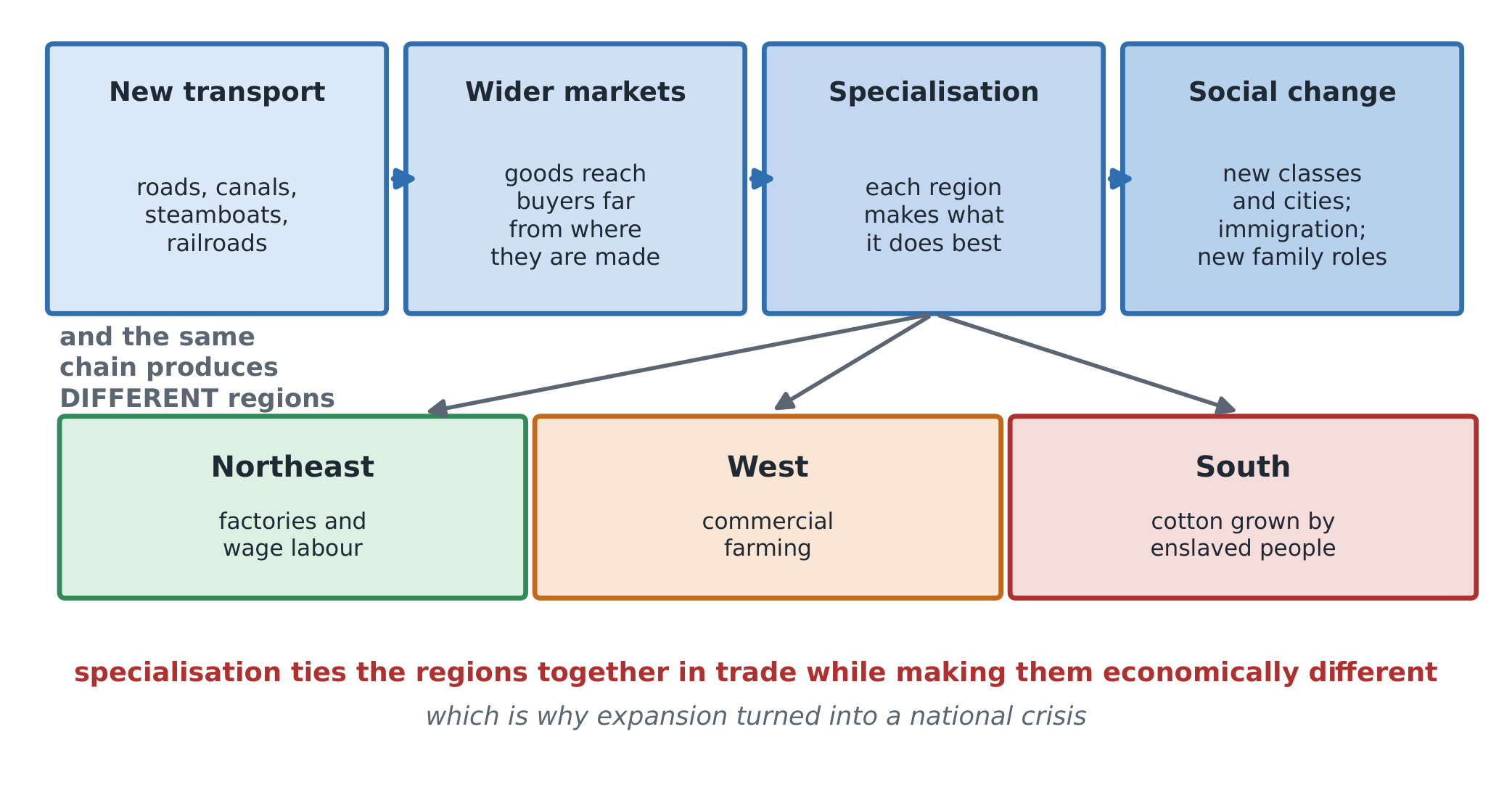
Follow the market revolution from transport to society
Cheaper transport widened markets; wider markets let regions specialise.
Match each innovation to its inventor.
Dificuldade 2/5 · Moedas 140 + pequeno bônus na primeira conclusão hoje
Named innovations.
Worked example: what the canal did
- Known: cost fell from about 100 to about 10 dollars a ton.
- Method: 10 ÷ 100 = 0.1, so a fall of 90%.
- Effect: Midwestern wheat reached East Coast markets cheaply, New York City became the country's main port, and towns such as Rochester grew along the route.
The cost fell from about 100 dollars to about 10 dollars a ton. By what percentage?
Dificuldade 2/5 · Moedas 140 + pequeno bônus na primeira conclusão hoje
(100 − 10) ÷ 100.
A lopsided map
- Most canals and railroads were built in the North, linking the Northeast with the Midwest.
- The South built fewer, because its rivers carried cotton to the coast.
Most canals and railroads were built in the South.
Dificuldade 1/5 · Moedas 100 + pequeno bônus na primeira conclusão hoje
Most were in the North.
Cotton tied the regions together
- Southern cotton, grown by enslaved people, fed New England's textile mills and was the country's largest export.
- Northern banks and shippers profited from the trade.
The market revolution did not make everyone better off. It brought wage labour, the Panic of 1837 and the expansion of slavery as cotton spread west.
The market revolution made every American better off.
Dificuldade 1/5 · Moedas 100 + pequeno bônus na primeira conclusão hoje
Wage labour, panics and slavery's spread.
From 1800 to 1848, canals, steamboats, railroads and new machines tied farms to distant markets. The Erie Canal cut transport costs by about 90%. Northern transport links grew fastest, but Southern cotton grown by enslaved people tied the regions' economies together.
Explain how the market revolution linked the North, the Midwest and the South.
Connections.