The Seven Years' War
Introduzido| English | Significado |
|---|---|
| Seven Years' War/ˈsevən jɪəz wɔː/ | The global war, ending in 1763, that left Britain dominant in North America. |
| Treaty of Paris | The 1783 treaty in which Britain recognised American independence, with a western border on the Mississippi. |
| salutary neglect/ˈsæluːtəri nɪˈɡlekt/ | Britain's loose enforcement of trade laws while it still benefited. |
A young officer surrenders, July 1754
- On 3 July 1754, a 22-year-old Virginia officer named George Washington surrendered his small, muddy stockade, Fort Necessity, to French forces in the Ohio Valley. Weeks earlier, his men had killed a French officer, Jumonville. The fight over the Ohio Valley grew into a world war — the Seven Years' War 七年战争 (1756–63), called the French and Indian War in America.
- Britain won, but the victory changed its relationship with the colonies.
A rivalry sharpened by population
- By 1750, about 1.2 million British colonists lived in North America against about 60 000 French.
- British settlers pushed west into the Ohio Valley, which France and its Native American allies claimed.
About 1.2 million British colonists faced about 60 000 French. How many times as many British?
Dificuldade 2/5 · Moedas 140 + pequeno bônus na primeira conclusão hoje
1 200 000 ÷ 60 000.
Victory at great expense
- After the capture of Quebec in 1759, Britain won. In the Treaty of Paris 巴黎条约 (1763), France gave up Canada and its lands east of the Mississippi.
- Britain's national debt almost doubled, to about 130 million pounds.
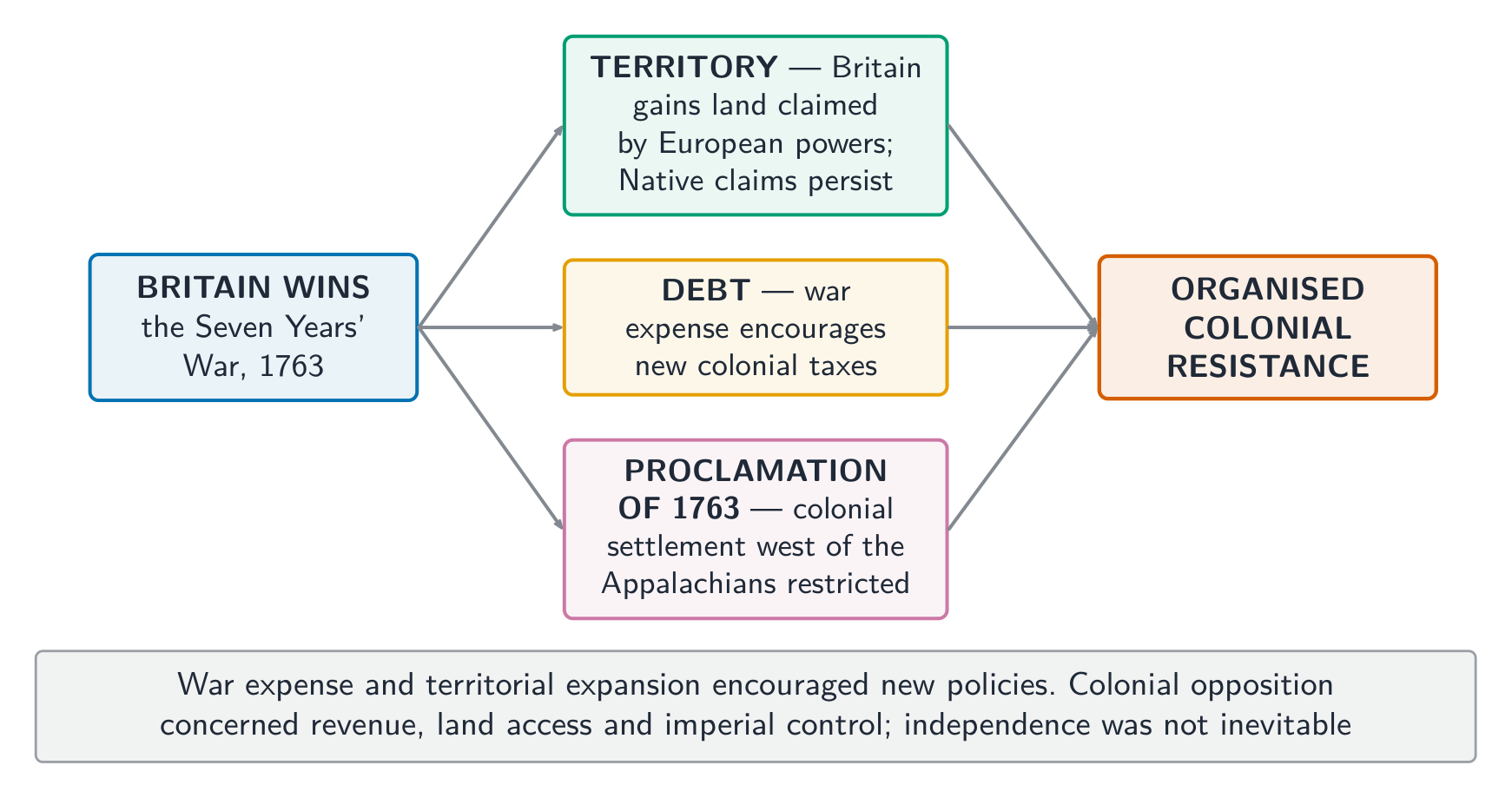
Turn one victory into three consequences
The exam treats the Revolution as an effect, so start from what the victory produced.
What did France give up in the Treaty of Paris (1763)?
Dificuldade 1/5 · Moedas 100 + pequeno bônus na primeira conclusão hoje
Britain's victory.
Worked example: one victory, three consequences
- Debt: Britain decided colonists should help pay, leading to the Sugar Act (1764) and the Stamp Act (1765).
- Land: Native nations led by Pontiac attacked British forts in 1763; Britain's Proclamation of 1763 then banned settlement west of the Appalachians.
- Confidence: colonists had fought alongside British troops and felt they had earned equal treatment as British subjects.
Match each consequence to Britain's response.
Dificuldade 2/5 · Moedas 140 + pequeno bônus na primeira conclusão hoje
Consequences and responses.
The new problem
- Without France as a common enemy, colonists needed British protection less.
- British officials, meanwhile, ended salutary neglect 有益的忽视 and enforced laws more strictly.
Why did colonists need British protection less after 1763?
Dificuldade 1/5 · Moedas 100 + pequeno bônus na primeira conclusão hoje
The common enemy was gone.
Why the relationship changed
- Britain saw new taxes as fair; colonists saw them as taxation without consent.
- Within twelve years of the treaty, colonists and British soldiers were fighting at Lexington (1775).
Put these in order.
Dificuldade 3/5 · Moedas 200 + pequeno bônus na primeira conclusão hoje
1754, 1759, 1763, 1765.
The war did not directly cause the Revolution. It created debts, land disputes and new attitudes; the Revolution came from how Britain and the colonists responded to them.
The Seven Years' War directly caused the Revolution by itself.
Dificuldade 1/5 · Moedas 100 + pequeno bônus na primeira conclusão hoje
The responses to it did.
A rivalry over the Ohio Valley, begun with Washington at Fort Necessity, became the Seven Years' War. Britain won all of France's land east of the Mississippi but doubled its debt. New taxes, the Proclamation of 1763 and the end of salutary neglect turned victory into conflict with the colonists.
Explain how the Seven Years' War changed the relationship between Britain and its colonies.
Causation.