From Policy to War
Introduzido| English | Significado |
|---|---|
| boycott | Refusing to buy goods from a person, firm or country as a protest. |
| salutary neglect/ˈsæluːtəri nɪˈɡlekt/ | Britain's loose enforcement of trade laws while it still benefited. |
| Sons of Liberty | Groups of American colonists formed in 1765 to resist British taxes, sometimes with violence. |
The Stamp Act, 1765
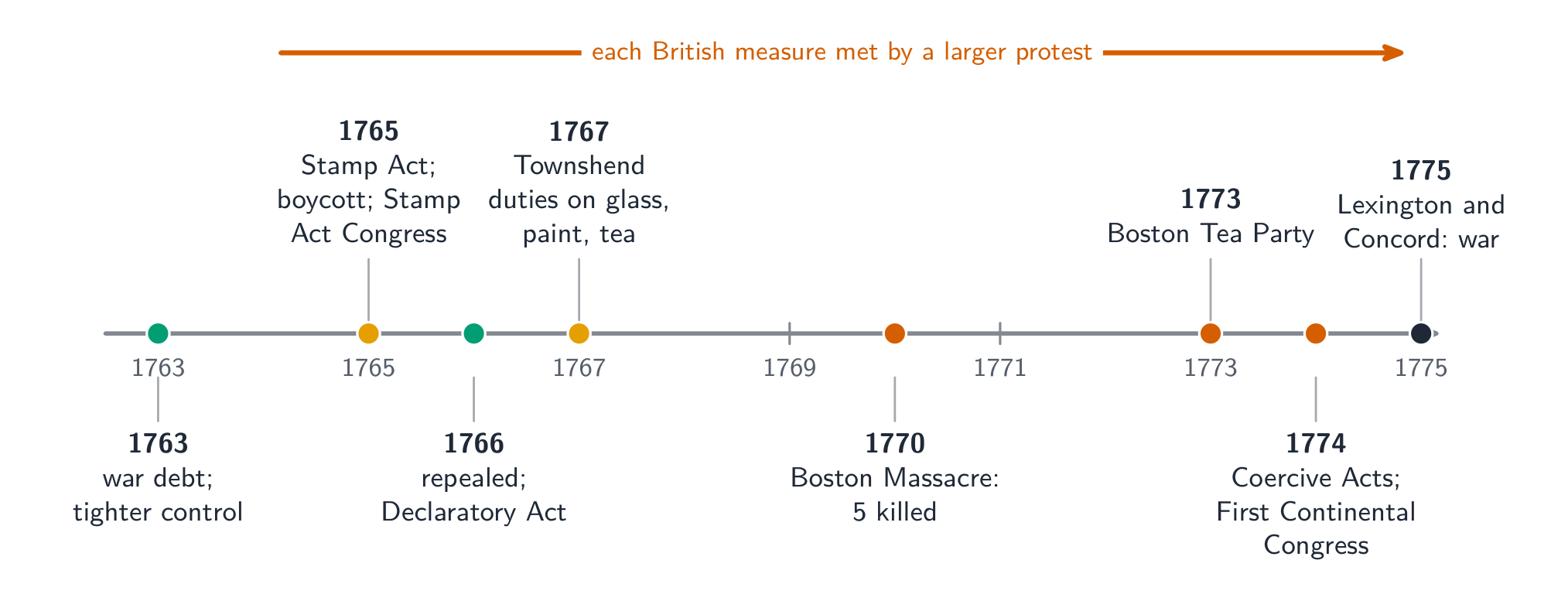
- To pay for the Seven Years' War, Parliament taxed newspapers, legal papers and playing cards in America. Colonists rioted, merchants agreed to boycott 抵制 British goods, and delegates from nine colonies met in the Stamp Act Congress. Parliament repealed the tax in 1766.
- Ten years later the colonies were at war with Britain.
The end of "salutary neglect"
- For decades Britain had followed salutary neglect 有益的忽视: loose enforcement of trade laws, which let colonies largely govern themselves.
- After 1763 Britain had huge war debts and new lands to defend, so it tightened control and taxed the colonies.
Why did Britain begin taxing the colonies after 1763?
Dificuldade 1/5 · Moedas 100 + pequeno bônus na primeira conclusão hoje
War debt and defence costs.
"No taxation without representation"
- Colonists argued that, as English subjects, they could be taxed only by their own elected assemblies — and they had no seats in Parliament.
- At first they asked for their rights within the empire, not for independence.
What did "no taxation without representation" mean?
Dificuldade 1/5 · Moedas 100 + pequeno bônus na primeira conclusão hoje
Rights as English subjects.
Worked example: the chain to war
- 1767: the Townshend Acts tax glass, paint, paper and tea; boycotts resume.
- 1770–73: British soldiers kill five colonists in the Boston Massacre; in 1773 the Sons of Liberty 自由之子 dump 342 chests of tea into Boston Harbor.
- 1774–75: Parliament punishes Boston with the Coercive Acts; the First Continental Congress meets; in April 1775 fighting begins at Lexington and Concord. Each British punishment united more colonists against it.
Trace policy into resistance
Colonial resistance is a response to a change in enforcement, not to the existence of the laws.
Put these events in order.
Dificuldade 3/5 · Moedas 200 + pequeno bônus na primeira conclusão hoje
1765, 1767, 1773, 1774, 1775.
Who resisted
- Elite leaders wrote pamphlets and organized congresses; ordinary colonists joined crowds, boycotts and committees.
- Women organized spinning bees to make cloth so that families could boycott British textiles.
Which were methods of colonial resistance?
Dificuldade 2/5 · Moedas 140 + pequeno bônus na primeira conclusão hoje
Colonists had no seats in Parliament.
From rights to independence
- Thomas Paine's Common Sense (January 1776) sold over 100 000 copies, arguing that a king could not be trusted at all.
- The Declaration of Independence followed on 4 July 1776.
Common Sense argued for independence from the king.
Dificuldade 1/5 · Moedas 100 + pequeno bônus na primeira conclusão hoje
Paine, January 1776.
The colonists did not want independence from the start. Until 1775 most demanded their rights as English subjects. Independence became the goal only after fighting began and compromise failed.
From 1765 most colonists demanded full independence.
Dificuldade 1/5 · Moedas 100 + pequeno bônus na primeira conclusão hoje
They first demanded rights within the empire.
After 1763, British taxes and controls ended salutary neglect. Colonists resisted with petitions, boycotts and protests, claiming their rights as English subjects. Each round of punishment and resistance — Stamp Act, Townshend Acts, Tea Party, Coercive Acts — pushed the colonies towards war and independence.
Explain how British policies between 1763 and 1775 led to the American Revolution.
Causation.