Control, Ideals and Competition
IntroduzidoA line on the map, October 1763
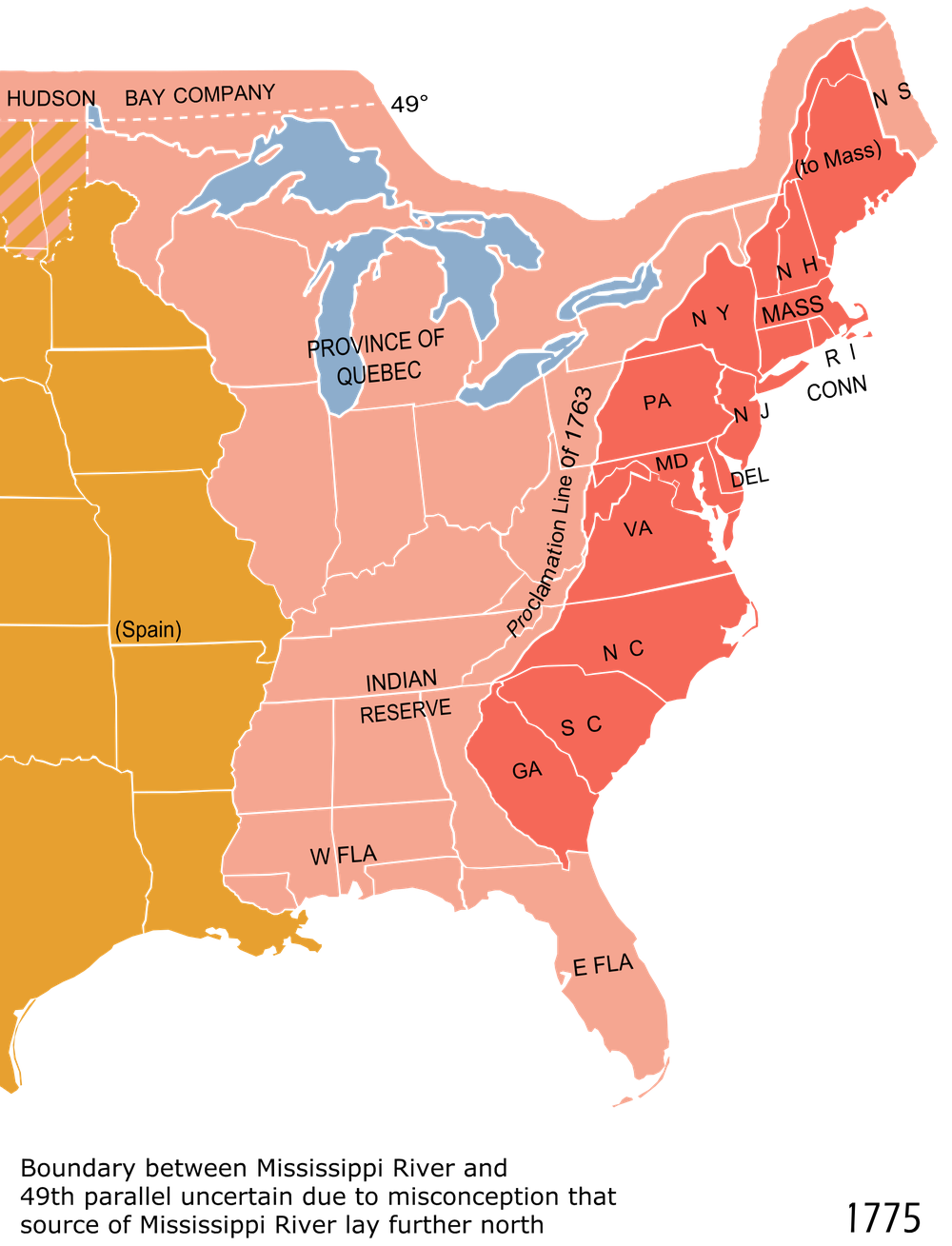
- On 7 October 1763, King George III issued a proclamation forbidding colonists to settle west of the Appalachian Mountains. Months earlier, the Odawa leader Pontiac and his allies had attacked British forts around the Great Lakes, angry at British settlers and at Britain's ending of gifts to Native allies. Britain wanted peace on the frontier. Colonists who had just fought France for that land were furious.
- Between 1754 and 1800, Britain tightened control, colonists turned to new ideals, and Americans experimented with new governments — while competition for the continent continued.
Why were colonists angry at the Proclamation of 1763?
Dificuldade 1/5 · Moedas 100 + pequeno bônus na primeira conclusão hoje
A line on the map.
Three big claims for the period
- Control: after the Seven Years' War, Britain tried to tighten control and raise taxes, and colonists resisted.
- Ideals: Enlightenment ideas about rights and self-government shaped the Revolution; experiments: Americans tried new forms of government, from state constitutions to the Constitution of 1787.
Match each claim to its example.
Dificuldade 2/5 · Moedas 140 + pequeno bônus na primeira conclusão hoje
Three claims.
A habit becomes a right
- During salutary neglect, colonial assemblies had raised taxes and passed laws with little interference.
- When Britain began to tax them directly after 1763, colonists saw an old habit as their right and its loss as tyranny.
Which of unit 3's threads?
Sort each statement into its thread.
Colonists saw self-taxation through their assemblies as a right.
Dificuldade 1/5 · Moedas 100 + pequeno bônus na primeira conclusão hoje
A habit became a right.
Worked example: one context paragraph
- Claim: the Revolution came from the clash between new British control and old colonial self-government.
- Evidence: the Proclamation of 1763, the Stamp Act (1765) and the Coercive Acts (1774) met boycotts, protests and finally war in 1775.
- Link: Enlightenment ideas, such as Locke's natural rights, turned complaints about taxes into a demand for independence.
Put these events in order.
Dificuldade 3/5 · Moedas 200 + pequeno bônus na primeira conclusão hoje
1763, 1765, 1774, 1781.
Experiments in government
- The new states wrote constitutions with strong legislatures and weak governors. The Articles of Confederation (1781) created a weak central government.
- The Constitution (1787) created a stronger federal government with checks and balances.
Competition for the continent
- Native nations, Spain, Britain and the new United States all claimed land west of the Appalachians.
- After 1783, settlers poured west, and Native nations fought to keep their lands.
Who competed for land west of the Appalachians?
Dificuldade 2/5 · Moedas 140 + pequeno bônus na primeira conclusão hoje
Competition for the continent.
The Revolution was not only about taxes. Land, self-government, Enlightenment ideas and Native policy all mattered. Use more than one cause in your answers.
The Revolution was caused only by taxes.
Dificuldade 1/5 · Moedas 100 + pequeno bônus na primeira conclusão hoje
Land, ideas and self-government mattered.
From 1754 to 1800, Britain's new control after the Seven Years' War clashed with colonial habits of self-government. Enlightenment ideals turned resistance into revolution; Americans experimented with state constitutions, the Articles and the Constitution; and Native nations, Spain and settlers competed for the West.
Explain how British policy after 1763 led to conflict with the colonies.
Causation.