Four British Regions
Introduzido| English | Significado |
|---|---|
| labour-intensive/ˈleɪbə ɪnˈtensɪv/ | Using a relatively large amount of labour compared with machinery and other capital. |
| indentured servant | A person who agreed to work for a master for several years, usually in return for the cost of passage to the colonies. |
| diverse/daɪˈvɜːs/ | Made up of many different kinds of people, for example of different religions or origins. |
Planters from Barbados, 1670
- In 1670, English settlers from the sugar island of Barbados founded Charles Town (later Charleston) in Carolina. They brought enslaved Africans and Barbados's harsh slave laws with them. By 1708, enslaved Africans were a majority of South Carolina's people — the only mainland colony where this was true.
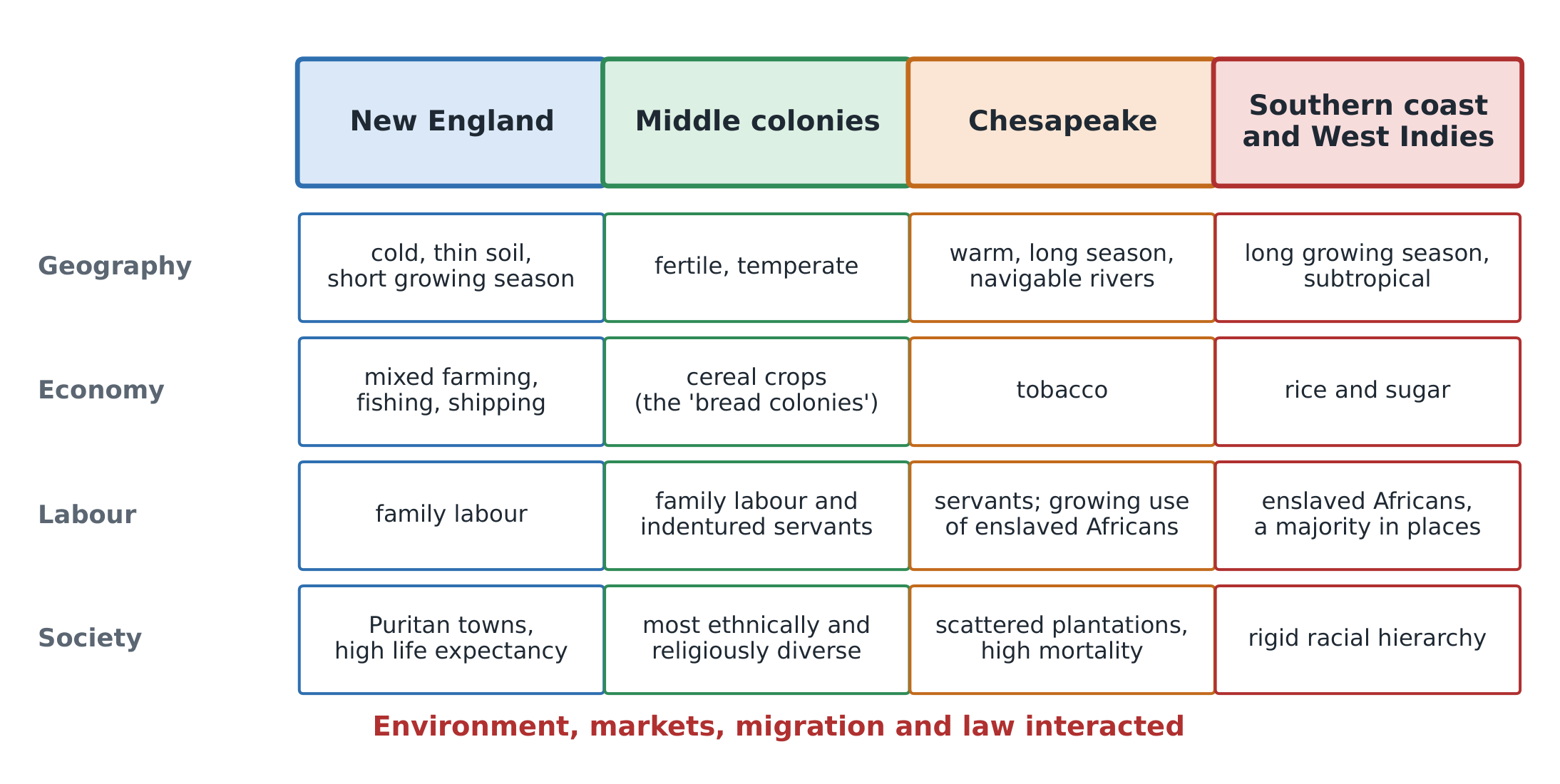
- Britain's mainland colonies formed four regions, and in each, geography set the crop, the crop set the labour system, and labour shaped society.
What was unusual about South Carolina by 1708?
Dificuldade 1/5 · Moedas 100 + pequeno bônus na primeira conclusão hoje
The only mainland colony with a Black majority.
The Chesapeake: tobacco and a change of labour
- Virginia and Maryland grew tobacco, a labour-intensive 劳动密集型 export crop.
- At first, planters used indentured servants 契约佣工 from England, who worked about 4–7 years for their passage. After about 1680, they turned to enslaved Africans.
Indentured servants worked about 4–7 years. What is the middle of that range?
Dificuldade 2/5 · Moedas 140 + pequeno bônus na primeira conclusão hoje
(4 + 7) ÷ 2.
New England: towns and a mixed economy
- Puritan families settled in small towns with family farms, churches and town meetings.
- Poor soil and long winters meant small farms, so the region grew through fishing, shipbuilding and trade.
Put the chain in order.
Dificuldade 3/5 · Moedas 200 + pequeno bônus na primeira conclusão hoje
Each sets the next.
Worked example: the middle colonies
- Geography: good soil and long rivers in New York, Pennsylvania and New Jersey.
- Crop and economy: wheat and other cereals for export — the "breadbasket" colonies — with ports such as Philadelphia and New York.
- Society: Pennsylvania's founder William Penn promised religious freedom, so Quakers, Germans, Dutch and Scots-Irish settled there — the most diverse 多元 region.
Which British colonial region?
Sort each description into its region.
Match each region to its main economy.
Dificuldade 2/5 · Moedas 140 + pequeno bônus na primeira conclusão hoje
Geography set the crop.
Why were the middle colonies the most diverse?
Dificuldade 1/5 · Moedas 100 + pequeno bônus na primeira conclusão hoje
Penn's promise.
The southern coast and West Indies
- South Carolina grew rice and indigo on large plantations worked by enslaved Africans, many from rice-growing regions of West Africa.
- The British West Indies grew sugar, with the highest death rates for enslaved workers in the Americas.
Self-government by distance
- Colonists built their own assemblies, beginning with Virginia's House of Burgesses in 1619.
- Britain was far away and enforced its laws loosely, so colonists grew used to governing themselves.
Slavery was not only a Southern institution. Enslaved people also lived and worked in New England and the middle colonies — about 14% of New York City's people in 1746 were enslaved.
Slavery existed only in the Southern colonies.
Dificuldade 1/5 · Moedas 100 + pequeno bônus na primeira conclusão hoje
About 14% of New York City's people were enslaved in 1746.
Britain's colonies formed four regions. The Chesapeake grew tobacco with servants and then enslaved Africans; New England built towns and a mixed economy; the middle colonies exported cereals and were diverse; and the southern coast and West Indies grew rice and sugar with enslaved labour. Distance let all of them govern themselves.
Compare the economies and labour systems of the Chesapeake and New England.
Comparison.