The Atlantic Economy
Introduzido| English | Significado |
|---|---|
| mercantilism/ˈmɜːkæntəlɪzəm/ | The economic theory that colonies exist to enrich the mother country by supplying raw materials and buying its goods. |
| Navigation Acts/ˌnævɪˈɡeɪʃn ækts/ | English laws that channelled colonial trade through English ships and ports. |
A hall built on molasses and slaves, 1742
- In 1742, the Boston merchant Peter Faneuil gave his town a market hall with a meeting room above it. His fortune came from Atlantic trade: fish and timber to the Caribbean, molasses and sugar back to New England, and a share in the trade in enslaved Africans. Twenty years later, colonists met in Faneuil Hall to protest British taxes, and it became known as the "Cradle of Liberty".
- In the colonial period, an Atlantic economy linked North America, Britain, Africa and the Caribbean — and Britain tried to control it.
Where did Peter Faneuil's fortune come from?
Dificuldade 1/5 · Moedas 100 + pequeno bônus na primeira conclusão hoje
Fish, molasses and enslaved people.
What was traded, and between whom
- The colonies sent tobacco, rice, fish, timber and furs; Britain sent manufactured goods; Africa's coast sold enslaved people for guns, cloth and rum.
- The Caribbean sugar islands bought food and timber and sent molasses, which New England distilled into rum.
Match each region to what it sent.
Dificuldade 2/5 · Moedas 140 + pequeno bônus na primeira conclusão hoje
An Atlantic exchange.
Trade changed Native communities
- Native hunters traded furs and deerskins for guns, metal tools and cloth. Charleston exported tens of thousands of deerskins a year in the early 1700s.
- Communities came to depend on European goods, and competition for hunting grounds and for captives caused wars. Carolina traders bought thousands of Native captives as slaves.
The economy, its effect on native communities, or imperial policy?
Sort each element of transatlantic trade.
How did trade change Native communities?
Dificuldade 2/5 · Moedas 140 + pequeno bônus na primeira conclusão hoje
Trade changed them twice over.
Worked example: mercantilism in law
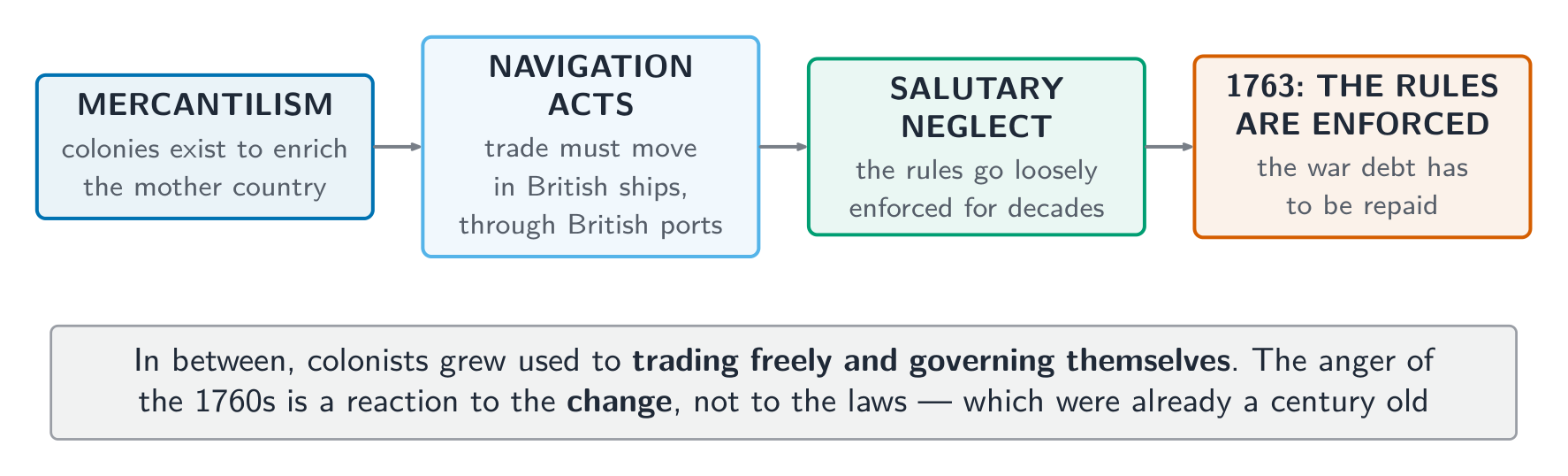
- The theory: mercantilism 重商主义 held that colonies existed to enrich the mother country by supplying raw materials and buying its goods.
- The laws: the Navigation Acts 航海条例 (from 1651) required colonial goods such as tobacco to be shipped to England on English or colonial ships. The Molasses Act (1733) taxed molasses from French islands.
- The reality: enforcement was weak, so colonists smuggled — New England merchants kept buying cheaper French molasses.
What did mercantilism say colonies were for?
Dificuldade 1/5 · Moedas 100 + pequeno bônus na primeira conclusão hoje
Raw materials and markets.
Why weak enforcement mattered
- For decades, colonists traded largely as they liked. They came to see this freedom as normal.
- When Britain began to enforce the laws strictly after 1763, colonists saw it as an attack on their rights.
Weak enforcement made colonists see free trade as normal.
Dificuldade 1/5 · Moedas 100 + pequeno bônus na primeira conclusão hoje
Later enforcement seemed an attack.
Slavery at the centre
- Much of the Atlantic economy — sugar, tobacco, rice and the rum trade — depended on enslaved labour.
- Northern merchants such as Faneuil profited from slavery even where few enslaved people lived.
The Atlantic economy was not only a "triangle". Trade went in many directions — between colonies, the Caribbean, Africa and Europe — and smuggling was common.
The Atlantic economy was a simple triangle with no other trade.
Dificuldade 1/5 · Moedas 100 + pequeno bônus na primeira conclusão hoje
Many directions and smuggling.
The Atlantic economy exchanged colonial raw materials, British manufactures, enslaved Africans and Caribbean sugar. It changed Native communities through the fur and deerskin trades. Britain organized it through mercantilist Navigation Acts, but weak enforcement let colonists trade freely — so later enforcement caused anger.
Explain why weak enforcement of the Navigation Acts mattered for later colonial anger.
Causation over time.