Three Ways to Hold a Colony
Introduzido| English | Significado |
|---|---|
| casta system/ˈkæstə ˈsɪstəm/ | The Spanish colonial system that ranked people by their mix of Spanish, Native and African ancestry. |
| fur trade | The trade of animal furs, especially beaver, between Native hunters and European merchants. |
Champlain fires on the Mohawk, 1609
- In July 1609, the French explorer Samuel de Champlain travelled south from Quebec with his Huron and Algonquin allies. At a lake that now carries his name, they met a Mohawk war party. Champlain fired his gun and killed two Mohawk chiefs. The French had chosen their side in Native politics — and the Haudenosaunee became France's enemies for decades.
- Spain, France, the Netherlands and England built different kinds of colonies, and each had a different relationship with Native peoples.
What was a result of Champlain's attack in 1609?
Dificuldade 1/5 · Moedas 100 + pequeno bônus na primeira conclusão hoje
France chose its side.
Spain: institutions built on conquest
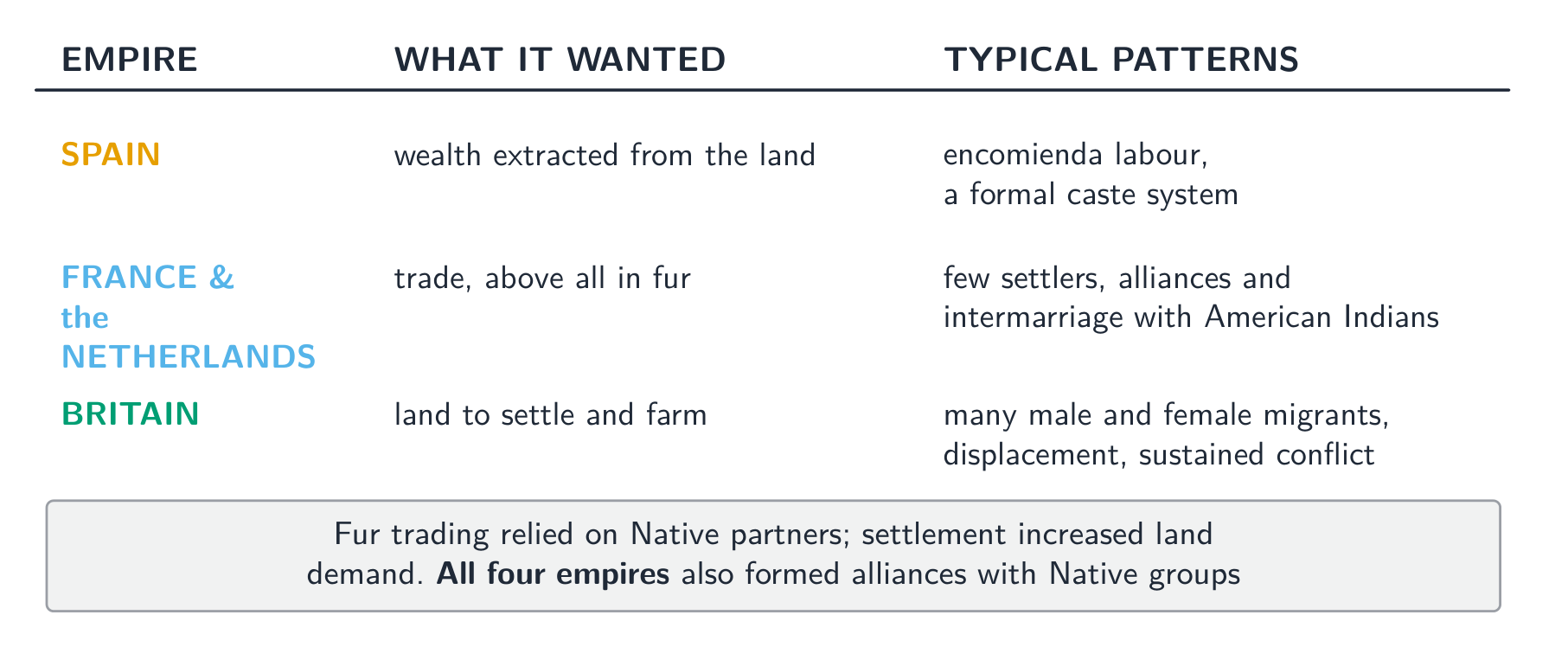
- Spain conquered large Native populations and ruled them through the encomienda and later forced labour, and through Catholic missions.
- A casta system 种姓制度 ranked people by their mix of Spanish, Native and African ancestry.
Which were features of Spanish colonies?
Dificuldade 2/5 · Moedas 140 + pequeno bônus na primeira conclusão hoje
Rule over conquered peoples.
France and the Dutch: few settlers, many allies
- New France had only about 60 000 colonists by 1750. The French depended on the fur trade 毛皮贸易, which needed Native hunters and partners.
- French traders often married Native women, and Jesuit missionaries lived in Native villages. The Dutch at New Amsterdam also traded furs with Native nations.
Spanish, French/Dutch, or English?
Sort each colonial pattern.
Worked example: England — many settlers, living apart
- Numbers: by 1750, the British colonies had about 1.2 million people, twenty times the population of New France.
- Goal: English colonists came as families to farm land permanently, so they needed Native land, not Native labour.
- Result: English settlers seldom married Native people and pushed them off the land, leading to wars such as the Powhatan wars in Virginia.
The British colonies had about 1.2 million people and New France about 60 000 in 1750. How many times larger were the British colonies?
Dificuldade 2/5 · Moedas 140 + pequeno bônus na primeira conclusão hoje
1 200 000 ÷ 60 000.
Why the patterns differed
- The goal of each colony — silver and souls, furs, or farmland — decided how it treated Native peoples.
- The number of settlers mattered too: few French settlers needed allies; many English settlers wanted land.
Match each colonizer to its main goal.
Dificuldade 2/5 · Moedas 140 + pequeno bônus na primeira conclusão hoje
Goals shaped relations.
Consequences
- Native nations often allied with the French against the expanding British.
- In the Spanish colonies, a mixed society emerged; in the British colonies, settler and Native societies stayed separate.
Native nations often allied with the French against the British.
Dificuldade 1/5 · Moedas 100 + pequeno bônus na primeira conclusão hoje
The British wanted their land.
The French were not simply "kinder". They needed Native allies because they were few. Their policy followed their goals and numbers, not only their attitudes.
The French made alliances only because they were kinder people.
Dificuldade 1/5 · Moedas 100 + pequeno bônus na primeira conclusão hoje
They needed allies because they were few.
Spain ruled conquered peoples through forced labour, missions and the casta system. France and the Dutch, with few settlers, depended on the fur trade and Native alliances. England's many settlers wanted farmland, lived apart and pushed Native peoples off their land. Each colony's goals shaped its relations with Native peoples.
Compare French and English relations with Native Americans.
Comparison.