What the Voyages Changed
Introduzido| English | Significado |
|---|---|
| Columbian Exchange/kəˈlʌmbɪən eksˈtʃeɪndʒ/ | The transfer of plants, animals, diseases and people between the Americas and other parts of the world following European contact. |
| encomienda | A Spanish colonial grant giving a colonist the labour and tribute of native people in return for "protection" and Christian teaching. |
| capitalism/ˈkæpɪtəlɪzəm/ | an economic system in which private owners invest money in trade and production to make a profit |
Smallpox in Tenochtitlan, 1520
- In 1520 smallpox reached Tenochtitlan, the Aztec capital of perhaps 200 000 people. The disease had arrived with a sick man from a Spanish ship. Native Americans had never met it, and thousands died, including the emperor Cuitláhuac. When Hernán Cortés attacked the weakened city in 1521, it fell after a siege of about three months.
- Voyages across the Atlantic after 1492 changed both sides of the ocean, in opposite ways.
Why did Tenochtitlan fall so quickly in 1521?
Dificuldade 1/5 · Moedas 100 + pequeno bônus na primeira conclusão hoje
Disease before the siege.
Population collapse in the Americas
- Smallpox, measles and influenza killed far more Native Americans than war did. Estimates vary, but central Mexico probably lost about 90% of its people within a century of contact.
- Europeans then turned to enslaved Africans for labour: by 1600 about 280 000 Africans had been carried across the Atlantic, mostly to Brazil and the Spanish colonies.
Most Native Americans who died after contact were killed by disease, not war.
Dificuldade 1/5 · Moedas 100 + pequeno bônus na primeira conclusão hoje
They had no immunity.
The Columbian Exchange
- Plants, animals and diseases crossed the ocean in both directions: the Columbian Exchange 哥伦布大交换. Horses, cattle, pigs, wheat and sugar cane went west; maize, potatoes, tomatoes, cacao and tobacco went east.
- Horses changed life on the Great Plains, where nations such as the Comanche became mounted hunters and warriors.
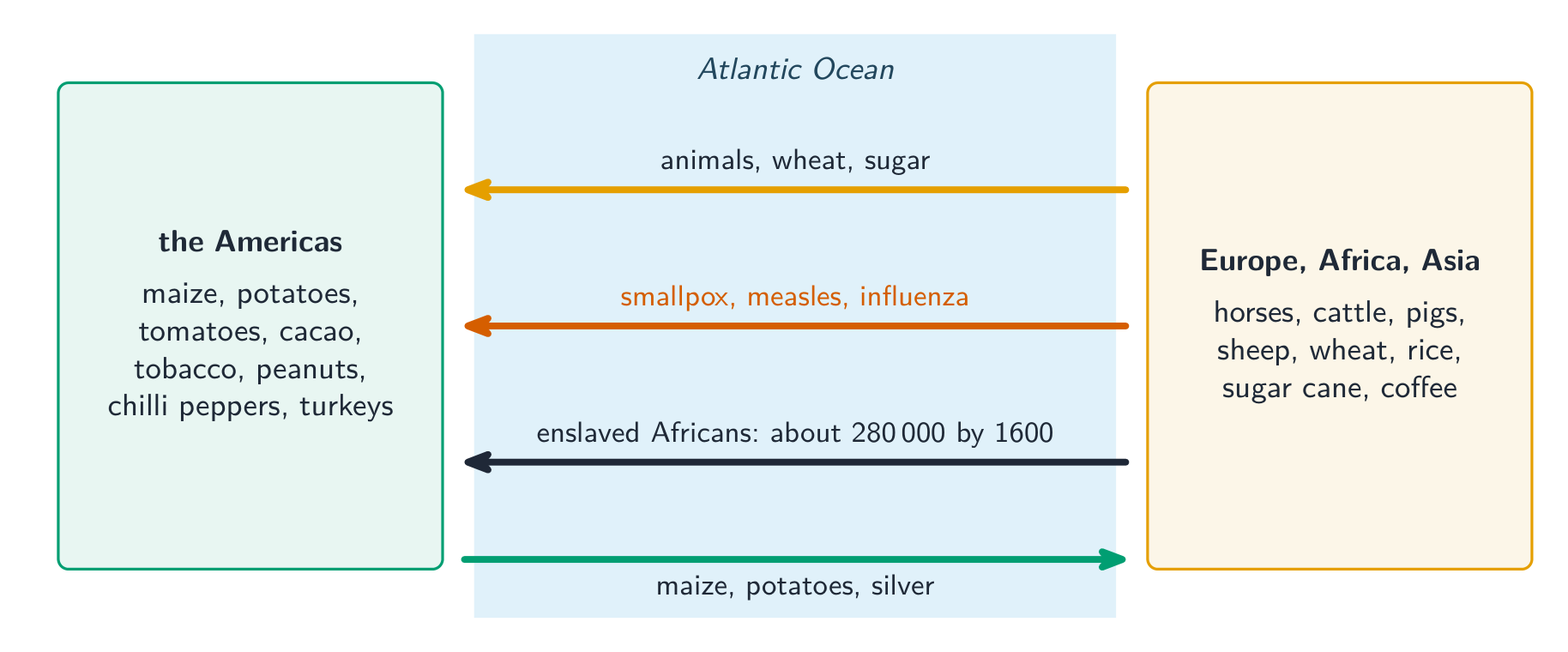
Match each to the direction it travelled.
Dificuldade 2/5 · Moedas 140 + pequeno bônus na primeira conclusão hoje
The Columbian Exchange.
Worked example: an effect far from the Americas. Potatoes and maize grow on poor soil and give more food per field than wheat. As farmers in Ireland, eastern Europe and China adopted them in the 1600s and 1700s, they could feed larger families. So a plant from the Andes helped Europe's and Asia's populations grow at the same time as the Americas' population collapsed — the same exchange, opposite results.
How did American crops affect Europe and Asia?
Dificuldade 1/5 · Moedas 100 + pequeno bônus na primeira conclusão hoje
More food per field.
Silver and a new economy
- In 1545 the Spanish found a mountain of silver at Potosí, in today's Bolivia; forced Native labourers mined it under the encomienda 委托监护制 and later the mita systems.
- American silver flowed to Spain and on to Asia. It paid for wars, raised prices across Europe and helped merchants and joint-stock companies grow — part of Europe's shift towards capitalism 资本主义.
In 1545 the Spanish found a mountain of silver at ____.
Dificuldade 1/5 · Moedas 100 + pequeno bônus na primeira conclusão hoje
In today's Bolivia.
Debates over the conquest
- The friar Bartolomé de las Casas described the cruelty he saw and argued that Native peoples had souls and rights. At Valladolid in 1550–51 he debated Juan Ginés de Sepúlveda, who claimed conquest was justified.
- Spain's laws limited the encomienda, but the abuse went on, and the demand for labour grew the Atlantic slave trade.
What the voyages changed on each shore
Follow the effects of the voyages on the Americas, Africa and Europe.
What did Bartolomé de las Casas argue?
Dificuldade 1/5 · Moedas 100 + pequeno bônus na primeira conclusão hoje
He debated Sepúlveda in 1550–51.
Give effects on both sides of the Atlantic. An answer about only the Americas, or only Europe, misses the point of the exchange: population fell in one place and rose in another, and wealth moved from one shore to the other.
From 1492 European diseases killed most Native Americans (central Mexico probably lost about 90%), and enslaved Africans were brought to replace their labour. The Columbian Exchange carried horses, wheat and sugar west and maize and potatoes east, helping Europe's population grow. American silver from Potosí fed Europe's economy, while writers such as Las Casas questioned the conquest.
Explain the effects of transatlantic voyages from 1491 to 1607 on both sides of the Atlantic.
Both sides of the ocean.