The Columbian Exchange
Introduzido| English | Significado |
|---|---|
| smallpox | A deadly infectious disease that Europeans carried to the Americas, where native peoples had no immunity. |
| Columbian Exchange/kəˈlʌmbɪən eksˈtʃeɪndʒ/ | The transfer of plants, animals, diseases and people between the Americas and other parts of the world following European contact. |
| joint-stock company/dʒɔɪnt stɒk ˈkʌmpəni/ | sociedade por ações |
Smallpox in Tenochtitlan, 1520
- When Spanish forces first retreated from the Aztec capital in 1520, smallpox stayed behind. The epidemic killed a large part of the city, including the emperor Cuitláhuac. A year later Cortés and his native allies captured a weakened city.
- Contact moved diseases, plants, animals and people in both directions across the Atlantic.
The Columbian Exchange
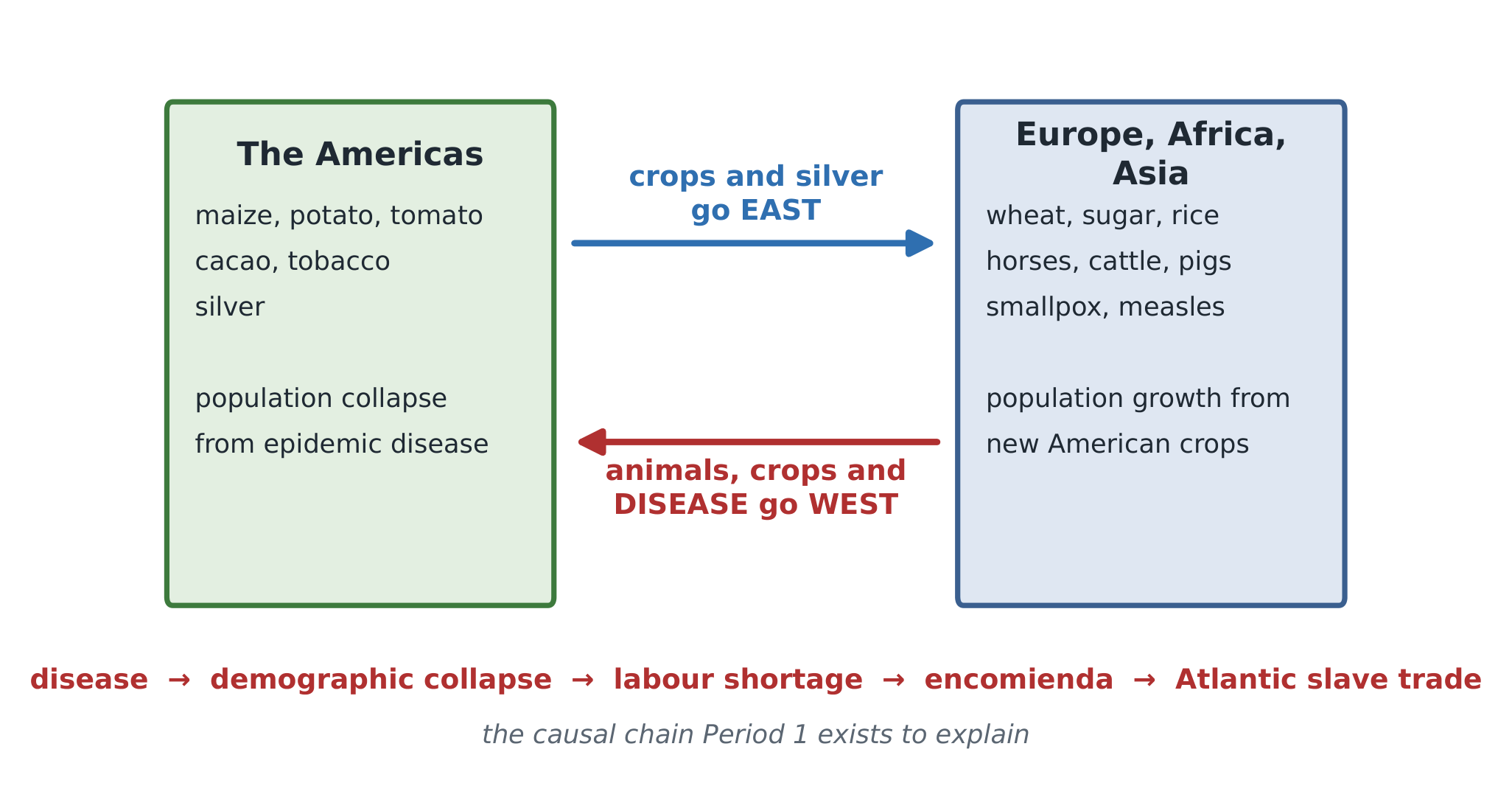
- The Columbian Exchange 哥伦布大交换 is the transfer of plants, animals, diseases and people between the Americas, Europe and Africa after 1492.
- To Europe and Africa: maize, potatoes, tomatoes, cacao. To the Americas: wheat, sugar cane, horses, cattle, pigs.
Match each item to the direction it travelled.
Dificuldade 2/5 · Moedas 140 + pequeno bônus na primeira conclusão hoje
Both directions.
Disease and population collapse
- Native Americans had no immunity to smallpox 天花, measles and influenza. Within a century, native populations in many regions fell by perhaps 50 to 90%.
- Labour shortages pushed Europeans to bring enslaved Africans to the Americas.
Why did European diseases kill so many Native Americans?
Dificuldade 1/5 · Moedas 100 + pequeno bônus na primeira conclusão hoje
Diseases were new to the Americas.
Worked example: a causal chain
How did the horse change the Great Plains?
- Arrival: Spanish colonists brought horses; many spread north after the Pueblo Revolt of 1680.
- Change: peoples such as the Comanche and Lakota became mounted bison hunters, able to travel and trade far more widely.
- Consequence: new mounted powers grew strong enough to resist Spanish and later American expansion for over a century.
Follow the Columbian Exchange as a chain
The marks are for the links, not the endpoints.
Put the chain in order.
Dificuldade 3/5 · Moedas 200 + pequeno bônus na primeira conclusão hoje
Cause to consequence.
Silver changes Europe
- From 1545, the mines of Potosí (in today's Bolivia) sent huge amounts of silver to Spain. Prices across Europe rose — the "price revolution".
- The flow of wealth helped shift Europe from feudalism towards capitalism.
What was one effect of American silver in Europe?
Dificuldade 1/5 · Moedas 100 + pequeno bônus na primeira conclusão hoje
More silver, higher prices.
New ways to fund empires
- A joint-stock company 股份公司 let many investors share the cost and risk of a voyage; the Virginia Company founded Jamestown in 1607.
- New crops such as the potato fed Europe's growing population.
Joint-stock companies let many investors share the risk of colonial ventures.
Dificuldade 1/5 · Moedas 100 + pequeno bônus na primeira conclusão hoje
The Virginia Company is an example.
The exchange was not equal. Europe gained crops, silver and land; the Americas lost most of their native population; Africa lost millions of people to the slave trade. "Exchange" describes the direction of movement, not fairness.
The Columbian Exchange benefited Native Americans and Europeans equally.
Dificuldade 1/5 · Moedas 100 + pequeno bônus na primeira conclusão hoje
Native populations collapsed.
After 1492, crops, animals, diseases and people crossed the Atlantic both ways. Disease devastated native societies, silver and new crops transformed Europe, and labour shortages fed the Atlantic slave trade.
Explain one way the Columbian Exchange changed Europe and one way it changed the Americas.
Causation.