Why Ships Were Sent
Introduzido| English | Significado |
|---|---|
| Reconquista | The Christian reconquest of Spain from Muslim rulers, completed with the fall of Granada in 1492. |
| caravel/ˈkærævl/ | A small, fast sailing ship developed by the Portuguese that could sail against the wind. |
| conquistador | A Spanish soldier and explorer who conquered lands in the Americas, such as Cortés or Pizarro. |
A contract with the queen, 17 April 1492
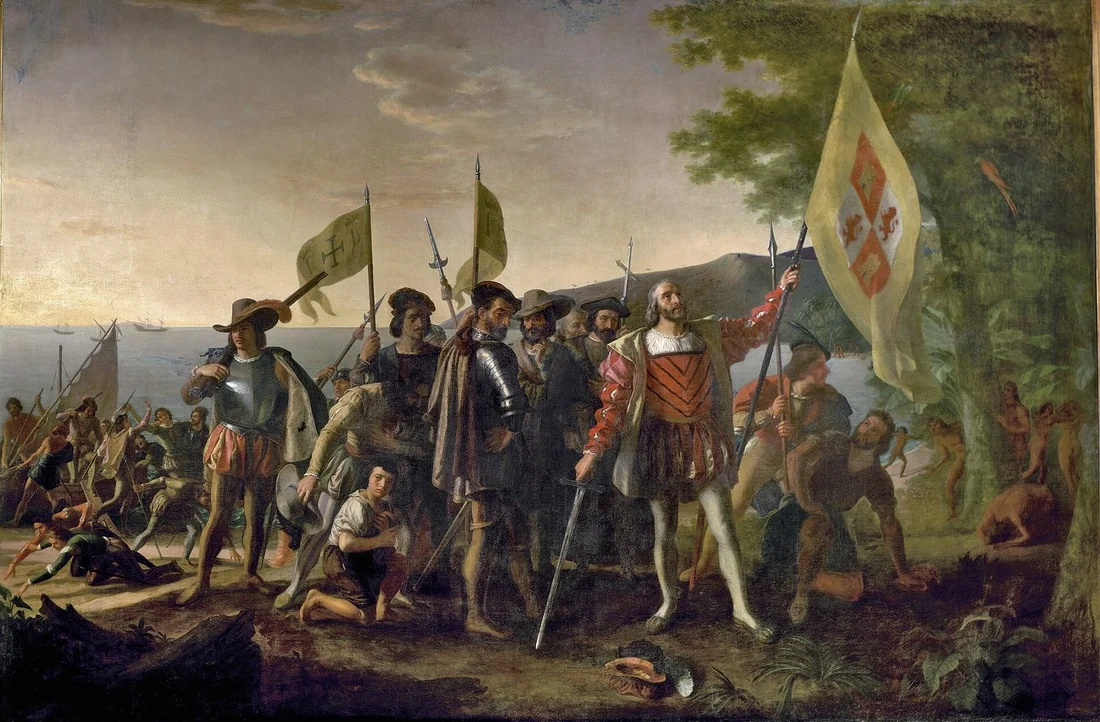
- On 17 April 1492, at Santa Fe outside Granada, Ferdinand and Isabella signed an agreement with Christopher Columbus. If he found new lands, he would become their admiral and governor and keep a tenth of all gold, silver, pearls and spices. Months earlier, the monarchs had conquered Granada, the last Muslim kingdom in Spain.
- Europeans sent ships across the oceans for wealth, power and religion — and new technology made the voyages possible.
What did Columbus's contract promise him?
Dificuldade 1/5 · Moedas 100 + pequeno bônus na primeira conclusão hoje
Santa Fe, 1492.
Three motives
- Gold: Europeans wanted direct access to Asian spices and silk without Muslim and Italian middlemen.
- Glory: monarchs wanted land and power. God: Christians wanted to spread Catholicism, and the end of the Reconquista 收复失地运动 in 1492 fuelled this zeal.
Match each motive to its example.
Dificuldade 2/5 · Moedas 140 + pequeno bônus na primeira conclusão hoje
Three motives.
Competition as a motive
- Portugal was ahead: Dias rounded Africa's southern tip in 1488, and da Gama reached India in 1498.
- Spain backed Columbus partly to catch up. The two powers divided the world in the Treaty of Tordesillas (1494).
Economic, strategic, or religious?
Sort each motive for exploration and conquest.
Put these events in order.
Dificuldade 3/5 · Moedas 200 + pequeno bônus na primeira conclusão hoje
1488, 1492, 1494, 1498.
Worked example: motive is not capacity
- Motive: Europeans had wanted Asian goods for centuries, but could not reach Asia by sea.
- Capacity: the caravel 轻快帆船, a ship that could sail against the wind; the magnetic compass and the astrolabe for navigation; and new maps.
- Money: monarchs who had centralized power, like Ferdinand and Isabella, could pay for voyages.
Which gave Europeans the capacity to explore?
Dificuldade 2/5 · Moedas 140 + pequeno bônus na primeira conclusão hoje
Desire was a motive.
Religion stated openly
- Columbus wrote that he hoped to convert the peoples he met. Spanish law later required conquistadors to read a demand to accept Christianity before attacking.
- Missionaries travelled with every Spanish expedition.
The results
- Spanish conquistadors 征服者 such as Cortés (Mexico, 1521) and Pizarro (Peru, 1533) conquered great empires.
- American silver made Spain the richest power in Europe in the sixteenth century.
Pizarro conquered the Inca Empire in Peru.
Dificuldade 1/5 · Moedas 100 + pequeno bônus na primeira conclusão hoje
By 1533.
Do not explain exploration by motives alone. Europeans had long wanted Asian wealth. New ships, navigation tools and stronger states explain why voyages happened after 1450.
Motives alone explain why exploration began after 1450.
Dificuldade 1/5 · Moedas 100 + pequeno bônus na primeira conclusão hoje
Capacity mattered too.
Europeans explored for gold, glory and God, and rivalry between Portugal and Spain pushed them further. New ships, compasses and centralized states with money gave them the capacity. Spain's conquests brought it great wealth and spread Catholicism in the Americas.
Explain why Spain sponsored Columbus's voyage in 1492.
Causation.