Before Anyone Crossed
Introduzido| English | Significado |
|---|---|
| maize/meɪz/ | A grain domesticated in the Americas and central to many Indigenous diets. |
| contextualization/kənˌtekstʃuːəlaɪˈzeɪʃn/ | Describing the wider situation — the conditions and events around a topic — that helps explain it. |
A city on the Mississippi
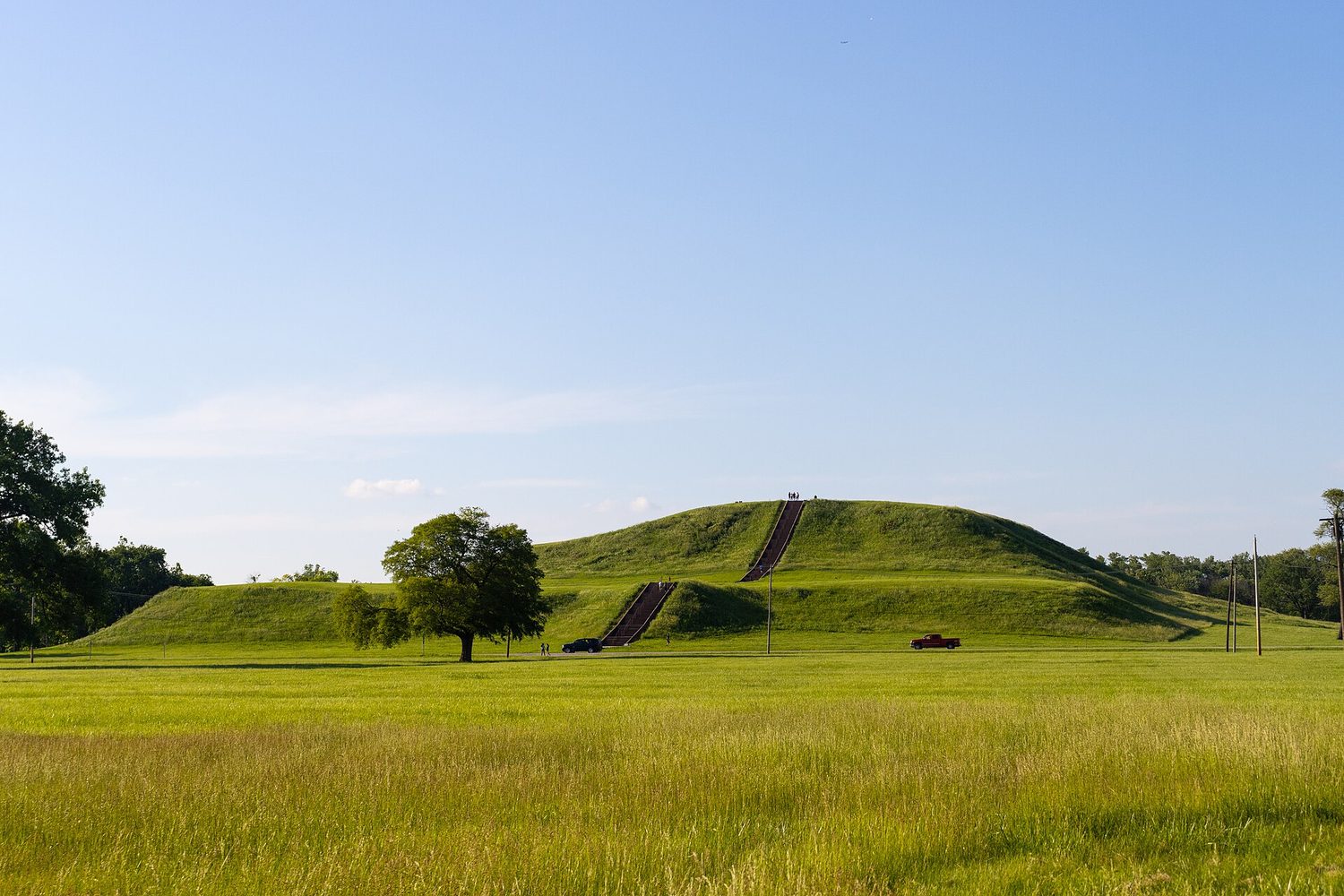
- Around the year 1100, Cahokia, near today's St Louis, may have held 10 000 to 20 000 people — a city comparable in size to London at the time. Its largest earth mound, Monks Mound, covers more ground than the Great Pyramid of Giza.
- North America in 1491 was not empty or simple. Millions of people lived in hundreds of different societies.
Cahokia was a large Mississippian city around the year 1100.
Dificuldade 1/5 · Moedas 100 + pequeno bônus na primeira conclusão hoje
Perhaps 10 000–20 000 people.
Societies shaped by environments
- In the dry Southwest, Pueblo peoples grew maize 玉米 with irrigation canals and built multi-storey adobe towns.
- On the Great Plains and in the Great Basin, scarce water meant small, mobile groups that hunted and gathered.
And environments shaped by societies
- In the Northeast and the Mississippi valley, peoples combined farming, hunting and gathering in permanent villages; the Haudenosaunee (Iroquois) lived in longhouses.
- Native peoples also changed the land: they burned forest undergrowth to create hunting grounds and dug canals to move water.
Match each region to the way of life that fitted its environment.
Dificuldade 2/5 · Moedas 140 + pequeno bônus na primeira conclusão hoje
Environment shaped each society.
Which shows native peoples transforming their environment?
Dificuldade 1/5 · Moedas 100 + pequeno bônus na primeira conclusão hoje
Fire changed the forest.
Worked example: a contextualization paragraph
Prompt: Explain the context for European encounters in the Americas, 1491–1607.
- Americas: by 1491 diverse societies already existed, from maize-growing Pueblo towns to mobile Plains bands, each adapted to its environment.
- Europe: monarchs in Spain and Portugal sought gold, trade routes to Asia and converts to Christianity, and new ships (the caravel), the compass and the astrolabe let them sail far from land.
- Africa: West African kingdoms already traded gold and enslaved people with Portuguese merchants. Each condition shaped what contact would become.
Which condition of the encounter?
Sort each element of the context.
Which technology helped Europeans sail far from land?
Dificuldade 1/5 · Moedas 100 + pequeno bônus na primeira conclusão hoje
Fifteenth-century maritime tools.
Why Europe looked west
- "God, gold and glory": Spain finished conquering Granada in 1492 and wanted wealth and Catholic expansion.
- Portugal had already reached West Africa by sea; Columbus hoped to reach Asia by sailing west.
Which motivated Spanish and Portuguese exploration?
Dificuldade 2/5 · Moedas 140 + pequeno bônus na primeira conclusão hoje
God, gold and glory.
West Africa before the Atlantic trade
- Kingdoms such as Mali, Songhai and Benin traded across the Sahara and along the coast.
- Portugal's coastal trading posts, from the 1440s, linked these networks to Europe — and to the slave trade that followed.
"Pre-Columbian America was untouched wilderness" is a myth. Native peoples farmed, built cities, traded over long distances and managed forests with fire. Europeans arrived in a continent already shaped by human hands.
North America in 1491 was an untouched wilderness.
Dificuldade 1/5 · Moedas 100 + pequeno bônus na primeira conclusão hoje
People had shaped it for thousands of years.
In 1491, North America held many distinct societies adapted to — and changing — their environments. European motives (wealth, faith, power) and maritime technology, together with West African trade networks, set the conditions for the encounters that began in 1492.
Write a three-sentence context paragraph for the question: "Explain the causes of European exploration of the Americas after 1492."
Contextualization.