Classical Conditioning
Introduzido| English | Significado |
|---|---|
| classical conditioning/ˈklæsɪkl kənˈdɪʃənɪŋ/ | classical conditioning |
| unconditioned stimulus/ʌŋkənˈdɪʃnd ˈstɪmjʊləs/ | estímulo incondicionado |
| unconditioned response/ʌŋkənˈdɪʃnd rɪˈspɒns/ | resposta incondicionada |
| neutral stimulus/ˈnjuːtrəl ˈstɪmjʊləs/ | estímulo neutro |
| conditioned stimulus/kənˈdɪʃnd ˈstɪmjʊləs/ | estímulo condicionado |
| conditioned response/kənˈdɪʃnd rɪˈspɒns/ | resposta condicionada |
| acquisition/əkwɪˈsɪʃn/ | acquisition |
| extinction/ekˈstɪŋkʃn/ | extinction |
| spontaneous recovery/spɒnˈteɪnɪəs rɪˈkʌvəri/ | recuperação espontânea |
| generalisation/ˌdʒenərəlaɪˈzeɪʃn/ | generalisation |
| discrimination/dɪˌskrɪmɪˈneɪʃn/ | discrimination |
| higher-order conditioning/ˈhaɪə ˈɔːdə kənˈdɪʃənɪŋ/ | higher-order conditioning |
| habituation/ˌhæbɪtʃuːˈeɪʃn/ | A different process: a weaker response to one repeated stimulus, with no association formed. |
| phobias/ˈfəʊbɪəz/ | fobias |
| counterconditioning/ˈkaʊntəkəndɪʃənɪŋ/ | counterconditioning |
| biological preparedness/ˌbaɪəˈlɒdʒɪkl prɪˈpeədnəs/ | preparação biológica |
| taste aversions/teɪst əˈvɜːʃnz/ | taste aversions |
| one-trial conditioning/wʌn ˈtraɪəl kənˈdɪʃənɪŋ/ | condicionamento em uma única tentativa |
A sound that makes your mouth water
- In the 1890s Ivan Pavlov was studying digestion in dogs. He noticed that the dogs began to salivate before food arrived: at the sight of the assistant, or at a sound that always came before feeding. They had learned that the sound meant food.
- Classical conditioning 经典条件反射 is learning by association: a stimulus that meant nothing comes to trigger a response because it reliably comes just before another stimulus that already triggers it. Nothing is rewarded and nothing is chosen.
The four terms
- The unconditioned stimulus 无条件刺激 (UCS, food) naturally produces the unconditioned response 无条件反应 (UCR, salivation). No learning is needed.
- A neutral stimulus 中性刺激 (NS, a tone) is paired with the UCS, the NS just before. After pairing it is the conditioned stimulus 条件刺激 (CS), and the response it now produces alone is the conditioned response 条件反应 (CR). The UCR and CR are usually the same behaviour; what differs is which stimulus causes it.
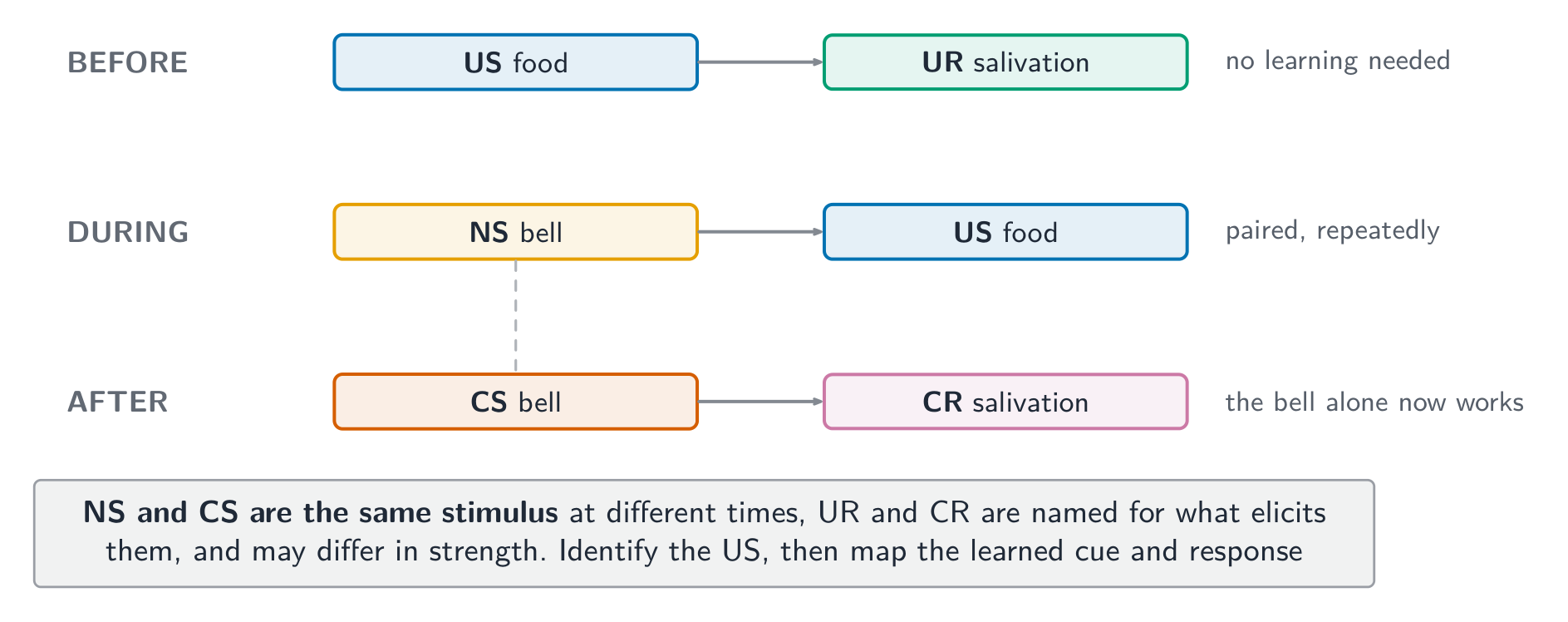
NS and CS are the same stimulus at different times- identify the US first
Pairing turns a neutral stimulus into a conditioned stimulus.
Condition a response in three stages
NS and CS are the same stimulus at different times, and so are UR and CR. Identify the US first.
Finding the terms in any scenario
- Step 1: find the response that happens without learning (fear of a loud noise, nausea from a virus): that is the UCR, and its cause is the UCS. Step 2: find what was paired with it and now causes the response alone: that is the CS, and the learned response is the CR.
- Example: a child gets a painful injection (UCS → pain and fear, UCR) from a nurse in a white coat. Later the child cries when seeing anyone in a white coat. White coat = CS; crying with fear = CR.
In Pavlov's study, the bell after conditioning is the...
Dificuldade 1/5 · Moedas 100 + pequeno bônus na primeira conclusão hoje
The bell started neutros and became the CS; salivation to it is the CR.
What happens to a conditioned response
- Acquisition 习得 builds the association through repeated pairing (fastest when the NS comes about half a second before the UCS). Extinction 消退: the CR weakens when the CS keeps appearing without the UCS. Spontaneous recovery 自发恢复: after a rest, the CR returns in a weaker form.
- Generalisation 泛化: the CR spreads to stimuli similar to the CS (a similar tone). Discrimination 辨别: the learner responds to the CS but not to other stimuli. Higher-order conditioning 高阶条件反射: a CS is used like a UCS to condition a new stimulus (a light paired with the tone).
Presenting the CS repeatedly without the UCS weakens the response — this is ____.
Dificuldade 1/5 · Moedas 100 + pequeno bônus na primeira conclusão hoje
Extinction weakens the association; spontaneous recovery later brings it partly back.
Select todos the processes that describe how a conditioned response changes.
Dificuldade 2/5 · Moedas 140 + pequeno bônus na primeira conclusão hoje
Scaffolding is a Vygotskian developmental term, not a conditioning process.
A dog has learned to salivate to a tone. Now a light is flashed just before the tone, with no food, and soon the light alone makes the dog salivate. This is
Dificuldade 1/5 · Moedas 100 + pequeno bônus na primeira conclusão hoje
The tone, already a conditioned stimulus, works like a UCS to condition the light.
Habituation is not classical conditioning. Conditioning forms an association between two stimuli; habituation is simply a fading response to one repeated stimulus. The CED lists them together precisely because they are easy to confuse.
Conditioned emotions: Little Albert
- In 1920 John Watson and Rosalie Rayner showed an 11-month-old boy, "Little Albert", a white rat (NS) while making a loud noise behind him (UCS → fear, UCR). After several pairings, Albert cried at the rat alone (CS → fear, CR), and his fear generalised to a rabbit and a fur coat. The study would be judged unethical today.
- This is the behavioural explanation of some phobias 恐惧症. Counterconditioning 对抗条件作用 replaces the fear with a calm response, the basis of exposure therapies in Unit 5.
In the Little Albert study, what was the unconditioned stimulus?
Dificuldade 1/5 · Moedas 100 + pequeno bônus na primeira conclusão hoje
The noise caused fear without any learning. The rat was the neutral stimulus that became the conditioned stimulus; fear was the response.
Taste aversion and biological preparedness
- Taste aversions 味觉厌恶 can form after a single pairing, even when illness comes hours later: one-trial conditioning 一次试验条件作用. John Garcia found that rats easily learned to avoid a taste paired with nausea, but not a light or sound paired with nausea.
- This shows biological preparedness 生物准备性: animals learn some associations, which helped their ancestors survive, far more easily than others. Habituation 习惯化 is a different process: a weaker response to one repeated stimulus, with no association formed.
Habituation is a type of classical conditioning.
Dificuldade 1/5 · Moedas 100 + pequeno bônus na primeira conclusão hoje
Conditioning links two stimuli; habituation is a fading response to um repeated stimulus.
Match each phenomenon to what makes it unusual.
Dificuldade 2/5 · Moedas 140 + pequeno bônus na primeira conclusão hoje
Taste aversion breaks the usual rules; generalisation and discrimination widen and narrow.
Worked AP-style question
Question: Every evening, Kai's phone plays a short tune just before his mother calls him to a dinner he enjoys, and his mouth waters when he smells the food. After some weeks, his mouth waters whenever he hears the tune. (a) Identify the unconditioned stimulus and the conditioned stimulus. (b) Explain how extinction could occur. (c) Explain how generalisation could appear.
(a) UCS: the smell of the food, which makes his mouth water without learning. CS: the tune, which was neutral but now causes his mouth to water.
(b) If the tune starts to play many times without dinner following (for example, his mother changes the tune's use to a reminder alarm), his mouth will water less and less at the tune until it stops.
(c) His mouth might also water when he hears a different tune that sounds similar to the original one.
- Why it scores: (a) names the stimuli as things (smell, tune), not responses; (b) says the CS appears without the UCS, not just "he stops responding"; (c) uses a stimulus similar to the CS.
AP practice. Rosa was stung by a bee in her garden and felt sharp pain and fear. Now she feels afraid when she hears buzzing, even from a fly. (a) Identify the UCS, UCR, CS and CR. (b) Explain how generalisation appears in this example. (c) Describe how counterconditioning could help Rosa.
Find the unlearned response first, then the stimulus that now causes it.
Classical conditioning pairs a neutral stimulus with a UCS until it becomes a CS producing a CR. Acquisition, extinction, spontaneous recovery, generalisation, discrimination and higher-order conditioning describe its course. Emotions can be conditioned (Little Albert) and unlearned (counterconditioning). Taste aversion needs only one trial because of biological preparedness; habituation is not conditioning.
Write from 12 pairings and then 8 alone
- A bell is paired with food 12 times, and the bell then produces salivation. The bell is later presented alone for 8 trials and salivation stops.
- Name acquisition and extinction.
After 12 pairings a bell produces salivation. After 8 presentations of the bell alone, salivation stops. What are those two stages, and what is the bell?
Acquisition builds the response. Extinction presents the conditioned stimulus without the unconditioned stimulus.
What are the 8 alone presentations?
Dificuldade 1/5 · Moedas 100 + pequeno bônus na primeira conclusão hoje
The bell alone, for 8 trials, is extinction of the conditioned response.