Comparing Competing Models · Comparando Modelos Concorrentes
| English | Português |
|---|---|
| linear model/ˈlɪnɪə ˈmɒdl/ | modelo linear |
| quadratic model/kwɒˈdrætɪk ˈmɒdl/ | modelo quadrático |
| exponential model/ˌekspəˈnenʃl ˈmɒdl/ | modelo exponencial |
| residuals/rɪˈsɪdʒuːəlz/ | resíduos |
Three curves, one data set
- The same scatter of points could be fit by a line, a parabola, or an exponential.
- Each will pass near the data, but only one captures its true shape.
- Picking the wrong family gives predictions that drift badly.
- So how do we decide which model actually deserves our trust?
Três curvas, um conjunto de dados
- O mesmo agrupamento de pontos poderia ser ajustado por uma linha, uma parábola ou uma exponencial.
- Cada uma passará perto dos dados, mas apenas uma captura sua verdadeira forma.
- Escolher a família errada dá previsões que desviam muito.
- Então como decidimos qual modelo realmente merece nossa confiança?
Try each family
- Fit a linear model 线性模型, a quadratic model 二次模型, and an exponential model 指数模型 to the same points.
- Each one produces a formula and a curve through the cloud of data.
- Look at where each curve sits relative to the points.
- A line cannot bend; a parabola bends once; an exponential curves ever upward.
Tente cada família
- Ajuste um modelo linear 线性模型, um modelo quadrático 二次模型, e um modelo exponencial 指数模型 aos mesmos pontos.
- Cada um produz uma fórmula e uma curva através da nuvem de dados.
- Observe onde cada curva fica em relação aos pontos.
- Uma linha não pode curvar; uma parábola curva uma vez; uma exponencial curva sempre para cima.
Residuals judge the fit
- A residual 残差 is the gap between a data value and the model's prediction there.
- Small residuals, scattered with no pattern, mean a good fit.
- Large residuals, or residuals that curve, mean the wrong family.
- Comparing residuals is how you rank competing models with evidence.
Resíduos julgam o ajuste
- Um resíduo 残差 é a diferença entre um valor de dado e a previsão do modelo naquele ponto.
- Resíduos pequenos, espalhados sem padrão, significam um bom ajuste.
- Resíduos grandes, ou resíduos que curvam, significam a família errada.
- Comparar resíduos é como você classifica modelos concorrentes com evidências.
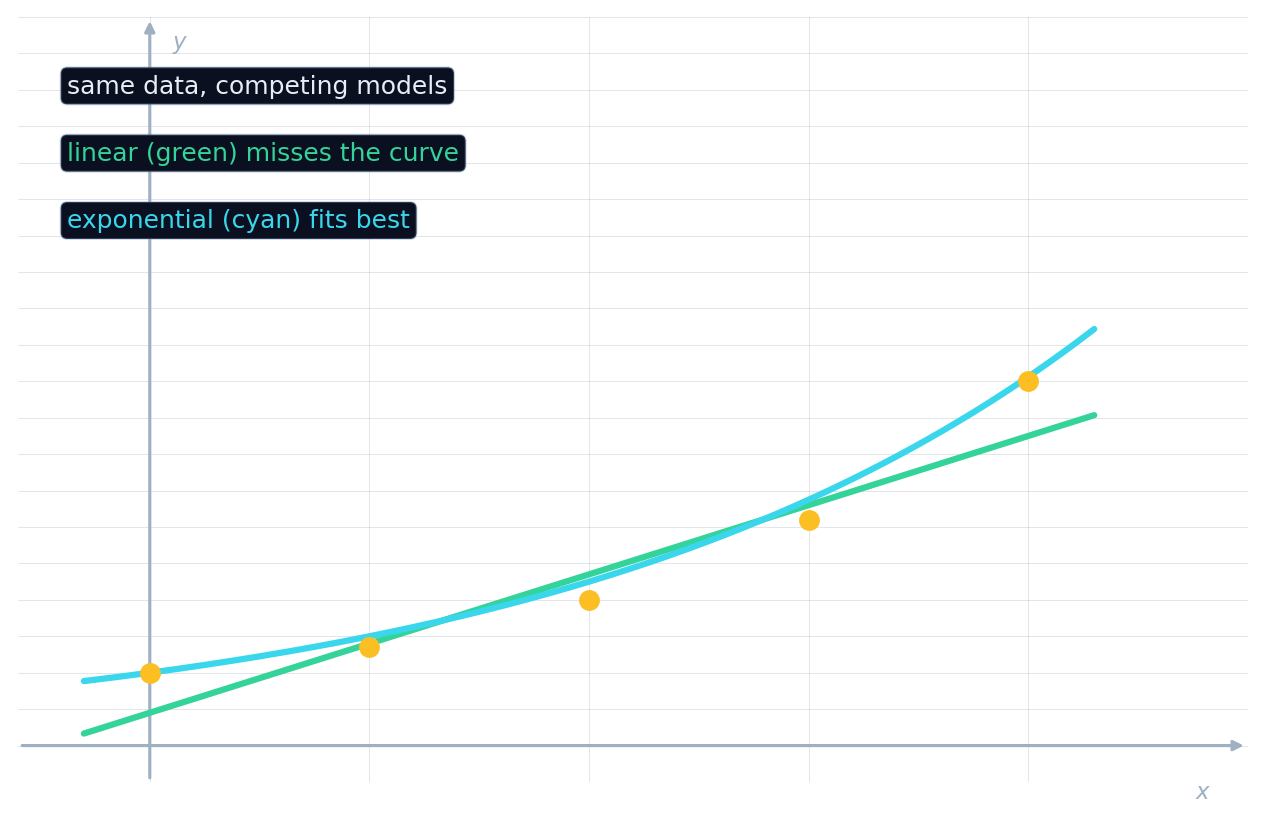
A curve a straight line cannot match · Uma curva que uma linha reta não consegue corresponder
y = a·bˣ
An exponential bends to hug curved data. Try lowering the base toward 1 to see it flatten toward a line. · Uma exponencial se curva para abraçar dados curvos. Tente reduzir a base em direção a 1 para vê-la achatando em direção a uma linha.
A residual is the difference between… · Um resíduo é a diferença entre…
A residual = observed − predicted. Small residuals mean the model fits the data closely. · Resíduo = observado − previsto. Pequenos resíduos significam que o modelo se ajusta bem aos dados.
To judge how well a model matches data, examine the size of its ____. · Para julgar o quanto um modelo se ajusta aos dados, examine o tamanho de seus ____.
Smaller residuals (and no obvious pattern in them) signal a better-fitting model. · Resíduos menores (e nenhum padrão óbvio neles) indicam um modelo com melhor ajuste.
Exponential eventually wins
- Over a long enough range, an exponential outgrows every polynomial.
- Even $x^{100}$ is left behind once $2^x$ gets going.
- So for data that keeps multiplying, the exponential is the natural long-run model.
- Polynomials curve, but they cannot keep up with steady doubling.
Exponencial eventualmente vence
- Sobre um intervalo longo o suficiente, uma exponencial supera todo polinômio.
- Mesmo $x^{100}$ fica para trás uma vez que $2^x$ começa a crescer.
- Então, para dados que continuam a multiplicar, a exponencial é o modelo natural de longo prazo.
- Polinômios curvam, mas não conseguem acompanhar a duplicação constante.
Given enough time, an exponential model eventually grows faster than any polynomial model. · Com tempo suficiente, um modelo exponencial eventualmente cresce mais rápido do que qualquer modelo polinomial.
Exponential growth outpaces $x^2, x^3,$ even $x^{100}$ in the long run — the exponent always wins. · Crescimento exponencial supera $x^2, x^3,$ mesmo $x^{100}$ a longo prazo — o expoente sempre vence.
Select all · todos true statements about comparing models. · Selecione todas as afirmações verdadeiras sobre a comparação de modelos.
The best fit has the smallest residuals, not the biggest. The other three are correct. · O melhor ajuste possui os menores resíduos, não os maiores. As outras três estão corretas.
Choose with context and evidence
- Use the residuals, but also use what you know about the situation.
- A savings account earns interest → exponential; a falling object → quadratic.
- Prefer the simplest model that fits well and makes physical sense.
- Justify your choice with both the data and the story behind it.
Escolha com contexto e evidências
- Use os resíduos, mas também use o que você sabe sobre a situação.
- Uma conta poupança rende juros → exponencial; um objeto caindo → quadrático.
- Prefira o modelo mais simples que se ajusta bem e faz sentido físico.
- Justifique sua escolha com tanto os dados quanto a história por trás deles.
Data doubling at a steady rate is best modeled by a… · O duplicação de dados em uma taxa constante é melhor modelada por um…
Constant-ratio doubling is the hallmark of an exponential model, not a polynomial one. · A duplicação de razão constante é a marca distintiva de um modelo exponencial, não de um polinomial.
A wiggly high-degree polynomial can pass through every point and still be a terrible model — it swings wildly between the data and predicts nonsense outside it. A close fit alone is not enough; the family must match the underlying behavior.
Um polinômio de alto grau oscilante pode passar por cada ponto e ainda ser um péssimo modelo — ele balança selvagememente entre os dados e prevê nonsense fora dele. Um ajuste próximo sozinho não é suficiente; a família deve corresponder ao comportamento subjacente.
Sales over four months: $100, 150, 225, 340$.
- Ratios: $150/100 = 1.5$, $225/150 = 1.5$, $340/225 \approx 1.5$ — nearly constant.
- A constant ratio points to an exponential model, not a line.
- Model: $S \approx 100 \cdot 1.5^{\,m}$, matching the roughly $50\%$ monthly growth.
Vendas em quatro meses: $100, 150, 225, 340$.
- Razões: $150/100 = 1.5$, $225/150 = 1.5$, $340/225 \approx 1.5$ — quase constantes.
- Uma razão constante aponta para um modelo exponencial, não uma linha.
- Modelo: $S \approx 100 \cdot 1.5^{\,m}$, correspondendo ao crescimento mensal de aproximadamente $50\%$.
To compare a linear model, quadratic model, and exponential model on the same data, examine the residuals — smaller is better. Remember an exponential eventually outgrows any polynomial, and let both the evidence and the context guide your final choice.
Para comparar um modelo linear, modelo quadrático e modelo exponencial nos mesmos dados, examine os resíduos — quanto menores, melhor. Lembre-se que uma função exponencial eventualmente supera qualquer polinômio, e deixe tanto a evidência quanto o contexto guiar sua escolha final.