Funções Racionais e Raízes
Introduzido| English | Significado |
|---|---|
| rational function/ˈræʃənl ˈfʌŋkʃn/ | função racional |
| zeros/ˈzɪərəʊz/ | zeros |
| numerator/ˈnjuːməreɪtə/ | numerador |
| domain/dəˈmeɪn/ | domínio |
| denominator/dɪˈnɒmɪneɪtə/ | denominador |
When is a fraction zero?
- Think of $\frac{0}{5}$, $\frac{5}{5}$, and $\frac{5}{0}$: only the first is zero.
- A fraction is zero exactly when its top is zero — the bottom just cannot be zero too.
- Rational functions follow the same simple rule.
- So finding their zeros means looking only at the numerator.
Zeros come from the numerator
- A rational function 有理函数 is $\frac{\text{numerator}}{\text{denominator}}$.
- Its zeros 零点 are the inputs that make the whole thing equal $0$.
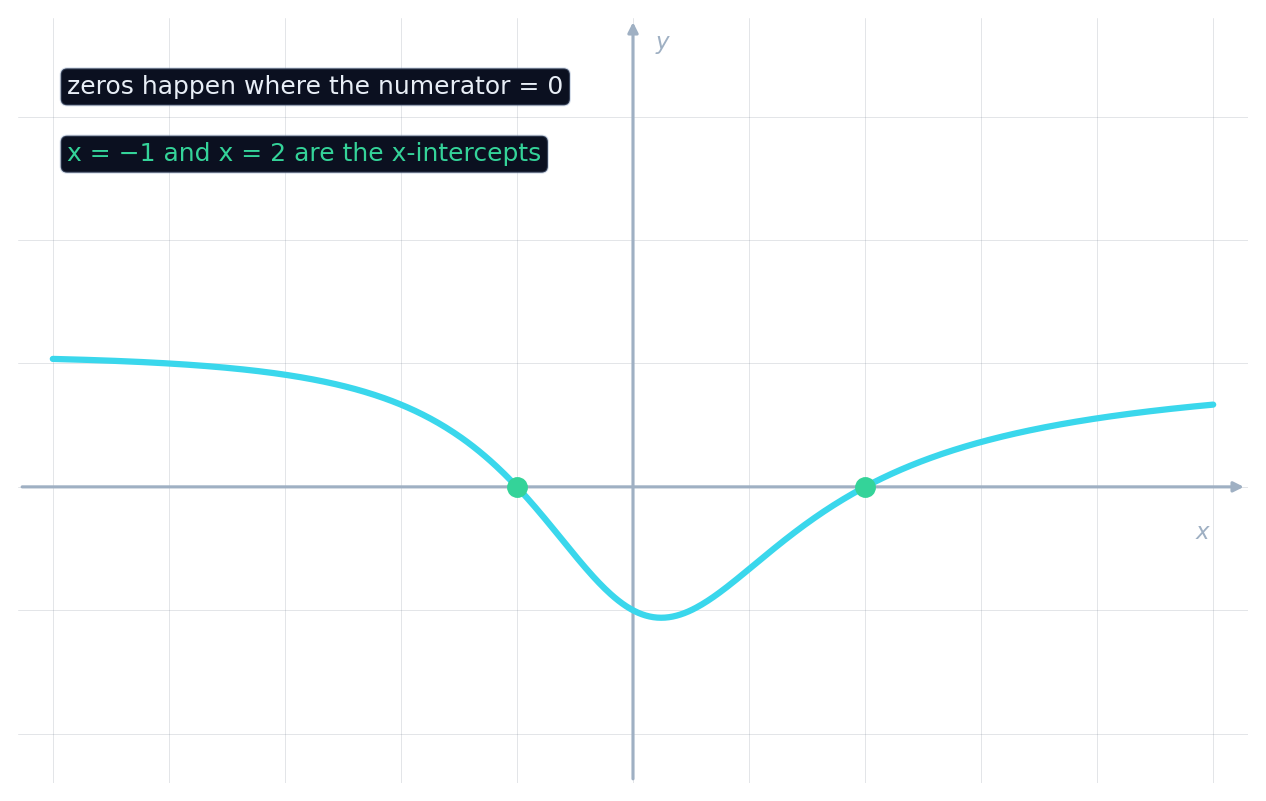
- That happens only where the numerator 分子 equals $0$.
- So set the top equal to zero and solve — those are your candidate x-intercepts.
Uma fração é igual a zero exatamente quando…
Dificuldade 1/5 · Moedas 100 + pequeno bônus na primeira conclusão hoje
Uma fração só é zero quando seu topo é zero (e seu fundo não é). $\frac{0}{5} = 0$, mas $\frac{5}{0}$ é indefinido.
…but only if they are allowed
- A candidate zero counts only if the value is in the domain 定义域 of the function.
- If it also makes the denominator 分母 zero, the function is undefined there — no zero.
- So check each numerator zero against the bottom before you trust it.
Onde ela cruza e onde ela quebra?
y = a/(x − b) + c
A curva cruza o eixo x em sua raiz, mas quebra em x = b onde o denominador é zero. São dois lugares diferentes.
Uma raiz do numerador é uma raiz real da função apenas se esse valor estiver no ____ da função.
Dificuldade 1/5 · Moedas 100 + pequeno bônus na primeira conclusão hoje
Se um valor zera tanto o numerador quanto o denominador, ele não está no domínio, logo é um buraco, não um zero.
Excluded values are not zeros
- A value that makes only the denominator zero is excluded from the domain.
- There the function is undefined — it produces a vertical asymptote or a hole, not a zero.
- Never call an excluded value an x-intercept.
- Zero on top → a zero of the function; zero on the bottom → trouble, not a zero.
Um valor que torna o denominador zero é uma raiz da função.
Dificuldade 1/5 · Moedas 100 + pequeno bônus na primeira conclusão hoje
Um denominador zero é excluído do domínio — a função é indefinida lá, não zero.
Verify by evaluating
- To confirm a zero, substitute the value and check that the function really gives $0$.
- $f(x) = \frac{x-4}{x+1}$ at $x = 4$: $\frac{0}{5} = 0$. Yes — $x = 4$ is a zero.
- The same test rejects an excluded value, because you would be dividing by zero.
- Evaluating is the reliable final check.
Quantos zeros tem $f(x) = \dfrac{(x-3)(x+2)}{x^2+1}$?
Dificuldade 2/5 · Moedas 140 + pequeno bônus na primeira conclusão hoje
O numerador é zero em $x = 3$ e $x = -2$; o denominador $x^2+1$ nunca é zero, então ambos são válidos — $2$ zeros.
Selecione todas as afirmações verdadeiras sobre os zeros de uma função racional.
Dificuldade 2/5 · Moedas 140 + pequeno bônus na primeira conclusão hoje
Um zero do denominador é excluído, não um intercepto x. As outras três estão corretas.
Do not confuse a numerator zero (a real zero, an x-intercept) with a denominator zero (an excluded value). They are opposite: one is where the graph touches the axis, the other is where the graph breaks.
Find the zeros of $f(x) = \dfrac{(x-2)(x+3)}{x-2}$.
- Numerator zero candidates: $x = 2$ and $x = -3$.
- But $x = 2$ also makes the denominator zero, so it is excluded — a hole, not a zero.
- Only $x = -3$ is a real zero of the function.
The zeros of a rational function are the zeros of its numerator that lie in the domain. A value that makes the denominator zero is excluded, not a zero. Always check numerator zeros against the bottom, and verify by evaluating.
Write from the data given
- f of x equals (x minus 1)(x minus 4)(x plus 5) divided by (x squared plus 4).
- Count the zeros.
Quantos zeros tem f(x) = (x − 1)(x − 4)(x + 5) dividido por (x² + 4)?
Três fatores do numerador permanecem.
Quantos zeros tem a função?
Dificuldade 1/5 · Moedas 100 + pequeno bônus na primeira conclusão hoje
O denominador não cancela nenhum zero do numerador. Outras opções — 2 zeros (contagem da lição); 5 zeros (as constantes somadas).