Change in Momentum and Impulse
Introduzido| English | Significado |
|---|---|
| impulse/ˈɪmpʌls/ | impulso |
| impulse-momentum theorem/ˈɪmpʌls məʊˈmentəm ˈθɪərəm/ | teorema do impulso e momento |
| contact time/ˈkɒntækt taɪm/ | tempo de contato |
Why airbags save lives
- In a crash, your body must stop — there is no avoiding that.
- An airbag cannot change how much your motion changes, only how long it takes.
- By stretching the stop from a hundredth of a second to a tenth, it cuts the force tenfold.
- The physics behind this is impulse.
Impulse
- Impulse 冲量 is force applied over time:
- It is the area under a force-versus-time graph.
- A big force for a short time can equal a small force for a long time.
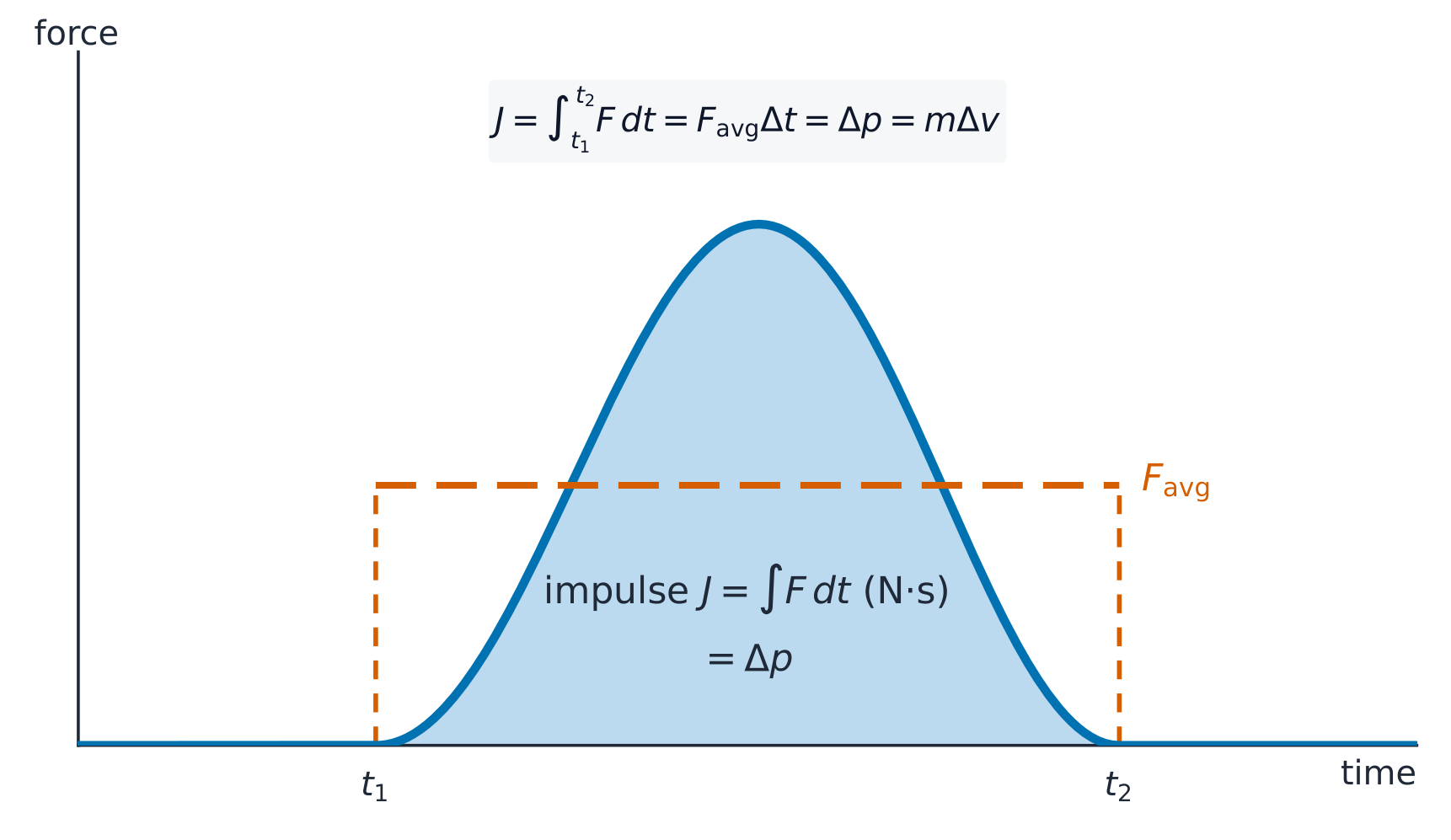
Impulse is the area under a force-time graph and equals the change in momentum
A force of $50\ \text{N}$ acts for $0.4\ \text{s}$. What impulse does it deliver (in N·s)?
Dificuldade 2/5 · Moedas 140 + pequeno bônus na primeira conclusão hoje
$J = F\Delta t = 50 \times 0.4 = 20\ \text{N}\cdot\text{s}$.
The impulse delivered by a varying force equals the area under its force-versus-time graph.
Dificuldade 1/5 · Moedas 100 + pequeno bônus na primeira conclusão hoje
$J = \int F\,dt$ is exactly that area.
The impulse-momentum theorem
- The impulse-momentum theorem 冲量动量定理 says impulse equals the change in momentum:
- To change an object's momentum, apply a force for some time.
- The bigger the impulse, the bigger the change in motion.
An impulse of $12\ \text{N}\cdot\text{s}$ acts on a $3\ \text{kg}$ cart at rest. Its final speed (in m/s)?
Dificuldade 2/5 · Moedas 140 + pequeno bônus na primeira conclusão hoje
$J = \Delta p = m\Delta v$, so $\Delta v = 12/3 = 4\ \tfrac{\text{m}}{\text{s}}$ from rest.
Newton's law, deeper
- Differentiating gives Newton's second law in its truest form:
- Force is the rate of change of momentum.
- For constant mass this reduces to the familiar $F = ma$.
Impulse and momentum change
Impulse is force times time, and it equals the change in momentum. Sort each case.
In its most general form, the net force equals the rate of change of ____.
Dificuldade 1/5 · Moedas 100 + pequeno bônus na primeira conclusão hoje
$\vec{F}_{net} = d\vec{p}/dt$ -- force is the time rate of change of momentum.
Stretch the time, soften the blow
- For a fixed change in momentum, a longer contact time 接触时间 means a smaller average force ($F = \Delta p / \Delta t$).
- Airbags, crumple zones, bent knees on landing, and catching an egg gently all use this.
- Same momentum change, gentler force.
An airbag reduces injury by...
Dificuldade 1/5 · Moedas 100 + pequeno bônus na primeira conclusão hoje
The momentum change is fixed; the airbag stretches the time, so the average force $F = \Delta p/\Delta t$ drops.
Two identical balls hit a wall with the same incident speed. One bounces back and the other stops. The magnitude of the bouncing ball's momentum change is... that of the stopped ball.
Dificuldade 1/5 · Moedas 100 + pequeno bônus na primeira conclusão hoje
For mass m and incident speed u, stopping changes momentum by magnitude mu. Rebounding with speed w gives magnitude m(u + w), which is larger. Equal incident and rebound speeds give twice the stopping impulse.
A $0.15\ \text{kg}$ ball hits a wall at $20\ \tfrac{\text{m}}{\text{s}}$ and bounces back at $20\ \tfrac{\text{m}}{\text{s}}$.
- Change in momentum: $\Delta p = m(v_f - v_i) = 0.15(-20 - 20) = -6\ \tfrac{\text{kg}\cdot\text{m}}{\text{s}}$.
- If the contact lasts $0.01\ \text{s}$, the average force is $|\Delta p|/\Delta t = 6/0.01 = 600\ \text{N}$.
A bounce changes momentum more than a stop. Coming in at $20$ and leaving at $-20$ is a velocity change of $-40$, with magnitude $40$, not a speed change; the speed stays $20$. Forgetting the sign flip on a bounce is a classic impulse mistake.
Impulse $\vec{J} = \int \vec{F}\,dt$ (the area under an $F$-$t$ graph) equals the change in momentum: $\vec{J} = \Delta\vec{p}$. Since $\vec{F} = d\vec{p}/dt$, stretching the contact time for a fixed momentum change lowers the average force — the secret of every airbag.
Write from the data: find the impulse
- A force of 8 N acts for 3 s.
- Find the impulse and the change in momentum.
A constant net force of 8 N acts in one direction for 3 s. What impulse does it give, and what is the change in momentum?
8 times 3 is 24.
A constant force of 8 N acts in one direction for 3 s. What is its impulse?
Dificuldade 1/5 · Moedas 100 + pequeno bônus na primeira conclusão hoje
Force times time is 8 times 3. Other options — 20 N s (the lesson impulse); 8 N s (the force used as an impulse).