Reference Frames and Relative Motion
Introduzido| English | Significado |
|---|---|
| reference frame/ˈrefrəns freɪm/ | sistema de referência |
| relative velocity/ˈrelətɪv vəˈlɒsɪti/ | velocidade relativa |
How fast are you really walking?
- Stroll forward down the aisle at $2\ \text{km/h}$ in a train moving at $100\ \text{km/h}$ relative to the ground.
- To the passenger beside you, that is your speed.
- To someone standing outside, you are doing $102\ \text{km/h}$.
- Both are right — speed depends on who is watching.
Reference frames
- A reference frame 参考系 is the point of view — the observer — you measure motion against.
- Velocity is always measured relative to some frame.
- Change the frame and the numbers change, even for the same motion.
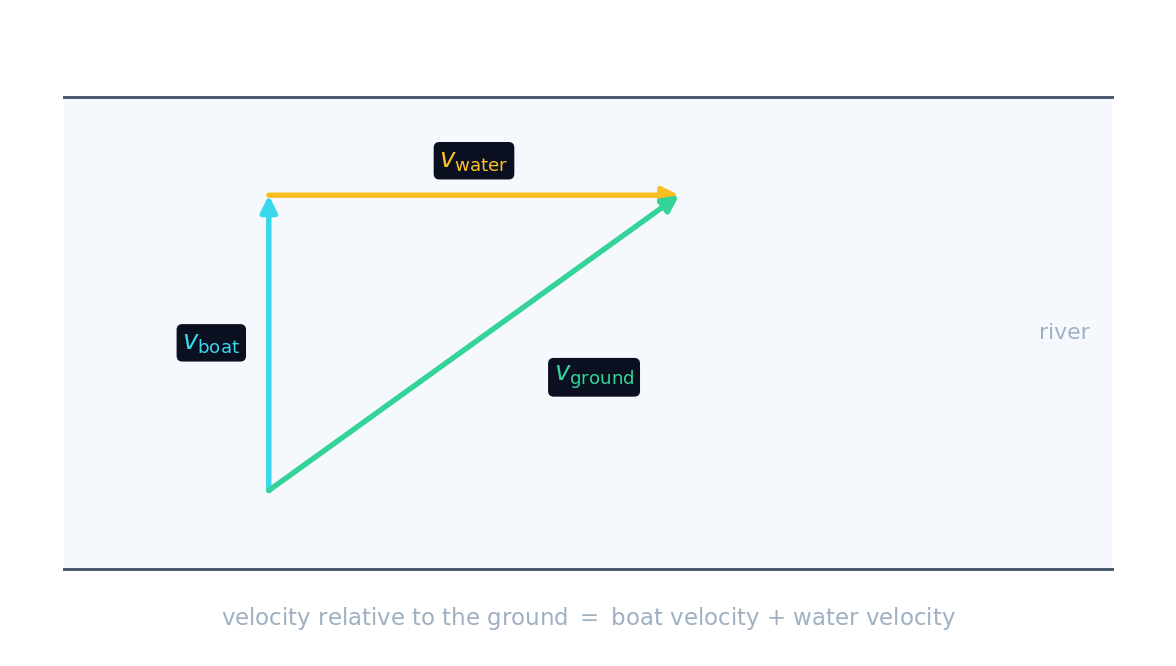
Velocity relative to the ground is the vector sum of the boat's velocity and the water's
The observer or point of view against which you measure motion is called a ____ frame.
Dificuldade 1/5 · Moedas 100 + pequeno bônus na primeira conclusão hoje
A reference frame is the viewpoint; all velocities are stated relative to one.
Relative velocity
- Relative velocity 相对速度 is found by adding velocities as vectors.
- Your velocity relative to the ground = your velocity in the train + the train's velocity.
- Same direction adds; opposite subtracts; at an angle, use components.
You walk forward at $1.5\ \tfrac{\text{m}}{\text{s}}$ in a train moving at $25\ \tfrac{\text{m}}{\text{s}}$. Your speed relative to the ground (in m/s)?
Dificuldade 2/5 · Moedas 140 + pequeno bônus na primeira conclusão hoje
Same direction, so add them, $1.5 + 25 = 26.5\ \tfrac{\text{m}}{\text{s}}$.
Now you walk backward at $1.5\ \tfrac{\text{m}}{\text{s}}$ in the same $25\ \tfrac{\text{m}}{\text{s}}$ train. Your speed relative to the ground (in m/s)?
Dificuldade 2/5 · Moedas 140 + pequeno bônus na primeira conclusão hoje
Opposite directions subtract, $25 - 1.5 = 23.5\ \tfrac{\text{m}}{\text{s}}$.
The addition rule
- The velocity of A relative to C is $\vec{v}_{AC} = \vec{v}_{AB} + \vec{v}_{BC}$.
- Chain the frames: A-relative-to-B, then B-relative-to-C.
- Reverse a subscript pair and you flip the sign: $\vec{v}_{BA} = -\vec{v}_{AB}$.
Velocidade Relativa
Add a boat's velocity across a river to the current's velocity to get its velocity relative to the bank.
To combine velocities across frames, you...
Dificuldade 1/5 · Moedas 100 + pequeno bônus na primeira conclusão hoje
$\vec{v}_{AC} = \vec{v}_{AB} + \vec{v}_{BC}$ -- a vector sum (which becomes plain adding or subtracting along one line).
Pick a smart frame
- Some problems are far easier in the right frame.
- A collision looks simplest in the frame of the center of mass.
- River-crossing problems are easiest split into "relative to water" and "water relative to ground."
There is one single "true" velocity for an object, the same for every observer.
Dificuldade 1/5 · Moedas 100 + pequeno bônus na primeira conclusão hoje
Velocity is always relative to a frame -- different observers measure different velocities for the same object.
Select todos true statements about relative motion.
Dificuldade 2/5 · Moedas 140 + pequeno bônus na primeira conclusão hoje
Velocity is frame-dependent and frames add as vectors; no velocity is absolute.
You walk forward at $2\ \tfrac{\text{m}}{\text{s}}$ inside a train moving at $30\ \tfrac{\text{m}}{\text{s}}$.
- Relative to the ground you move at $2 + 30 = 32\ \tfrac{\text{m}}{\text{s}}$.
- Walk backward instead and it is $30 - 2 = 28\ \tfrac{\text{m}}{\text{s}}$.
There is no single "true" velocity — only velocity relative to a chosen frame. A ball dropped in a moving bus falls straight down to you but follows a curve to someone outside. Always state (or assume) the frame before quoting a velocity.
A reference frame is the observer you measure against; velocity is always relative to one. Combine frames with vector addition: $\vec{v}_{AC} = \vec{v}_{AB} + \vec{v}_{BC}$ (relative velocity). No velocity is absolute — choosing a smart frame can make a hard problem easy.
Write from the data given
- A boat moves at 18 m/s. You walk at 2 m/s along the deck.
- Find your ground speed walking forward and walking back.
A boat moves at 18 m/s relative to the ground. You walk at 2 m/s toward the bow, then later at 2 m/s toward the stern. What is your ground speed in each case?
18 plus 2 is 20. 18 minus 2 is 16.
A boat moves forward at 18 m/s relative to the ground. You walk toward the stern at 2 m/s relative to the boat. What is your ground speed?
Dificuldade 1/5 · Moedas 100 + pequeno bônus na primeira conclusão hoje
The boat and the backward walk are in opposite directions, so 18 minus 2 is 16. Other options — 20 m/s (the forward result); 26.5 m/s (the lesson train speed).