Induced Currents and Magnetic Forces
Introduzido| English | Significado |
|---|---|
| Lenz's law/ˈlentsɪz lɔː/ | lei de Lenz |
| eddy currents/ˈedi ˈkʌrənts/ | correntes parasitas |
The induced current always fights the change that made it
- Push a magnet at a coil and the coil pushes back.
- The induced current flows the way that opposes the incoming change.
- This stubborn opposition is Lenz's law 楞次定律.
- It is the minus sign in Faraday's law, and it comes from energy conservation.
Lenz's law: oppose the change
- The induced current makes its own magnetic field.
- That field points so as to fight the change in flux.
- Push a north pole in, and the coil's near face becomes a north pole to repel it.
- Pull it out, and the coil turns south to try to hold it back.
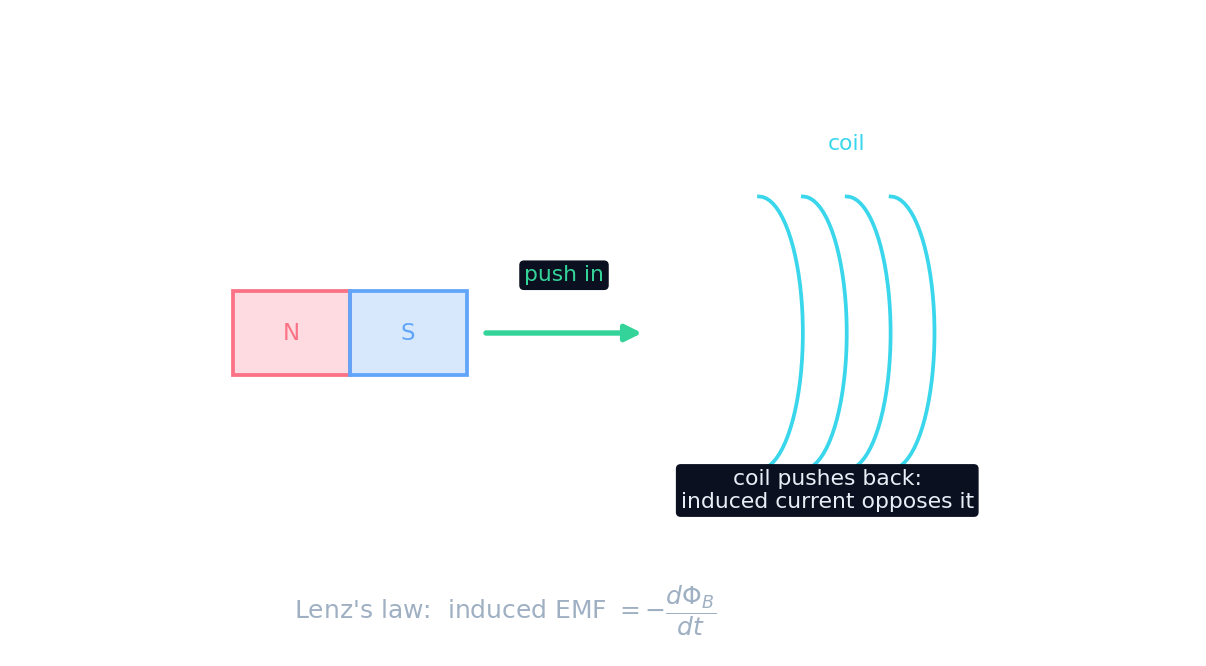
Watch the opposition
Push the magnet in and out and see the induced current reverse to always oppose the change.
The induced current in a coil always flows so that its magnetic field:
Dificuldade 1/5 · Moedas 100 + pequeno bônus na primeira conclusão hoje
Lenz's law: the induced field always opposes the change.
You push a north pole toward a coil. The coil's near face becomes a:
Dificuldade 1/5 · Moedas 100 + pequeno bônus na primeira conclusão hoje
To oppose the approach, the near face turns north and repels.
Why: you can't get free energy
- Suppose the induced current helped the magnet instead of opposing it.
- Then the magnet would speed up on its own, making even more current — free energy.
- That would break energy conservation, so nature forbids it.
- You must do work against the opposition to keep the flux changing.
Lenz's law is a direct consequence of the conservation of:
Dificuldade 1/5 · Moedas 100 + pequeno bônus na primeira conclusão hoje
If the current helped the change, you would get free energy — forbidden.
The opposition feels like a drag
- For a magnet moving toward or away from a closed resistive coil, the induced current produces a resisting force against that motion.
- Move the magnet faster and the drag grows — you push harder, and more current flows.
- The mechanical work you do becomes the electrical energy induced.
- Opposition is exactly what makes induction an energy converter.
The induced current creates a force that opposes the motion causing it (a drag).
Dificuldade 1/5 · Moedas 100 + pequeno bônus na primeira conclusão hoje
The opposition acts as a drag; your work becomes electrical energy.
Select todos true statements about Lenz's law.
Dificuldade 2/5 · Moedas 140 + pequeno bônus na primeira conclusão hoje
Opposes the change, from energy conservation, acts as a drag. It never helps the change.
Everyday uses of the drag
- Eddy currents 涡电流 induced in a metal disc brake a train smoothly, with no pads.
- Induction cooktops drive eddy currents in the pan base; the pan's electrical resistance converts their energy to heat. Magnetic hysteresis can also contribute.
- A metal detector's changing field induces eddy currents in a coin, and the detector senses their secondary magnetic field.
- Each turns a changing flux into heat or a braking force.
The swirling induced currents used for smooth braking are called ____ currents.
Dificuldade 1/5 · Moedas 100 + pequeno bônus na primeira conclusão hoje
Eddy currents brake trains and heat induction cooktops.
You push the north pole of a magnet toward a coil.
- By Lenz's law, the coil's near face becomes a north pole to repel it.
- You must do work pushing against that repulsion — that work becomes the induced electrical energy.
Worked example: a loop crossing a field region
A square loop (side $0.10$ m, resistance $0.50\ \Omega$) moves right at $2.0$ m/s through a region of uniform field $B=0.40$ T into the page. The region is wider than the loop.
- While an edge cuts the field, $\varepsilon=BLv=(0.40)(0.10)(2.0)=0.080$ V, $I=\varepsilon/R=0.16$ A and the force is $BIL=0.0064$ N.
| Stage | Flux | Current | Force |
|---|---|---|---|
| Entering | rising | 0.16 A, counterclockwise | 0.0064 N, left |
| Inside | constant | zero | zero |
| Leaving | falling | 0.16 A, clockwise | 0.0064 N, left |
- Direction: on entering, inward flux grows, so the induced field points out of the page, which needs a counterclockwise current.
- The force opposes the motion both times, so you must push to keep the speed constant.
In the example, what is the induced current while the loop is completely inside the field region?
Dificuldade 1/5 · Moedas 100 + pequeno bônus na primeira conclusão hoje
Induction needs a changing flux. Fully inside a uniform field, the flux stays the same, so no EMF and no current.
In the example, at what rate must you do work to keep the loop moving at 2.0 m/s while it enters the field?
Dificuldade 2/5 · Moedas 140 + pequeno bônus na primeira conclusão hoje
P = Fv = 0.0064 × 2.0 = 0.0128 W, which equals I²R = 0.16² × 0.50 = 0.0128 W: the work becomes heat.
The induced current always opposes the change, never helps it. If you ever find an induced current that reinforces the change, you have the direction backward — check with Lenz's law, which guarantees energy conservation.
Lenz's law: the induced current always opposes the change in flux — the minus sign in $\varepsilon = -d\Phi_B/dt$. It follows from energy conservation (no free energy), so the opposition feels like a drag; eddy currents use it for braking and induction heating.
Write from the data: find the flux fall
- The north pole of a magnet is pulled away from a closed resistive coil. Taking the original flux direction as positive, flux falls from 0.80 weber to 0.30 weber.
- Find the flux change and say which pole the near face becomes.
A north pole is pulled away from a closed resistive coil. Taking the original flux direction as positive, flux falls from 0.80 weber to 0.30 weber. What is the signed flux change, and which pole does the near face become?
Delta flux = 0.30 - 0.80 = -0.50 Wb. A field supporting the original flux gives the near face a south pole, attracting the departing north pole. Mechanical work supplies electrical energy.
A north pole is pulled away from a closed resistive coil as the flux falls from 0.80 weber to 0.30 weber. What is the decrease and which pole does the near face become?
Dificuldade 1/5 · Moedas 100 + pequeno bônus na primeira conclusão hoje
The decrease is 0.50 weber, and opposing that decrease makes the near face a south pole.